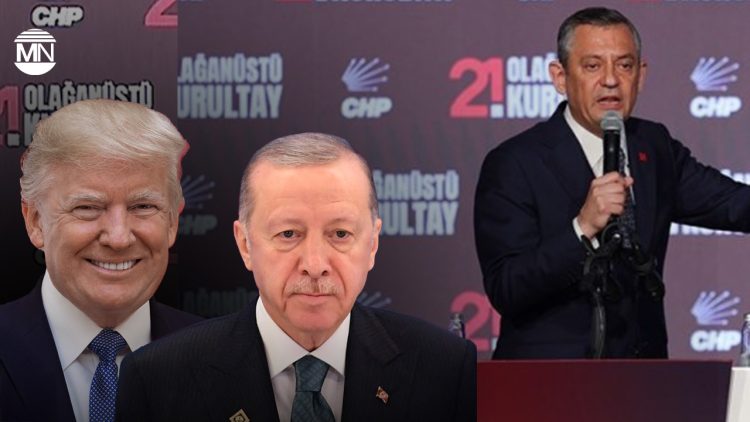
Özgür Özel was re-elected by a large majority as leader of Turkey’s Republican People’s Party (CHP) at the party’s 21st Extraordinary Congress in Ankara on 6 April. In a speech delivered immediately afterwards, Özel accused President Recep Tayyip Erdoğan of executing a political coup targeting Istanbul’s elected mayor, Ekrem İmamoğlu. Özel’s address also included the explosive claim that US President Donald Trump had been informed in advance about the mayor’s arrest.
This accusation came as thousands gathered outside the Nazım Hikmet Cultural Centre for a public rally under the slogan ‘Standing up for the will of the people’. The rally was framed by the CHP leadership as a defence of electoral legitimacy in response to what they describe as an increasingly authoritarian and centralised style of governance under the ruling Justice and Development Party (AKP).
Özel addressed the crowd, saying:
“There are reports suggesting the United States was consulted. Trump knew about İmamoğlu’s arrest. We are no longer dealing with a democratically accountable president, but with a junta leader who seeks validation from foreign powers.”
The context of this rhetoric is Turkey’s deeply polarised political environment, where judicial independence and democratic norms have become subjects of intense domestic and international scrutiny. Imamoğlu, widely viewed as Erdoğan’s most formidable challenger in upcoming national elections, was arrested on 23 March. His detention occurred shortly before CHP’s primary party vote, a coincidence that critics argue reflects deliberate political interference.
Özel described the series of events, beginning with a police raid on 19 March, as a calculated effort to suppress political opposition. He argued that the crackdown extended beyond Imamoğlu to target broader civil society institutions, including the Istanbul Bar Association and the municipality itself. According to Özel, the coordination of these actions and the timing of the arrest suggest that approval was sought not only from domestic authorities but also from actors “across the ocean”.
In a direct challenge to Erdoğan, Özel declared:
“Neither America nor Trump will save you in the next elections. You’ve turned your back on the people and instead reached across oceans for support. You used to accuse others of being subservient to foreign powers, but now you are the one chasing their favour.”
Özel accused the Turkish government of abandoning national sovereignty in favour of maintaining power through foreign alignment and domestic repression. He also accused the judiciary of acting on executive orders, thereby undermining the rule of law and eroding public trust in democratic institutions. Notably, at the time of writing, the United States government has issued no formal response to Özel’s public accusation concerning Trump’s alleged involvement.
Central to the opposition’s response is a nationwide petition campaign, which Özel described as the largest of its kind in Turkish political history. The campaign demands both Imamoğlu’s release and the calling of early elections. By the time of the congress, the initiative had collected over seven million signatures. CHP representatives claim this mobilisation reflects a growing desire among Turkish citizens to defend democratic processes through collective action.
Related Articles:
Turkey’s opposition boycott call triggers gov’t backlash, Chief Prosecutor’s Office launches investigation
Turkish court removes Istanbul Bar Board in politically charged ruling
Erdoğan hints at hopes for Trump victory, signals authoritarian convergence
In addition to political pressure, Özel called for an economic and media boycott targeting entities perceived as complicit with the government. Specifically, he urged people to avoid supporting media outlets like NTV and commercial enterprises owned by the Doğuş Group, known to be pro-AKP outlets. His call reflects broader concerns over media freedom in Turkey, where many outlets are seen as closely aligned with state interests.
“We are a movement of people who are no longer remaining passive,” Özel said, referring to a new strategy of active street-level mobilisation and increased public engagement, adding that the party’s transformation into a more dynamic political force would help it achieve victory in the next general election.
A well-known political analyst, Murat Sabuncu, noted a shift in CHP’s public discourse under Özel’s leadership. The party appears to be tapping into widespread dissatisfaction over Turkey’s economic struggles, perceived democratic backsliding and questionable judicial practices. Framing the arrest of İmamoğlu as emblematic of a broader decline in democratic standards, Özel positions the CHP as the principal defender of Turkey’s republican legacy.
Background notes
Just a few hours before the police operation targeted Istanbul Metropolitan Municipality on 19 March, the Turkish presidential spokesperson issued a statement confirming that President Erdoğan had held a telephone conversation with US President Donald Trump. According to the post, the two leaders discussed regional developments and the strategic partnership between Turkey and the United States. However, the Trump administration did not publish any official readout of the call. Following İmamoğlu’s arrest, when questioned by reporters, Trump’s representatives responded only briefly, stating that the matter was an internal issue of Turkish politics and that the US was only slightly concerned about the developments.
İmamoğlu, the elected mayor of Istanbul and a leading opposition figure, was formally arrested on 23 March following detention in a police operation carried out on 19 March. The arrest was part of a broader corruption investigation led by the Interior Ministry, which accused İmamoğlu of crimes including bid rigging, bribery, unlawful data collection and the links to a criminal organisation. Several other municipal officials were also implicated.
The investigation coincided with internal leadership elections within the CHP, raising concerns over politically motivated timing. On 24 March, İmamoğlu was formally suspended from office by ministerial order. The move triggered widespread demonstrations across major Turkish cities. Protesters and opposition figures allege that the charges are fabricated and part of an effort to prevent İmamoğlu from participating in future presidential elections.
The CHP has launched a coordinated legal and political campaign to challenge the arrest. The party argues that the case represents a direct attack on local democracy and rule of law, framing it as an attempted coup against the electoral will of Turkish citizens.