

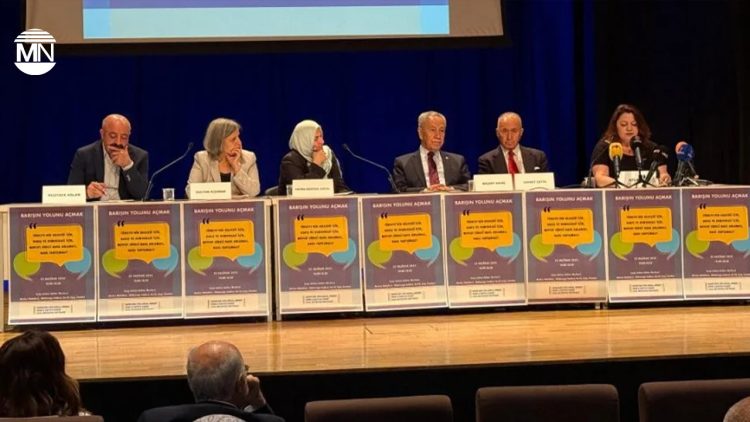
Leaders from across Turkey’s political and civil spectrum convened in İstanbul on Sunday for a conference titled, “Opening the Path to Peace”, calling for inclusive dialogue, legal reform and renewed commitment to resolving the Kurdish question through democratic means.
Organised by the Civic Initiative for Peace, the event brought together figures such as Kurdish politician Gültan Kışanak, former Speaker of Parliament Bülent Arınç, former main opposition Republican People’s Party (CHP) leader and diplomat Hikmet Çetin, and civil society lawyer Rıza Türmen. The conference also featured messages from opposition leaders, including the imprisoned Mayor of İstanbul, Ekrem İmamoğlu.
In his opening remarks, Rıza Türmen stressed that peace must be built not merely by ending armed conflict, but by addressing the structural causes of war and embedding peace in society. “If we want to take advantage of this opportunity, we must integrate these processes and push towards democratisation,” he said, emphasising the critical role of civil society and the need for parliamentary engagement beyond a security-focused lens.
The first session, titled “Where are we in solving the Kurdish question?” featured reflections on memory, pluralism and democratic co-existence. Ayça Atçı from the Federation of Caucasian Associations said, “For us Circassians, history often lives in whispers,” noting that peace must be rooted in truth and the ability to speak one’s language without fear.
Former Deputy Prime Minister Bülent Arınç said that peace meant “living together in plurality while preserving identity”. He called for a roadmap to remove the root causes of violence and urged improvements to any forthcoming parliamentary commission tasked with addressing the Kurdish issue.
Kurdish politician Gültan Kışanak said, “We carry a historical and moral responsibility. On the subject of peace, if mothers ask ‘What should we do but defend peace?’ we need to nurture this hope.” She argued that confidence-building measures are essential and warned that peace will not be achieved through waiting around or making abstract demands.
Former Foreign Minister Hikmet Çetin repeated that peace must go hand-in-hand with democratisation, while Alevi leader Mustafa Arslan added, “The cure for pluralism is the internalisation of democracy,” stressing the need to resist politics of denial.
In the second session, participants discussed joint political strategies that could guide the process. Pro-Kurdish Peoples’ Equality and Democracy (DEM) Party Deputy Co-Chair Tayip Temel said the current momentum was not a government-led process but one shaped by regional shifts and the influence of Kurdish political movements. He credited imprisoned Kurdish leader Abdullah Öcalan with taking the foundational step with his call for peace, and argued that real progress would require parliamentary mechanisms and active opposition leadership.
Temel added, “The aim of this process is not to abandon struggle, but to change its methods—to shift to legal, democratic and social avenues.”
Speakers also highlighted gender and legal perspectives. Activist Feride Eralp warned against leaving the peace process in the hands of a mysogenistic authoritarian state, arguing that peace opens space for women’s movements. Legal scholar Levent Köker said much could be achieved by the courts under existing laws, urging the enforcement of European Court of Human Rights rulings as a sign of genuine reform.
In the final session, Peoples’ Democratic Congress (HDK) co-spokesperson Meral Danış Beştaş said restoring the rule of law and improving Öcalan’s prison conditions were essential starting points. She also called for a commission in parliament and for laws to be brought into harmony with international conventions.
Law professor Sevtap Yokuş stressed the urgency of removing legal obstacles to the freedom of expression, criticised the ongoing use of the anti-terror law, and called for the resolution of the controversial “trustee” practice that removes elected Kurdish officials.
The conference concluded with a call to recognise the historic opportunity for peace and democratic transformation, asserting that civil society and political actors must act together to turn this moment into lasting change.
(*) Two interconnected conferences have been held this weekend – one in Diyarbakır on 21–22 June, titled “Path to Peace: Memory and Justice,” and the other in İstanbul on 22 June, titled “Opening the Path to Peace”. Organised by the Human Rights Association (İHD) in Diyarbakır and the Civic Initiative for Peace in İstanbul, these gatherings aimed to advance the 2025 Kurdish peace process through inclusive dialogue, justice and democratic reform. The Diyarbakır conference, with its subtitle “Memory and Justice,” emphasised grassroots perspectives, human rights and historical reckoning, whilst the İstanbul event focused on political engagement and cross-party collaboration. These conferences align with the broader “Social Peace and Freedom Meetings” organised by the Peoples’ Equality and Democracy (DEM) Party across cities such as Siirt, Mersin and İstanbul, which further promote public support for the peace process. Together, these efforts represent a coordinated campaign to build momentum for sustainable peace, addressing both local and national dimensions of the Kurdish conflict.


