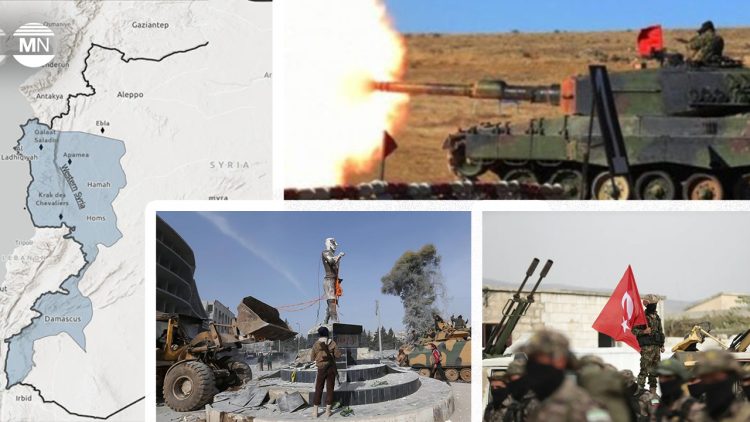
Over 1,000 people have been massacred in western Syria over the past week, marking one of the bloodiest periods in Syria’s history since the beginning of the civil war in 2011. The majority of those killed have been Alawite people from the cities of Homs, Latakia and Tarsus.
An investigation by the Guardian reveals that the Amsha and Hamzat divisions of the Turkey-backed Syrian National Army (SNA) have carried out the majority of the killings. The Amsha division is also known as the Sultan Suleiman Shah Division. Both groups have previously been responsible for massacres in areas under the control of the Autonomous Administration of North and East Syria (AANES), notably Afrin (Efrin). Members of the Sultan Suleiman Shah Division were also recruited as mercenaries last year by Turkey, to fight against the Kurdistan Workers’ Party (PKK) in northern Iraq. Fighters from both divisions were photographed with leaders of the Turkish Nationalist Movement Party (MHP) last year. The MHP is part of Turkey’s ruling coalition.
Alawite uprising
The massacres follow an uprising by Alawite forces led by Brigadier General Ghyath Suleiman Dala, sparked by the escalating revenge attacks against the Alawite community since the fall of the Alawite-led regime of Bashar Al-Assad as well as disillusionment with the new government of Ahmed Al-Sharaa (also known as Muhammed Al Julani). Miqdad Fatiha, a former Assad security officer, also played a part in the Alawite offensive.
The Syrian interim government sent reinforcements to where the uprising was taking places. Armed civilians have reportedly joined the government forces.
At least 745 of those killed so far have been civilians who are unconnected to the uprising. The vast majority of them are from the Alawite community. The Guardian has collected testimony and video evidence of mass indiscriminate shootings, and piles of corpses in civilian clothing.
The report also accuses the Alawite forces of killing 211 civilians.
As well as committing massacres of civilians, the SNA divisions are also accused of executing injured Alawite fighters, in breach of international law.
Massacres led by the SNA
One source told the Guardian newspaper that these SNA factions would commit atrocities for as long as they could until Hay’at Tahrir al-Sham (HTS) forces arrived, at which point they would move to a new area. That account was verified by video and testimony from residents of Latakia, interviewed by the Guardian.
Related articles:
Bloodshed in Syria: Alawites targeted in escalating sectarian violence

European Parliament sets conditions for support for Syria amid political transition

Alawite uprising escalates as HTS forces kill civilians in Syria’s coastal regions
The massacres in western Syria could affect international recognition for the new Syrian government. On 7 March, the European Parliament signalled cautious support for Syria’s post-war reconstruction and political transition, but stressed that their support was conditional on respect for human rights and the protection of minorities.
International condemnation
The Turkish government’s role in the massacres has faced heavy criticism. Turkish opposition Republican People’s Party (CHP) leader Özgür Özel has called on Ankara to “take decisive action to prevent civilian deaths”.
Al-Sharaa announced during a speech on 9 March: “We will hold accountable, with full decisiveness, anyone who is involved in the bloodshed of civilians, mistreats civilians, exceeds the state’s authority or exploits power for personal gain. No one will be above the law.” He has called for a full inquiry into the recent violence, and a committee to explore the concerns of Syria’s Alawite citizens.
Ilham Ahmed, AANES public relations spokesperson, has expressed grave concern over the massacres, saying: “Protecting civilians and pursuing peaceful solutions through dialogue are essential.”
Ongoing Turkish and SNA attacks on northeast Syria
The SNA, which the Amsha and Hamzat divisions are part of, has been engaged in fierce fighting against the Kurdish-led Syrian Democratic Forces (SDF) in northeast Syria. As Aleppo fell to HTS forces in November, the SNA began a new offensive on territories controlled by AANES. Fighting has concentrated around the Tishreen (Tişrîn) Dam, Manbij (Minbîc) and the Qara Quzak (Qere Qozaq) Bridge on the Euphrates south of Kobani (Kobanê). These SNA attacks have continued in March, backed up by Turkish airstrikes,