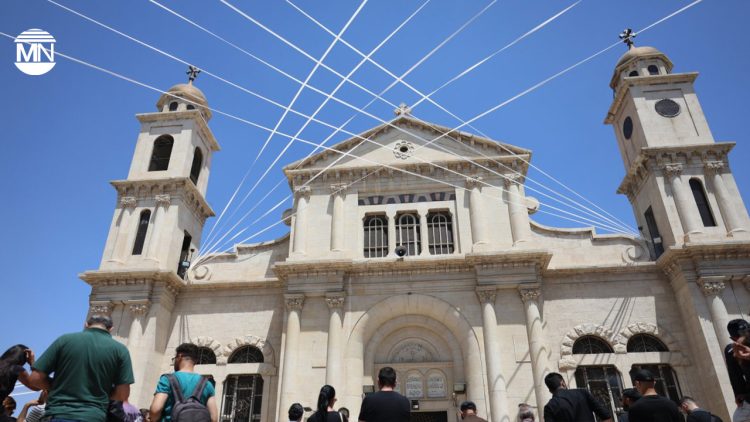
The Syrian Democratic Forces (SDF) have rejected claims by Damascus officials that the perpetrators of the 23 June suicide bombing at Mar Elias Church in Damascus came from al-Hol camp in northeastern Syria. The attack, which killed over 30 worshippers, was one of the deadliest in recent years in the Syrian capital.
Speaking on 25 June, a spokesperson for the SDF responded to allegations made by Noureddine Al-Baba, the new spokesperson for Syria’s Ministry of Interior, who had asserted that the attackers were non-Syrian nationals linked to ISIS and had come from al-Hol camp.
The SDF stated that all individuals recently released from al-Hol had been Syrian nationals, and that any Iraqis had already been repatriated to Iraq. The force said these conclusions were drawn from a review of internal records and documentation on camp residents.
They also emphasised that al-Hol primarily shelters families of ISIS fighters — mostly women and children — and does not host foreign combatants.
The SDF condemned the church attack and called for a transparent and independent investigation by the Syrian authorities, urging them to present credible evidence rather than issue accusations they believe are politically motivated.
In a separate statement, Rohilat Afrin, a commander with the Women’s Protection Units (YPJ), echoed the SDF’s concerns and directly criticised the Damascus regime. She highlighted the government’s ties with Hay’at Tahrir al-Sham (HTS), a faction with jihadist origins linked to Al-Qaeda.
Afrin further denounced the “patriarchal and extremist” ideologies of HTS-linked groups that have reportedly been integrated into the Syrian army. She warned that unless the government in Damascus works with the Autonomous Administration of North and East Syria (AANES) to support democracy and women’s rights, it risks political collapse.
Afrin also criticised cooperation between the Syrian interim government and Turkey, including what she described as the naturalisation of foreign fighters and their incorporation into Syrian armed forces. This, she argued, allows extremist ideologies “alien to Syrian aspirations” to take root.
The YPJ commander went on to reject Turkish military presence in Syria, accusing Damascus of enabling Turkish military bases in areas such as Palmyra, Hama and Deir ez-Zor — moves she said undermine Syrian sovereignty and autonomy.
In response to recent speculation about potential cooperation with Israel, Afrin stated: “We do not close the door to any serious dialogue with any country, if the goal is to achieve peace and guarantee the rights of the Syrian people.” She did not specify what she meant by “Syrian national interest” but reaffirmed the YPJ’s intent to build alliances with minority communities such as Druze and Alawites.
Afrin concluded by reiterating that the YPJ continues to take responsibility for the administration of al-Hol camp, and rejected any suggestion that mismanagement of the site contributed to the Mar Elias attack.