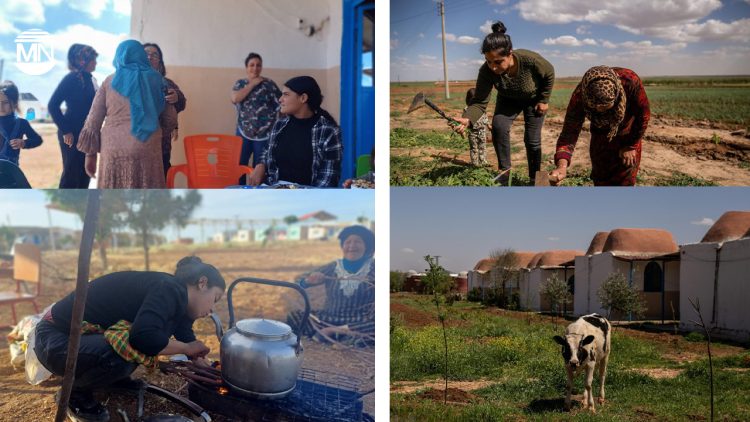
A newly released report by the campaign group Women Defend Rojava sheds light on Jinwar, a women-only village in northeast Syria, where survivors of war, gender violence, and Islamic State (ISIS) captivity have created a unique model of communal, self-governed life.
Published on 4 June, the report offers a rare glimpse into daily life in Jinwar, founded in 2018 following years of planning by Kurdish women’s organisations. The village was established to provide a safe and sustainable community for women who have faced trauma, from forced marriage and domestic abuse to the horrors of war.
“When we arrived, women and children came out of their houses to greet us. There was joy, curiosity and a desire to connect,” recalls Julia, an internationalist visitor quoted in the report. “It is a place that shines around the world.”
Jinwar lies in North and East Syria, a region governed by the Autonomous Administration formed after the 2012 Rojava Revolution. The idea of a women-led village was inspired by the writings of imprisoned Kurdish leader Abdullah Öcalan and was realised through the efforts of grassroots groups including Kongra Star, the Jineolojî Academy, and the Free Women’s Foundation.
Constructed using traditional adobe techniques, the homes are decorated with symbols of women’s knowledge and resistance, including murals of Şahmaran, a mythical female guardian of wisdom. The village economy is based on self-sufficiency, with residents running a bakery, shop, and vegetable-drying operation. Women also farm the land collectively and share the harvest.
Education is central to life in Jinwar. Sirîn, a former teacher from Qamishli (Qamişlo), now teaches literacy in Kurdish and Arabic to both mothers and children. “We’re organising life together, supporting each other, and sharing knowledge,” she says.
The village is also home to ŞifaJin (Women’s Healing), a health centre offering natural treatments, emergency care, and education in traditional medicine. Women from nearby villages join efforts to preserve and share herbal knowledge passed down for generations.
Decisions in Jinwar are made collectively in village assemblies, with children and youth participating through their own councils — a rare example of grassroots democracy in the region.
The report concludes that Jinwar is not only a refuge, but a revolutionary experiment in women-led community building. “We need more places like this across the world,” Julia says. “Jinwar shows what’s possible when women take back power.”