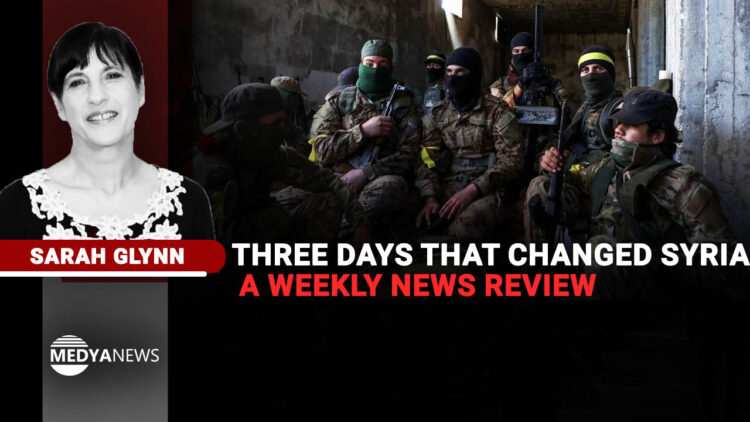
Sarah Glynn
I am writing this on Friday night with the situation in Syria evolving by the minute. By the time you read it, or listen to it, it will be out of date, but I hope at least to be able to give some background to what is happening. When I began writing on Thursday, there were reports of a large anti-government offensive by Turkish-backed Islamist militias heading towards Aleppo, and of retreats by Syrian government troops. But no one predicted that 24 hours later those militias would already be celebrating in Aleppo’s streets and taking photographs of themselves in the Aleppo governor’s residence and police headquarters, while the Syrian Democratic Forces (SDF) of the Autonomous Administration of North and East Syria would be coming in to defend the Autonomous Kurdish districts of the city against anticipated attacks. No-one expected the Syrian army to be so very weak, or the Russian response to be so inadequate.
This week’s review will focus on Aleppo, but will then jump via Turkey, to Haringey. Although Greater London would seem to have little connection with the Syrian civil war, events in both places are the product of the ruthless geopolitics of competing powers, and of Turkish aggression; of Turkey’s foundational antagonism towards the Kurds, and of international indifference towards those who suffer from it.
In Syria, civil war has afforded opportunities for neighbouring and international powers to vie for wealth and control. Since Turkey’s last invasion in 2019, the country has been in a period of unstable and bloody equilibrium, with ongoing fighting in many areas, but Israel’s war has disturbed that balance. There has been much speculation over possible scenarios, but this week the first advantage has been taken by Turkey and their Islamist allies.
Syria’s political landscape
Before looking at what has been happening, I want to give a brief outline of the different states and military organisations active in the country.
Kurds are concentrated in the north of Syria. They were oppressed by Assad’s Syrian Arab government, and managed to use the power vacuum of the civil war to take autonomous control of their region. The Autonomous Administration today also controls many non-Kurdish areas that their forces liberated from ISIS, and they have lost control of some Kurdish areas to Turkey’s invasions. The current area under the Autonomous Administration consists of a large triangle covering the north-east of Syria, with a strip missing in the centre of the northern border, captured by Turkey in 2019, and pockets of Syrian Government control in the cities of Qamishli and Hasaka. There are also autonomous exclaves in Shahba – the small part of Afrîn not captured by Turkey – and the northern Aleppo districts of Sheikh Maqsoud and Ashrafiya, which suffer from blockades imposed by the Syrian Government. The Administration emphasises that they are not seeking independence, but rather regional autonomy within a democratic and decentralised Syria; however that sort of Syria is not part of Assad’s vision, and he has dismissed their requests for negotiations with ungrounded accusations of separatism.
Russia and Iran both back the Syrian regime, and have used the war to secure important strategic and economic interests for themselves. As well as members of Iran’s Islamic Revolutionary Guard Corps (IRGC), Syria hosts many Iranian-backed militias.
Turkey – Iran’s regional rival – backs the militant Islamist groups opposed to President Assad and his Syrian government, naming them the Syrian National Army (SNA). Turkey also seeks greater power and control, and, in addition, they want to eliminate any form of Kurdish autonomy or self-conscious Kurdish presence. They have carried out three invasions and occupations in northern Syria in order to block and destroy the Autonomous Administration established by the Kurds and their allies. They have used the Islamist militias as mercenaries in their fight against the Kurds, and facilitated the growth of ISIS as an anti-Kurdish force. Although President Erdoğan initially wanted to remove Assad, he now wants to rebuild relations with him and persuade him to join these attacks against the Kurds and the Autonomous Administration of North and East Syria. But Assad will not talk with Erdoğan while Turkey is still occupying large parts of Syria without plans for leaving.
In the areas Turkey has occupied, day to day life is under the brutal control of the SNA’s mercenary gangs, which include Islamist adventurers from several countries and specialise in extortion and gratuitous violence. Turkey also provides support to Hay’at Tahrir al-Sham (HTS), which evolved from Syria’s Al Qaeda, and is a more well-trained and disciplined force than the SNA militias. HTS runs the region of Idlib, and has been blocking with some of the SNA militias to increase their area of control. Despite the brutal reality of these militant Islamist groups, and the terrorist listing of HTS by the United States (and also by their Turkish backers), because they are fighting Assad, Western media still often refers to them by the benign names of “rebels” or “the Syrian opposition”.
Despite their often opposing interests, Russia, Iran, and Turkey have held many joint meetings and made pragmatic agreements – such as the deal that made way for Turkey to invade the Kurdish canton of Afrîn in 2018, while promising to contain HTS within a demilitarised zone round Idlib.
At the start of the civil war, the United States also backed the Islamist groups, hoping to use them to achieve regime change; but when this failed, and ISIS threatened to take over the region, the Americans shifted to backing the Kurdish forces as the only group successfully resisting ISIS. The US-dominated International Coalition maintains bases in North and East Syria and has a tactical alliance with the SDF in the continued fight against ISIS sleeper cells. Their presence prevents Turkey from carrying out another full-scale invasion, but they have not intervened to stop Turkey’s continuous bombardment of North and East Syria nor their devastating air attacks. From the US perspective, the anti-ISIS mission gives them another foot in the region, where they continue to pressure Assad – notably by sanctions that have impoverished the country – and to see Iran as the consummate enemy.
Although ISIS was defeated as a territorial force in 2019, it still carries out attacks against the Autonomous Administration and against Syrian Government forces. Its ideology lingers, and the instability resulting from Turkey’s attacks allow it to recruit new members, while the Turkish-occupied areas provide ISIS fighters with a relatively safe haven.
Israel occupies a large part of Syria’s Golan Heights and carries out cross border strikes. These are largely aimed at Iranian linked targets, and have increased since October 2023. Although publicly part of the “axis of resistance” in support of Palestine, Syria has been keeping a low profile, wary of Israel scaling up these strikes.
Israel’s attacks on Iranian military targets and Iran-linked militias, and the withdrawal of Hezbollah forces following Israel’s attacks on Lebanon, have caused an upset to the power balance. Turkey, through their friends in HTS and the SNA, have shown themselves ready to exploit this.
HTS versus the Syrian Government
Despite a 2020 ceasefire brokered by Russia and Turkey, there has continued to be sporadic fighting between the Russian-backed Syrian Government and Turkish-backed HTS, with military and civilian casualties. Recently, this has been escalating, but the scale of the assault begun on Wednesday and led by HTS is of a different order.
Although there have been many accounts of military build-ups in the region, and although, last Saturday, North Press Agency could write of “renewed reports of HTS and other opposition factions preparing for a potential military offensive against government positions in the area,” when the attack came, early on Wednesday morning, the Syrian government forces appear to have been caught by surprise. HTS, in alliance with a combination of SNA militias rapidly took control of a dozen towns and villages, despite Russian airstrikes in support of the Government forces.
On Thursday, it was reported that the Syrian Government forces had withdrawn from key positions back to a secondary line of defence, but that they were bringing in reinforcements. The HTS and SNA militias had taken dozens of towns and villages and a large military base. The general in command of Iran’s military advisors in the Aleppo Governorate had been killed, and the vital road linking Aleppo to Damascus had been cut off.
By Friday afternoon, the militias had penetrated the outskirts of Aleppo City, and Syrian and Russian airstrikes had damaged areas of Idlib and Western Aleppo. The Syrian Observatory for Human Rights (SOHR) was reporting an overall death toll, over the three days, of 255, including four university students killed when an HTS rocket hit their student dorm, and twenty other civilians. Thousands of people had fled the conflict zone to look for safety.
By Friday evening, it was clear that Syrian Government forces had melted away, and Russia, which has redeployed much of their air power to Ukraine, was unable to provide the necessary support.
Turkey is not openly involved, but no one with knowledge of the region doubts that they are behind the attacks. As SDF spokesperson Farhad Shami put it on Twitter, “This attack is managed step by step by Turkey and to fully comprehend this process, it is crucial to see Turkey’s role.” This has been an opportunistic power grab and may be used to put pressure on Assad – whose weakness has become all too apparent – to come to an agreement on Turkey’s terms. Though any deal would also have to be accepted by the now strengthened militias.
With the attacking militias just 10km from Sheikh Maqsoud and Ashrafiyah, and fears that the city of Tel Rifat in Shahba could be the next target, Shami wrote, “The developments in northwestern Syria are sensitive, and we directly care about them and closely monitor them. Whatever happens, our national and moral priority remains the defense of our people and our regions. Therefore, we will intervene as necessary to defend our people.”
On a smaller scale, the SDF had carried out a retaliatory action on Tuesday, aimed at disrupting the activities of the Turkish-backed militias whose shelling had killed a member of Manbij Military Council the previous day. This action was claimed to have killed 17 Turkish mercenaries, and wounded others.
The SDF are a formidable fighting force but, again, can expect no support from their American allies, who don’t like to upset Turkey and are ready to countenance Islamist militias when these are weakening Assad and embarrassing Russia.
Lawfare in Turkey
Though overshadowed by what is happening in Syria, this has also been an eventful week in Turkey, where oppression commonly takes the form of lawfare.
In Turkey, elected representatives continue to be persecuted through the courts, and democracy continues to be dismantled. This week, the DEM Party co-mayor of Bahçesaray Municipality in Van was sentenced to three years 11 months, and a government trustee appointed to replace him. The lawsuit against the co-mayor was filed in 2015, but this didn’t prevent him being allowed to stand as a candidate. Most Kurdish politicians have old baseless cases hanging over them, and these are now being used to remove elected mayors one by one. In Esenyurt, where the Republican People’s Party (CHP) mayor was deposed in October and imprisoned, his deputy has now been issued with a detention order. The imposition of trustees has even extended to a village mukhtar, or headman. Șahismail Göyük was removed from his elected post after arguing against the government’s treatment of Alevis. In the newly completed trial of 38 members of Kurdish parties, 21 people were given sentences of over six years and three of over a year.
On Tuesday morning, 231 people were detained in raids across 30 provinces: journalists, activists and politicians, including well known names.
Monday was the International Day for the Elimination of Violence against Women, marked by women’s demonstrations across the world. In Diyarbakir, the authorities tried to impose a ban on the Kurdish Women’s Movement slogan, “jin jiyan azadi”, which has now become an international rallying cry. Women responded by using the slogan even more forcefully.
Erdoğan’s London policemen
In Turkey, the politicisation of courts and police is blatant, but politics corrupts in other countries too. When geopolitics requires that those countries keep good relations with Turkey – for strategic reasons or to promote trade deals – they find themselves under pressure to abide by Turkey’s requests to clamp down on Kurdish organisation. Turkey demands that they outlaw the PKK and criminalise Kurdish activists for perceived links to it. This governments accept with few qualms. The anticapitalist politics of the Kurdish Movement already marks them as enemies of the establishment. For Kurdish refugees, European police forces have become tools of the Turkish state that they have escaped from.
This week in London, the Metropolitan Police clamped down on the Kurdish community with a very public show of force, which must have been designed to give a message to the Kurds and to Turkey.
27 November is the anniversary of the founding of the PKK, and so of the wider Kurdish Freedom Movement. It is marked by Kurdish communities everywhere with the usual mix of music, dance and speeches. Last year at the London Kurdish Community Centre in Haringey, police attempted to disrupt the celebrations but were forced to retreat as they lacked a warrant. This year they raided the centre and also carried out early morning raids on the homes of key activists. People were manhandled, six people were arrested, and the police announced that the centre will be closed for up to two weeks while they carry out their investigations. When community members and friends arrived to protest the raid, they were met by mass police with dogs and a helicopter.
Labelling a community as potential terrorists immediately turns them into a focus of fear and resentment. The police statement is insidious in its suggestions of public danger. “There is not believed to be any imminent threat to the public”, it says, conjuring images of a threat down the line. The police claim to be “protecting all of our communities” and “urge anyone who thinks they may have been affected or targeted by those linked to the PKK to get in touch.” If the police felt there was a real threat of terrorism, they would hardly have waited to act on a significant date.
Some people have expressed surprise that all this has taken place under a Labour government, but the post 9/11 terrorism laws and the listing of the PKK were brought in by a Labour government too. The modern Labour Party is very much an establishment party, defending capitalism and espousing the realpolitik of trade deals and NATO alliances. When the PKK was listed by the UK – and shortly afterwards by the European Union – it was undertaking a long ceasefire and trying to establish peace negotiations. The listing effectively gave support to Turkey’s decision to reject peace talks in favour of a military “solution”.
Sarah Glynn is a writer and activist – check her website and follow her on Twitter or bluesky