

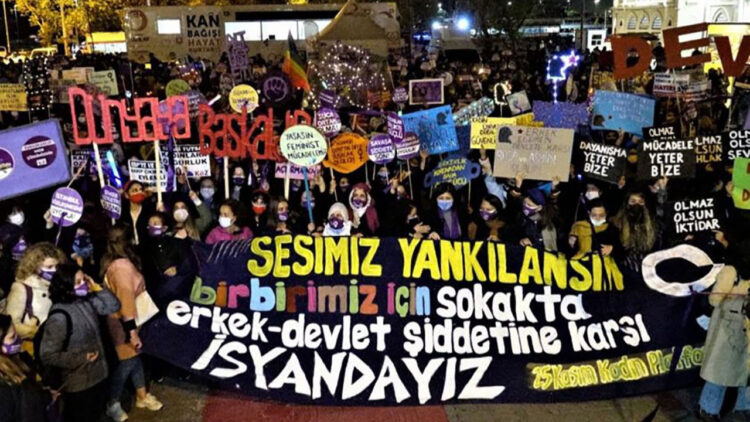
Kurdish Women in Diyarbakır (Amed), Turkey, delivered a powerful message of resistance on the International Day for Elimination of Violence against Women, marching determinedly despite state restrictions and challenging systemic gender-based oppression.
Organised by Dicle Amed Women’s Platform and Amed Violence Resistance Network on Monday, the demonstration drew significant political support, including Democratic Regions Party (DBP) Co-Chair Çiğdem Kılıçgün Uçar, Kurdish politicians Gültan Kışanak and Ayla Akat Ata. Protesters carried photographs of murdered women and brandished a banner reading ‘Against Male-State Violence: Jin, Jiyan, Azadî’ [Woman, Life, Freedom].
Pro-Kurdish Peoples’ Equality and Democracy (DEM) Party Diyarbakır Women’s Council spokesperson Güliz Kaya denounced the systemic violence, stating, “We know that male violence is not limited to individual actions, but is organised through state policies, impunity and patriarchal ideological impositions.” The protesters emphasised their commitment to continuing their struggle, declaring that their voices would rise “despite all prohibitions”.
Gültan Kışanak powerfully articulated the movement’s core principles, asserting, “Women defend life against death, freedom against slavery, and peace against war. We are legitimate, and those imposing war and slavery are illegitimate.” She called for a future where violence is eliminated and peace prevails.
Challenging local authorities directly, Çiğdem Kılıçgün Uçar addressed the Diyarbakır governor’s criticism of their slogan, emphasising that ‘Jin, Jiyan, Azadî’ emerged from the voices of women who have faced imprisonment and struggled for freedom.
In a provocative move last week, Diyarbakır authorities sought to suppress the powerful feminist slogan ‘Jin, Jiyan, Azadî’ of the Kudish women’s movement, claiming it represented organisational propaganda. Local police contacted women’s groups with an unsubstantiated verbal prohibition, offering no official documentation of the ban. The women’s response was immediate and resolute: they gathered, performed traditional music, and continued chanting the slogan, with DEM Party representatives publicly condemning the attempt to silence their collective voice and reaffirming the slogan’s global significance in women’s liberation struggles.
Free Women’s Movement defiant as Turkish governor bans Jin Jiyan Azadî slogan
Women in Kurdish-led North and East Syria organised large-scale protests across six major cantons and cities. The demonstrations, drawing thousands of participants, transformed urban landscapes from Al Hasakah (Hesekê) to Kobani (Kobanê), with protesters consistently voicing their rejection of violence through iconic slogans like ‘Jin, Jiyan, Azadî’ and ‘No to Occupation and Women’s Oppression’.


