

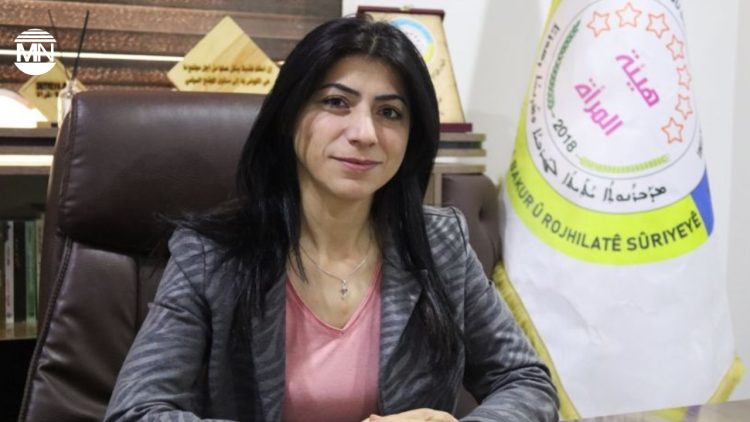
A senior official from the Women’s Committee of the Autonomous Administration of North and East Syria (AANES) has criticised a new draft constitution published by the interim Syrian government in Damascus, claiming it excludes women and minority communities from political life.
Adalet Omer, head of the Women’s Committee, told JINNEWS on Saturday that the 53-article document, effective 12 March, reflects a “monolithic” approach and fails to address women’s rights.
The interim government, backed by hardline Islamist factions, took control of Damascus following the fall of the Baathist regime. It recently signed a political agreement with the Syrian Democratic Forces (SDF), a multi-ethnic armed alliance led by Kurdish groups. However, the new constitution has drawn criticism from both sides.
Critics, including AANES and Syrian Democratic Council (SDC) leaders, argue that the constitution consolidates centralised power, grants unchecked executive authority to the president, and marginalises ethnic and religious minorities by enshrining Islam as the primary source of legislation (Article 3) and Arabic as the sole official language (Article 4).
Ilham Ahmed, co-chair of the AANES Foreign Relations, has criticised the constitution for ignoring the contributions of women in the Rojava Revolution and excluding diverse groups. Xelil Ebdo of the Democratic Union Party (PYD) highlighted the absence of Kurdish representation in the constitutional process, noting that the document threatens to erase decades of Kurdish cultural and political gains.
Protests have erupted across minority communities, including Kurds and Alawites, who view the constitution as a tool to entrench Sunni Islamist dominance under Ahmed al-Sharaa’s (aka Julani) leadership.
Omer said the draft constitution does not reflect the multi-ethnic reality of Syria. “Current research shows that 17 national groups live on Syrian territory. If a constitution is prepared for just one, that is unacceptable,” she stated.
Omer argued that changing political figures without altering the broader system achieves little. “What is needed is democratic transformation. The Middle East has repeatedly shown that centralised systems benefit no one.”
She added that women in the region are particularly concerned by the draft. “The articles suggest power is concentrated in one individual, with no recognition of women. We, as women of North and East Syria, raise our voices against this,” she said.
According to Omer, the interim government’s national congress excluded the country’s diverse peoples and promoted a single ideology. “A constitution that ignores us has no legitimacy,” she added.
Efforts to draft an alternative women-led constitution in North and East Syria have been ongoing for nearly two years. “We believe a democratic and free life requires a constitution that recognises women’s rights. Women in the Rojava Revolution fought on the front lines—those women must also have a say in political decision-making,” Omer explained.
She noted that women in the region are active in all areas of life, but the interim government is attempting to erase their presence. “Why should women not make up 50 percent of leadership?” she asked.
Omer also raised concerns about the safety of women under the current administration, saying there have been reports of abductions. “This government is trying to confine women to traditional roles. There is public distrust towards this administration, and it must clarify what it is doing about missing women,” she stated.
Related articles:
Kurdish women in Rojava reject draft constitution, pursue leading role in new Syria


