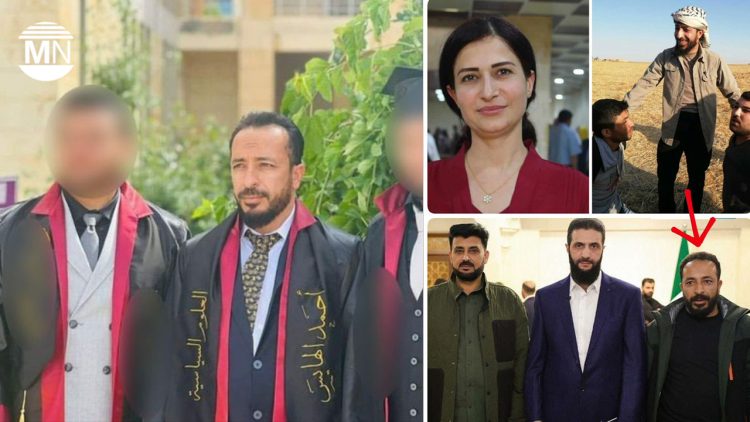
The US Department of the Treasury has imposed sanctions on Ahrar al-Sharqiya figures Ahmad Ihsan Fayyad al-Hayes (Ahmad al-Hayes) and Raed Jassim al-Hayes (Abu Jaafer Shaqra) under Executive Order 13894. This action contrasts sharply with Turkish President Recep Tayyip Erdoğan’s ongoing support for the group. Ahrar al-Sharqiya is widely associated with the extrajudicial killing of Kurdish politician Hevrin Khalaf, a crime that remains prominent in public memory.
Ahrar al-Sharqiya, part of the Turkish-backed Free Syrian Army (SNA), is actively involved in attacks on northeastern Syria. The group’s leader, Ahmad al-Hayes, graduated from Artuklu Mardin University’s Department of Political Science on 8 June 2023, with images showing the Free Syrian Army flag displayed during the ceremony. He was also seen participating in a meeting of the National Coalition of Syrian Revolutionary and Opposition Forces (SNC), supported by Turkey, on 23 November 2020.
Al-Hayes is implicated in severe human rights abuses. He supervised a prison near Aleppo after 2017 where hundreds of prisoners were executed from 2018 onward. Additionally, he has been involved in trafficking Yazidi women and children and integrating former ISIS members into Ahrar al-Sharqiya. Many former ISIS officials have pledged allegiance to him, assisting in extortion and blackmail efforts. Despite US sanctions following Turkey’s Olive Branch operation, Erdoğan has publicly praised al-Hayes and other commanders for their actions.
Ahrar al-Sharqiya’s involvement in the 2019 murder of Kurdish politician Hevrin Khalaf stands out as one of its most egregious acts. Although the group denied responsibility, video evidence showed members of the faction executing civilians, including Khalaf, on the international road south of Tal Abyad.
Formed in 2016, Ahrar al-Sharqiya emerged from Ahrar al-Sham and Jabhat al-Nusra remnants, initially led by ex-Jabhat al-Nusra commander Abu Maria al-Qahtani. It comprises approximately 2,500 fighters, primarily from Deir ez-Zor clans displaced by ISIS. Under Abu Hatem Shaqra’s leadership, the group seized territories such as Al-Bab and Afrin during Turkish operations Euphrates Shield and Olive Branch. The group is notorious for kidnappings, civilian reprisals, and its role in the execution of Hevrin Khalaf, which was deemed a war crime by the US Treasury.
The US Treasury has documented Ahrar al-Sharqiya’s unlawful killings, torture, and recruitment of ISIS members, citing the Khalaf murder as a war crime for which no one has been held accountable. Five years after Khalaf’s death, questions remain about the efficacy of international efforts to address this crime. Despite US sanctions targeting Ahrar al-Sharqiya and its leaders, Turkey’s continued material and military support for the group highlights contradictions in global human rights enforcement and counterterrorism strategies.