Israel and Iran have entered a fourth day of military hostilities marked by intensifying air strikes, high civilian casualties, and deepening regional alarm. At least 224 people have been killed in Iran and 19 in Israel since the first Israeli strikes on Friday, with both governments vowing continued retaliation.
The conflict erupted when Israeli jets launched a broad assault on Iran’s nuclear and military infrastructure, including facilities in Natanz and Fordow. Israel claims the operation aimed to pre-empt what Prime Minister Benjamin Netanyahu described as an “existential threat” posed by Iran’s alleged nuclear weapons programme. Iran has denied it is developing such weapons and called the strikes a “declaration of war”.
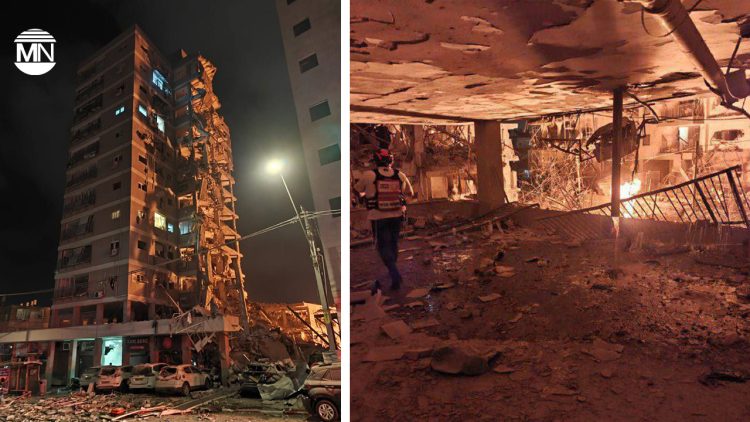
In response, Iran launched waves of drones and ballistic missiles at Israeli cities including Tel Aviv, Haifa and Bat Yam. While many were intercepted by the Iron Dome defence system, others struck residential areas, killing civilians and causing widespread destruction. Israeli authorities confirmed five deaths in the latest round of Iranian missile strikes.
Netanyahu stated that “the issue here is not de-escalation”, but rather ensuring Iran cannot further develop its nuclear capacity. In an interview on Fox News, he suggested regime change in Tehran “could certainly be the result” of Israel’s campaign. He also confirmed Israeli strikes had successfully targeted the head of Iran’s Islamic Revolutionary Guard Corps (IRGC) intelligence unit and his deputy.
In Iran, the health ministry said a total of 224 people have been killed and over 1,200 wounded in Israeli strikes since Friday, with the majority of casualties reportedly civilians. State television has shown footage of destroyed residential buildings, fires at oil refineries, and significant damage to government offices.
The International Atomic Energy Agency (IAEA) convened an emergency meeting in Vienna following Israeli strikes on Iranian nuclear sites. While Iran pushed for a formal resolution condemning the attacks, diplomats indicated such a move would likely fail to garner majority support. Instead, a general statement expressing concern over the escalation is expected.
The regional and global ramifications of the conflict are beginning to surface. At the G7 summit in Canada, world leaders expressed deep concern over the fighting. European Commission President Ursula von der Leyen reiterated that Iran must not obtain a nuclear weapon, but stopped short of condemning Israel’s actions. “Iran is the principal source of regional instability,” she said.
The United States has played an ambiguous role. While President Donald Trump has called for a peace deal, he also stated that “sometimes countries have to fight it out first”. According to US media reports, Trump rejected a recent Israeli proposal to assassinate Iran’s Supreme Leader, Ayatollah Ali Khamenei—a move that could have dramatically escalated the crisis. Netanyahu declined to confirm the report but acknowledged “close coordination” with Trump.
In a sign of potential regional spillover, Iran’s President Masoud Pezeshkian urged Iraq to prevent Israel from using its airspace. Kurdish politician Bafel Talabani, President of the Patriotic Union of Kurdistan (PUK), warned that “a full-scale war between Israel and Iran could destabilise the entire region and must be avoided”. His comments reflect growing concern in Iraq and across the Gulf about being drawn into a broader conflict.
Turkish President Recep Tayyip Erdoğan also spoke with Donald Trump in a phone call on Sunday. While few details were disclosed, both leaders reportedly emphasised the need for regional stability. Erdoğan is expected to push for a diplomatic initiative through the Organisation of Islamic Cooperation in the coming days.
Despite mounting international calls for de-escalation, both Tehran and Jerusalem have shown no willingness to back down, heightening the risk of further regional escalation.