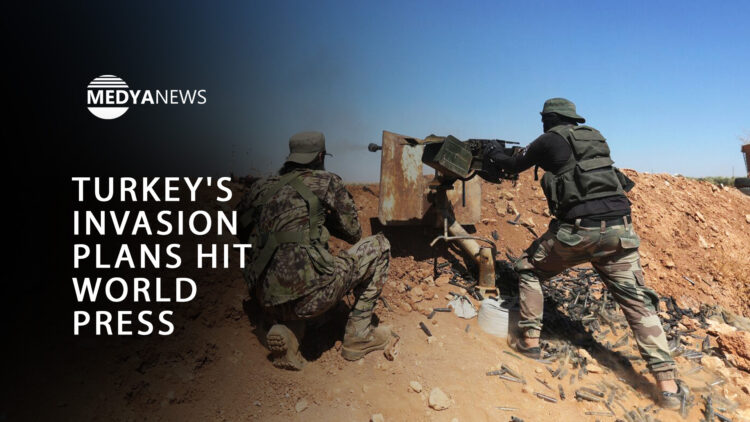
The global media has turned its attention to the escalating tensions in northern Syria, focusing on the faltering efforts to maintain a US-brokered ceasefire between the Kurdish-led Syrian Democratic Forces (SDF) and the Turkish-backed Syrian National Army (SNA). The situation has raised fears of an imminent Turkish offensive on Kobani (Kobanê), a city of deep symbolic significance to the Kurds due to its historic resistance and victory against the Islamic State (ISIS).
After Turkish-backed jihadist groups seized areas under SDF control, including Manbij (Minbîc), the ceasefire initially failed but has since been extended until the end of the week. Despite this extension, Turkey’s military build-up around Kobani signals that an attack on the city remains a possibility. Prominent international newspapers and publications have given front-page coverage to the potential assault and the diplomatic efforts to prevent further escalation.
Al-Monitor: Ceasefire breakdown and Turkish demands
According to Al-Monitor, a US-based outlet, the Turkish-backed SNA informed the SDF on Monday that it was resuming hostilities. Sources cited disagreements over the status of Kobani as a primary cause for the collapse of talks. The SDF had proposed a demilitarised zone in the area, but Turkey rejected the idea.
Al-Monitor also highlighted intensified Turkish rhetoric, with Turkish Foreign Minister Hakan Fidan reiterating Ankara’s objective to eliminate the SDF, which Turkey views as being linked to the Kurdistan Workers’ Party (PKK). Additionally, the report mentioned that the SNA has been regrouping and deploying reinforcements near Kobani, signalling preparation for a possible escalation.
China Daily: Humanitarian concerns in Manbij and Kobani
China Daily reports that the humanitarian situation in Manbij and Kobani has deteriorated, with Turkish-backed militias blocking the Kurdish Red Crescent from evacuating civilians and casualties. The Syrian Observatory for Human Rights (SOHR) corroborated these reports, adding that Turkey’s military build-up resembles the preparations for its 2019 incursion into northeastern Syria.
The SDF, which withdrew from Manbij under a previous ceasefire agreement, accused Turkey of rejecting provisions for relocating civilians to safer areas. The China Daily report also emphasised the dire living conditions in the conflict zones, where access to essential supplies and medical aid remains severely restricted.
Junge Welt: Kobani resistance and strategic interests
Junge Welt: Kobani’s symbolic and strategic significance
German newspaper Junge Welt highlighted the symbolic and strategic significance of Kobani, a predominantly Kurdish city that achieved global recognition in 2014 for repelling an ISIS siege, suggesting that Kobani’s symbolic importance to Kurds worldwide might galvanise resistance, potentially leading to protracted conflict.
The report pointed to Turkey’s stalling the ceasefire talks with its insistence on having the culturally significant mausoleum of Suleyman Shah moved back to its original location as part of its broader territorial objectives. The SDF opposes Turkey’s demands to establish a military base near the site, citing concerns over control of key infrastructure like the Qara Quzak (Qere Qozaq) Bridge.
Wall Street Journal: US alarm at Turkish military movements
The Wall Street Journal reported that senior US officials are alarmed by Turkey’s troops and militia build-up near Kobani, which they fear signals an impending large-scale invasion. Kurdish officials have appealed to US leaders, warning that a Turkish offensive would displace over 200,000 civilians and exacerbate instability in the region. US-brokered ceasefire negotiations collapsed without resolution, leaving Kurdish forces and civilians vulnerable.
The report further detailed that US Secretary of State Antony Blinken recently travelled to Turkey to urge restraint, but Turkish officials have shown little willingness to compromise.
ND Aktuell: Regional implications of Turkish offensive
ND Aktuell, a German online magazine, highlighted concerns from Kurdish officials about a potential humanitarian crisis, should Turkey launch an offensive against Kobani. Its report suggests that Turkey aims to connect its controlled territories across northern Syria, consolidating its influence. Kurdish leaders have called for a unified Syrian dialogue to counterbalance Turkish aggression but face uncertainty over their inclusion in post-conflict negotiations. The report also noted that recent statements from European leaders have offered little concrete support for Kurdish forces, leaving the region increasingly isolated.
The international press emphasises that the collapse of the ceasefire could have far-reaching consequences for Syria and the broader Middle East, with a Turkish offensive likely to destabilise northern Syria, strain Turkey’s relations with its NATO allies, and displace hundreds of thousands of civilians, worsening the humanitarian crisis and overwhelming relief efforts. Analysts also highlight the potential weakening of the Kurdish-led SDF, a key US ally against ISIS, which could lose territory and operational capacity, paving the way for a resurgence of extremist activity in the region.