

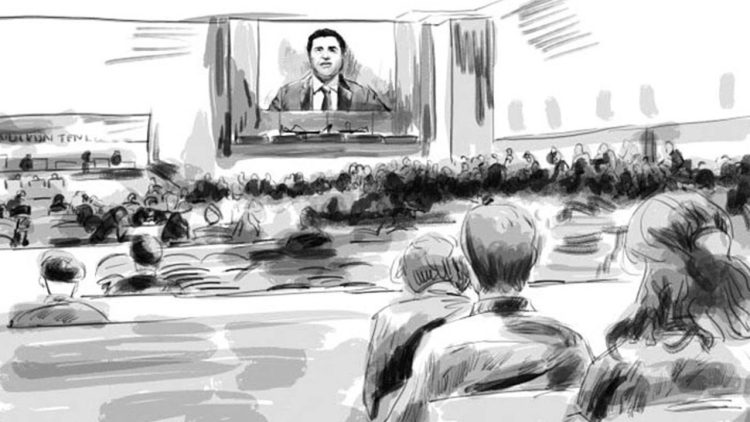
A Turkish court has finally released the 32,000-page long-awaited reasoning behind the May 2024 verdict in the politically charged Kobane case, one year after sentencing former pro-Kurdish opposition leaders to lengthy prison terms, Kısa Dalga reported on Wednesday. The publication clears the way for an appeal process that could redefine the future of high-profile detainees, including ex-Peoples’ Democratic Party (HDP) co-chairs Selahattin Demirtaş and Figen Yüksekdağ.
The case stems from the 2014 Kobanê [the Kurdish-Syrian city of Kobani] protests, when demonstrations erupted across Turkey in solidarity with Kurds fighting the Islamic State in Syria. The Turkish government accused HDP leaders of inciting violence. The case, widely criticised by rights groups, resulted in prison terms ranging from nine to 42 years for over 20 politicians.
Demirtaş, once a leading opposition figure and presidential candidate, was sentenced to 42 years. Yüksekdağ received 32 years and nine months. Other prominent Kurdish politicians, such as Gültan Kışanak, Sebahat Tuncel, and Ahmet Türk, were also convicted.
The verdict’s delay in explanation—an unusual practice in Turkish legal proceedings—had stalled the appeals process for a year. Defence lawyers and human rights observers called the delay a breach of fair trial standards. “A verdict without a reason is a verdict without justice,” said one lawyer for the defence.
Under Turkish law, an appeal cannot proceed until the full reasoning of the judgement is released. With the document now finalised, appeals can move forward, potentially leading to retrials or reduced sentences.
Adding to the political intrigue, the ruling came just one day after Justice Minister Yılmaz Tunç held a rare meeting with the pro-Kurdish Peoples’ Equality and Democracy (DEM) Party. While officials said the discussion focused on general prison conditions, political circles speculate the Kobane case was also on the agenda.
Recent amendments to sentencing laws and whispers of a potential “new solution process” between Ankara and Kurdish actors have further fuelled speculation. Sources suggest that the appeal could lead to partial releases, with retrials calibrated to time already served.
In a tweet before the verdict was issued, Nationalist Movement Party’s (MHP) legal spokesperson Feti Yıldız stated: “Reasoning is what legitimises a judgement in the eyes of conscience, logic and law.”
While the appeal begins, the Kobane case remains a lightning rod for debate over the rule of law and the future of Kurdish political participation in Turkey.


