

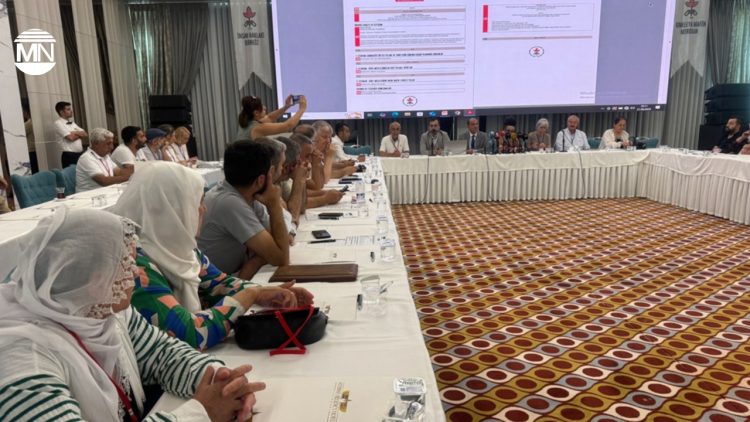
A landmark peace conference in Diyarbakır (Amed) under the title “Path to Peace: Memory and Justice” has called on the Turkish government to immediately suspend military operations and initiate inclusive dialogue, warning that continued violence risks undermining a fragile but growing civil movement for peace.
Held on 21–22 June and organised by the country’s independent Human Rights Association (İHD), the conference brought together rights defenders, civil society organisations, legal experts and families of victims of the decades-long Kurdish conflict. In its concluding statement, the organisers urged the Turkish authorities to adopt a multi-dimensional approach that recognises both structural injustices and present grievances.
İHD Co-Chair Hüseyin Küçükbalaban stated that while some non-state actors had taken meaningful steps toward de-escalation – citing the ceasefire and disarmament congress of the Kurdistan Workers’ Party (PKK) – the Turkish state had not reciprocated. “We see no serious initiative from the state. New military operations not only risk lives but sabotage this delicate process,” he warned, calling on the authorities to suspend armed operations and reopen space for political dialogue.
The declaration listed critical shortcomings in the current process: the continued reliance on security-based policies, the exclusion of civil society from negotiations, the lack of representation for women and minority groups and the failure to document past violations. It stressed that peace must be built not only through disarmament but also through truth-telling, justice and democratic participation.
Messages from grieving mothers Makbule Kaymaz and Ayşe Bülbül were highlighted as symbolic breakthroughs. Kaymaz, who lost her 12-year-old son Uğur and his father in a 2004 police shooting, wrote: “I do not want other mothers to suffer the same. We want justice, equality and peace, because peace will do us all good.”
The conference recommended immediate policy actions, including:
• The suspension of military operations in Kurdish regions;
• The release of sick and political prisoners, including those detained under the Anti-Terror Law;
• The implementation of European Court of Human Rights rulings;
• Official recognition of civil society as a stakeholder in peace talks;
• The establishment of independent truth commissions with access to state archives;
• The return of displaced villagers and the reversal of trustee appointments in Kurdish municipalities;
• Protection of minority rights, cultural identity and mother tongue within the constitution;
• Institutional guarantees for women’s participation in peace-building.
Speakers warned that failure to address these demands could deepen distrust. “Without justice and social records, there can be no sustainable peace,” said Ercan Yılmaz, head of İHD’s Amed branch, who read the full declaration.
(*) Two interconnected conferences have been held this weekend – one in Diyarbakır on 21–22 June, titled “Path to Peace: Memory and Justice,” and the other in İstanbul on 22 June, titled “Opening the Path to Peace”. Organised by the Human Rights Association (İHD) in Diyarbakır and the Civic Initiative for Peace in İstanbul, these gatherings aimed to advance the 2025 Kurdish peace process through inclusive dialogue, justice and democratic reform. The Diyarbakır conference, with its subtitle “Memory and Justice,” emphasised grassroots perspectives, human rights and historical reckoning, whilst the İstanbul event focused on political engagement and cross-party collaboration. These conferences align with the broader “Social Peace and Freedom Meetings” organised by the Peoples’ Equality and Democracy (DEM) Party across cities such as Siirt, Mersin and İstanbul, which further promote public support for the peace process. Together, these efforts represent a coordinated campaign to build momentum for sustainable peace, addressing both local and national dimensions of the Kurdish conflict.


