By Jürgen Klute
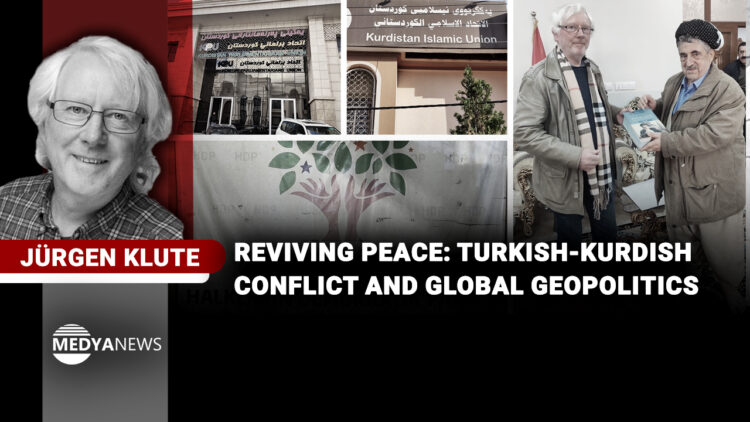
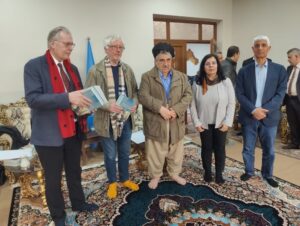
At the end of January 2024, I visited southern Kurdistan [Kurdistan Region of Iraq] with Zainab Murad Sahrab, the co-chair of the KNK [Kurdistan National Congress] who lives in Sweden, and former Icelandic Justice Minister Ögmundur Jónasson. We spoke with various party representatives about the possibility of revitalising the peace process between the Kurds and the Turkish state, which was halted by the Turkish government in 2015. The willingness and desire on the part of our dialogue partners to resolve the armed conflicts, which have been recurring for decades, by political and diplomatic means was evident throughout.
However, it also became clear very quickly in our talks that ending the armed conflicts does not depend solely on the willingness and readiness of the Kurdish side. Turkey and Iran also play a central role. There are also links with the conflict between Israel and Palestine and with Russia’s war against Ukraine. The latter is in turn linked to conflicts of interest over raw materials in the context of the end of the use of fossil fuels. See also the article by Ögmundur Jónasson and myself, ‘A complex conflict and how it could be resolved’ published by Medya News.
The current Turkish attacks on Kurdish neighbourhoods in northern Iraq should be seen in this context. In addition, there are the upcoming elections in the USA and the new formation of the European Parliament and the European Commission after the European elections on 9 June. Turkey is using the turbulent world situation to assert its interests in its shadow: to establish a buffer zone controlled by the Turkish military along the Syrian-Turkish and Iraqi-Turkish borders on Syrian and Iraqi territory.
The Turkish attacks on northern Syrian (Rojava) territory, which have been going on for some time, and the current attacks on northern Iraqi (Başȗr) territory are clearly illegal under international law. It is an attack on the territory and integrity of neighbouring states. Such attacks are clearly a breach of international law. International law accepts only one form of war as legitimate: self-defence against a military attack. From the point of view of international law, the actions of the Turkish state are therefore to be equated with the Russian attack on Ukraine and equally condemned.
The European Union, the USA, NATO and the UN have so far remained silent on the Turkish attacks on Iraq, which violate international law. This is no coincidence. Turkey is a NATO member and secures NATO’s eastern flank. Turkey also has one of the largest and most powerful armies in NATO. The Western states want to keep Turkey as an ally. Turkish President Recep Tayyip Erdoğan has shown often enough how he can put pressure on the EU and NATO: He can reopen the Turkish border to refugees heading for the EU at any time. And he can intensify his pendulum swing between Putin and NATO, i.e. strengthen Putin and thus put NATO under pressure.
At the same time, the EU is slipping further and further into a dead end with its value-orientated foreign policy. Politics means the non-military negotiation of different or controversial interests, and if politicians only want to negotiate with governments that share the same values as the EU, then there are not many negotiating partners left. It is precisely important to remain in negotiations with governments that do not share your own values. This does not mean abandoning your own convictions. But sharing one’s own convictions cannot be made a prerequisite for negotiations, because then there will be no negotiations. The current conflicts in various parts of the world and the ever-increasing threat of global warming, on the other hand, require action across territorial and ideological boundaries.
If the EU and NATO want to resolve the dilemma described above, they need to develop a new strategy. In my opinion, an end to the two most explosive current wars must be at the centre of such a strategy: Israel’s war against Hamas and Russia’s war against Ukraine. Israel had international law on its side when it responded militarily to the terrorist attack by Hamas on 7 October. But Israel will not be able to continue this war indefinitely. It must find a way back to a negotiated solution. This is also in Israel’s own interests. That would be a first step towards de-escalating the situation in the Middle East.
The second step is much more difficult to take: an end to the Russian war against Ukraine. China may play a key role here. China is currently supporting the Russian side moderately. China’s aim is presumably to prevent Russia from capitulating, as this would put the West back in a dominant global role. On the other hand, China is not interested in the use of nuclear weapons. China is interested in politically stable framework conditions to develop its economy and trade. Even a limited nuclear conflict would quickly negatively impact the Chinese Silk Road project – i.e. land-based trade with Europe.
China wants to be recognised as a global power factor due to its now enormously developed economic power. If the West were able to reach a peaceful arrangement with China given its now completely changed global economic and political role, then it would be entirely conceivable that China would agree to convince Russia to end its aggression towards Ukraine. China certainly has the necessary economic policy leverage to do so. And even more so in cooperation with the West, Russia could be pressurised into ending its war against Ukraine.
This would create leeway for the EU and NATO to urge the Turkish government to end its attacks on Kurdish settlement areas and to resume the peace process between the two parties to the conflict that began in 2013.
Given the current situation, these ideas may sound somewhat utopian. However, in my opinion, the complexity of the conflict situation in the Middle East cannot be resolved with local arrangements, nor in the short term. A sustainable and stable political solution must take the entire conflict situation into account and then develop solution strategies. Whether the West likes it or not, it will not be able to avoid China. A return to an interest-orientated foreign policy would therefore be a sensible first step. This does not mean abandoning one’s own stance on human rights, the rule of law and democracy. They are part of our interests alongside economic and security policy interests.
The overarching interest of all states involved should be the interest in preserving the basis of human life: in other words, a reorganisation of the economic basis that prevents further climate warming and, in the long term, leads to a reduction of the warming that has already occurred. Ending the current wars would be a significant step towards stopping global warming. After all, wars contribute massively to global warming.
As Ukraine’s enormous natural resources are at the centre of the Russian war against Ukraine – 30 of Ukraine’s natural resources are considered strategically important raw materials for an energy transition – the question arises as to whether the raw materials extraction should be placed under international control, to establish fair access and prevent the political power of these raw materials from being abused.
Jürgen Klute is a former Die Linke (The Left) MEP and spokesman for the Kurdish Friendship Group in the European Parliament from 2009 to 2014. He is editor of Europa.blog and a columnist for Medya News.