

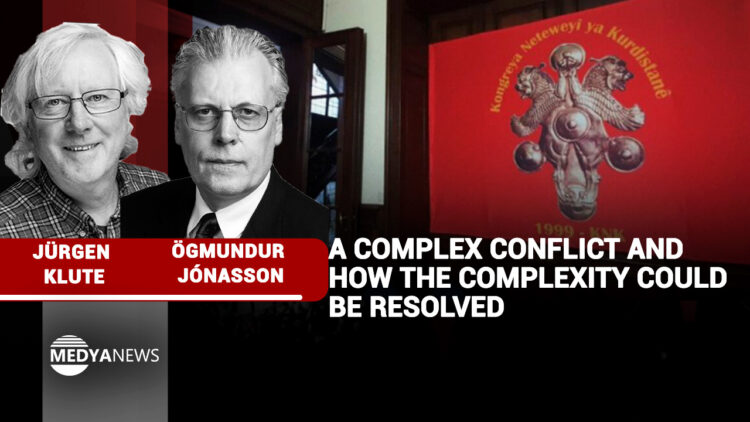
In the last week of January 2024, we took part in a small delegation to Northern Iraq and Southern Kurdistan – Başȗr in Kurdish – at the invitation of the Kurdish National Congress (KNK) based in Brussels. We were accompanied by Zainab Murad Sahrab, the co-chair of the KNK, who lives in Sweden. The KNK is a multinational platform founded in 1985, to which almost all Kurdish organisations and parties belong. It campaigns for the political and cultural rights of Kurds.
The aim of our small delegation was to talk to representatives of the Kurdish parties in Southern Kurdistan about their assessment and stance on revitalising the peace process ended by the Turkish government in 2015 and the role of Abdullah Öcalan in such a process. Öcalan has been held in solitary confinement by Turkey on the prison island of İmralı in the Sea of Marmara since 1999. In breach of international law and human rights conventions he is denied any contact with lawyers and family members.
The talks were informative for us. On the one hand, all Kurdish parties are in favour of reviving the peace process. On the other hand, however, it is also clear that there are differences. Although they all emphasise the importance of Abdullah Öcalan, some interviewees also pointed out that it is not only Öcalan who is imprisoned, but also several thousand journalists and Kurdish politicians. Some interviewees also missed a greater unity among the Kurdish parties. While there was only one unified party in Iraq during the time of Saddam Hussein, today there is a rather colourful party landscape in Kurdish-controlled northern Iraq, which is an expression of the democratic development in this region. At the same time, however, this makes it clear that democracy means recognising different interests within a society, on which a compromise must then be negotiated.
Another point is the role of women. Almost no women were represented among our dialogue partners. The Kurdish self-administration in northern Syria and the political organisations of the Kurds in Turkey differ significantly from the Kurdish parties in Southern Kurdistan in this respect.
Finally, representatives of the ruling parties emphasised that, in the interests of economic stability, they could not pursue a course of sharp confrontation against Turkey and Iran, even though both states repeatedly attack Kurdish territory both in Northern Iraq and in Northern Syria (in particular Turkey) in violation of international law. To a large extent the international community has ignored military aggression by Turkey where the Turkish military has been accused of using chemical weapons. The OPCW (the Organisation for the Prohibition of Chemical Weapons) has so far not responded for calls to investigate these allegations.
It is known that visions for the future vary on whether an independent and politically autonomous Kurdistan is feasible or autonomous regions within the current state borders. Both options can be found, with the majority of Kurds in Northern Kurdistan (Turkey) and in Rojava in favour of a federal structure with Kurdish autonomous regions within the current state borders.
However, a peace process does not depend on the Kurds alone. They are clearly endeavouring to achieve an internal political balance. But a peace process also depends on the interests of the two competing regional powers, Turkey and Iran. Both states clearly have no interest in a democratic and economically and politically stable self-governing Kurdish region.
The current Iranian drone and missile attacks in Northern Iraq are partly interpreted as an attempt to destroy the Kurdish economy there and partly as a message to the USA and Israel in the context of Israel’s war against Hamas, as Iran claims that the victims of the attacks were members of the Israeli secret service Mossad.
The situation is made even more complex by the fact that Turkey, as a Nato member, is playing an ambivalent role in the Ukraine war and Turkish President Erdoğan is repeatedly seeking proximity to Russian President Putin.
Reviving a peace process in such a complex situation is not easy. A simple call for negotiations and political solutions falls short in view of this complex situation. With a view to [how the conflict ended] in Northern Ireland, the Kurdish side is calling for a third party – the EU or the UN – to accompany and moderate a peace process. This demand is also based on the experience that the Iraqi central government in Baghdad, for example, has always offered peace agreements when it was politically and militarily weakened, according to our dialogue partners. Once it had recovered, it began attacking the Kurds again. From the Kurdish point of view, peace agreements – as desirable as they may be – are by no means necessarily peace-building, but can also prolong the conflict if breaks in the conflict are used to gather forces for a new attack.
How can this complexity be made manageable?
It will not be easy to find an approach for reviving a peace process in this complex and difficult to understand situation, which is characterised by the intertwining of several conflicts.
One conceivable start to a peace process could be the removal of the PKK and Öcalan from the EU terror list (and also from the US terror list). In our opinion this would without doubt be a realistic way forward. We urge that steps be taken towards a reassessment of the PKK and the Kurdish struggle for political and cultural self-determination.
In September 2017, the Belgian Court of Appeal (Cour d’appel) in Brussels ruled that the PKK is not a terrorist organisation, but a party to an internal armed conflict, i.e. a civil war. In 2020 the decision has been confirmed. The German-language public Belgian news portal Flanderninfo wrote about the judgement at the time: “This judgement is the first of its kind in the European Union to qualify the Turkish-Kurdish conflict as a civil war and not as a terrorist matter. According to the Belgian judiciary, the international law of war must be applied here, as this civil war is an armed conflict. The lawyer of the PKK defendants in Brussels expressed satisfaction on behalf of his clients that the Belgian judiciary considers this conflict to be a civil war.”
Several passages of the European Commission’s Turkey Report 2023 contain very clear statements on the human rights situation in Turkey and the Turkish penal system. The report emphasises that the PKK is still on the EU terror list and acknowledges Turkey’s right to protect itself against terror. At the same time, the report calls on Turkey to adhere to international standards and the principle of proportionality. The Turkey Report 2023 also points out that Turkey has not yet complied with multiple requests from the Council of Europe and its Committee for the Prevention of Torture to ensure that human rights are respected. The EU Commission thus confirms the accusations frequently levelled by Kurds and other members of the opposition in Turkey against the Turkish state, the Turkish security forces and the Turkish judiciary for ignoring human rights.
While the EU Commission’s report on Turkey is still diplomatically worded in its assessment of the human rights situation, the report ‘Global Terrorism Threat Assessment 2024’ published in February 2024 by the Center for Strategic and International Studies (CSIS) in Washington is clearer.
The authors of the report tend to see Turkey as being responsible for the instability in the region. On page 80, it states: “The Turkish government has expanded its campaign against Kurdish groups beyond its borders. The number of attacks in Turkey has decreased since 2020, but violence between Turkish forces and Kurdish armed groups outside of Turkey has increased dramatically in the same period.[40] The Turkey-PKK conflict continues to drive regional instability and, indirectly, terrorism in the wider Middle East. Turkey has escalated its rhetoric against Kurdish nationalist groups, including the People’s Defence Units that comprise a sizeable portion of the US-supported Syrian Defence Forces (SDF) [ed: *Syrian Democratic Forces].”
Furthermore, the authors write: “Terrorist attacks pose a minor threat inside of Turkey, although the Turkey-Kurdish conflict remains a major driver of violence and instability in the wider region. […] This decrease in terrorist violence within Turkey has occurred alongside a substantial increase in conflict between Turkey and the PKK in Iraq. […] The PKK poses no direct threat to Western countries other than Turkey. […] The PKK threat to Turkish territorial integrity is also questionable. The group lacks the capabilities to directly challenge the Turkish military as has been made repeatedly clear during Turkey’s interventions into northern Syria and northwest Iraq. The PKK officially accepts the current borders of Turkey and has replaced its demands for independence with calls for greater self-determination. The PKK currently espouses an ideology Öcalan calls ‘democratic confederalism’, which attempts to achieve self-determination without questioning the existing political borders. The PKK’s public statements at least suggests that the group poses no meaningful threat to Turkish territorial integrity.”
The authors of the CSIS report ultimately confirm with their analysis what the Belgian Court of Appeal found about the PKK in 2017: it is not a terrorist group. In fact, the PKK does not threaten the USA or the European Union. Nor does it threaten Turkey’s territorial integrity. If one takes all these assessments seriously, then there is no longer any reason why the PKK should not be removed from the US terror list and the EU terror list, especially as the PKK has played a central role in the fight against the “Islamic State” on the side of the West. Removal would open the door to the revival of an urgently needed peace process in Turkey and ultimately in the entire Middle East, because the destabilising effect of this conflict would come to an end.
Despite the reassessment of the PKK that is emerging in the aforementioned texts, the PKK will not be removed from the two terror lists easily or in the short term.
Due to its close co-operation with the Turkish government, the German government is unlikely to agree to a removal from the EU terror list for the time being – unless the US government were to exert corresponding pressure on Berlin. Removal from the EU terror list requires unanimity in the EU Council. It is therefore of central importance to convince the German government to remove the PKK from the EU terror list in the interests of stabilising the region in view of the current political challenges and to convince it of the necessity and expediency of doing so.
Due to the war in Ukraine, there is unlikely to be any short-term success on this issue. The Turkish government will use all the means at its disposal to oppose any de-listing. As long as the war in Ukraine continues, the Turkish government also has an effective means of exerting pressure on the EU, as outlined above. Another means of pressure in the hands of the Turkish government is the so-called refugee deal between the EU and Turkey.
However, in order to revitalise the peace process in the medium term, it is necessary to start the needed preparations today. Removing the PKK from the aforementioned terror lists would be a clear political signal to the Turkish government to engage in a revitalisation of the peace process. Without such a signal, it is unlikely to do so. Political initiatives should be developed and pursued in this spirit and with this goal in mind. There will only be lasting peace if both parties to the conflict agree on peace together.
Jürgen Klute is a German politician, and founding member of the Die Linke party, and a former member of the European Parliament. He is a vocal advocate for peace in Kurdistan.
Ögmundur Jónasson is an Icelandic politician. He was formerly the minister of the interior, minister of justice and minister of health for the Left-Green Party. He is a signatory of the International Initiative ‘Freedom for Abdullah Öcalan – Peace in Kurdistan’ and led a 2019 International Peace Delegation to the Turkish prison island of İmralı, where Öcalan is imprisoned.


