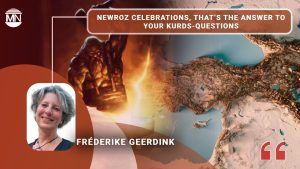
Fréderike Geerdink
In a shocking move, the government decided to illegally rob Ekrem İmamoğlu, the elected mayor of Istanbul, of his university degree, and then jail him on charges of corruption and terrorism. It’s outright absurd. It may push Turkey towards full autocracy, or it maybe the move with which Erdoğan has finally overplayed his hand. Interestingly, many commentators are asking questions about the position of the Kurds. Will they join the mass protests that have erupted in many cities in Turkey? My counter-question is: Don’t you see the Newroz celebrations?
The lastest news is that İmamoğlu is now officially arrested, after giving his testimony to the prosecutor on Saturday. There are unfounded corruption charges against him. The terrorism charges are based on the way İmamoğlu and other Republican People’s Party (CHP) candidates in the local elections last year built alliances with the Peoples’ Democratic Party (HDP), predecessor of the Equality and Democracy (DEM) Party, to secure a victory over the the ruling Justice and Development Party (AKP) candidates. The strategy was very successful in several key cities, and now this is being used against İmamoğlu.
It has been used against other CHP mayors as well, for example last year in Esenyurt, when CHP mayor Ahmet Özer was replaced by an AKP stooge. Of course, the vote of the Kurds has been disrespected like this much more often, including after previous local elections. So much so even, that hardly any elected Kurdish mayor was still in their seat when last year’s local elections commenced. It was the goal of the Kurdish movement to reclaim their seats, and they did.
Empire
It’s interesting to see the usual pundits on Turkey starting to ask what I coin here the ‘K-questions’. What will the Kurds do? Why is it that the Kurds have been rather silent so far? Which side will the Kurds be on? The presumption behind the K-questions is that if only the Kurds would massively support the protesters against the anti-democratic treatment of İmamoğlu, finally Erdogan’s empire would fall.
The funny thing is: the K-questions are asked while all over Kurdistan and Turkey, Newroz celebrations are going on. What do they think Newroz celebrations are? Shallow dancing and lighting fires to welcome the new year? Of course not. They are highly political gatherings, based on Kurdish mythology.
The mythology is about Kawa the blacksmith, who lived in Mesopotamia, where the people were ruled by the cruel king Dehak, after having lived in freedom and prosperity for centuries. Dehak’s cook was actually the devil, which Dehak didn’t know. The cook asked to kiss the king’s shoulder, and when he did so, black snakes emerged from the shoulder. The snakes had to be fed with the brains of children from among the people. From then on, the people lived in darkness. Literally: the sun didn’t rise again. Crops didn’t grow anymore, birds flew elswhere, and one child after another was sacrificed to the king.
Zagros mountains
Until Kawa decided to not obey the demand to sacrifice his last child, a daughter. Instead of his daughter’s brains, he gave those of a sheep. All other people followed his example. Soon, hundreds of children were saved. They went to live in the Zagros mountains, where Kawa taught the young men and women to fight. Then one day, they came down from the mountains and headed to Dehak’s castle. Villagers joined them. Kawa, standing on a high peak, gave a sign with his smith’s hammer, and thousands of fighters and villagers crushed the castle and beat the guards.
Kawa stormed to the king’s rooms. He killed the king with his hammer and chopped his head off, after which the snakes died. He then climbed a mountain and lit a fire, to let the people of Mesopotamya know that they were free again. Soon, fires burned everywhere and the good news spread. The next morning, the sun rose again. Flowers bloomed, birds returned and sang, the people laughed and danced around the fires.
This is the mythology that drives the Kurdish movement. This is why Newroz celebrations are so important. And this year, they coincide not just with the Kurdish movement’s demand of the government to start solving the Kurdish issue through a democratic process instead of violence so the PKK can disarm and dissolve itself as Öcalan has requested, but also, incidentally, with İmamoğlu’s arrest. For the whole week now, at the celebrations, speakers have referred to the illegal measures against Istanbul’s elected mayor.
Spectrum
So, the question is not what the Kurds will do: they’ve been persistently doing it for decades. The question is not why the Kurds have been rather silent so far: they haven’t been silent at all. The question is not on which side the Kurds are: they are clearly on the side of democracy.
In all their actions, Kurds have been following ‘the third path’. That path is not about serving the needs of any side of the Turkish political spectrum, which are all rooted in their oppression, but focusing on a future in which Turkish fascism is eradicated and everybody can live as equals with full political and cultural rights. For the third parth, both the Islamo-fascism of the AKP and the Nationalist Movement Party (MHP), and the Kemalist-fascism of CHP have to go. If factions within those blocks are willing to work with the Kurdish movement, the Kurds will take that opportunity, but if not, they struggle on their own, with the people.
There are factions within the CHP who showed solidarity with Kurdish mayors being replaced. The CHP leadership, still consisting of only men, by the way, has spoken out on behalf of replaced mayors in Van and Mardin, and have visited them in support. But, are they willing to join Kawa’s masses? Can they re-direct their course and follow the third path, straight to the castle so eventually, the sun can rise again?
Happy Newroz everybody!
*Fréderike Geerdink is an independent journalist. Follow her on Bluesky (or X) or subscribe to her acclaimed weekly newsletter Expert Kurdistan.