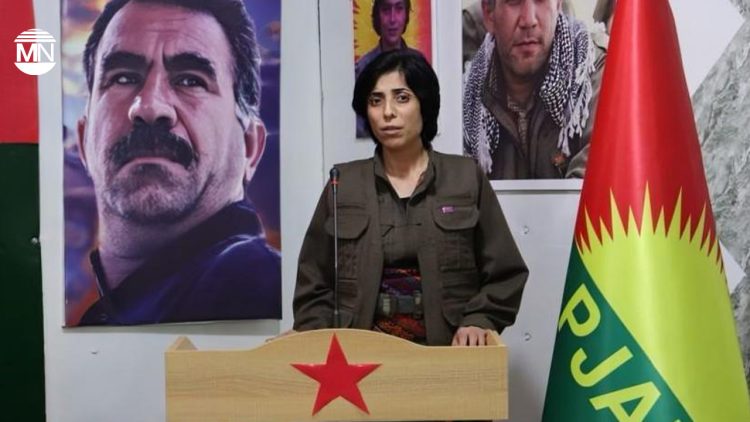
In a wide-ranging interview published by Arab21 News on Sunday, Paiman Fiyan, co-chair of the Free Life Party of Kurdistan (PJAK), warned of a looming crisis in Iranian/Eastern Kurdistan, known by its Kurdish name Rojhilat, amid escalating regional tensions and increasing military pressure from state forces. She called for a democratic and feminist alternative to authoritarianism, war and nationalistic domination in the Middle East.
The comments came shortly before the Israeli military launched fresh airstrikes on military infrastructure in Iran’s northwestern Kermanshah province on Monday, marking the eleventh consecutive day of escalating hostilities between the two regional rivals. The strikes are part of an intensifying series of tit-for-tat attacks that have heightened tensions across the Middle East.
“The Iranian-Israeli conflict is not an isolated episode but part of a broader project to reshape the region,” she said. Fiyan described the Islamic Republic as a regime that has repressed non-Persian identities and pursued foreign dominance through proxy forces — but one that is now exposed to direct retaliation. “After the Hamas operation of 7 October, Iran has been targeted more openly. The fallout affects all peoples in the region, especially Kurds.”
She warned that Iran’s Islamic Revolutionary Guard Corps (IRGC) have ramped up their presence in Rojhilat, a predominantly Kurdish-populated geographical area located in the country’s northwest, heightening fears of escalating conflict. “Although Kurds in Iran are among the most politically organised communities, they are not prepared for another devastating war,” she said, calling for unity based not on narrow party interests but on shared political vision and dialogue.
Fiyan denounced both Iran and Israel for treating the Middle East as a battleground for domination. “These are not wars of liberation — they are power struggles waged by patriarchal, authoritarian states,” she said. In contrast, she argued, Kurdish movements offer a third way: a grassroots political model based on democratic confederalism, gender equality and ethnic pluralism.
“The nation-state has failed. It has produced only tyranny, forced displacement, and destruction,” Fiyan said. She described confederal democracy as the only viable model for peace — one that is driven by local communities, not imposed by external powers or centralised elites.
A key focus of the interview was the role of women in Kurdish political life. “The Kurdish woman is not a participant — she is the engine of the revolution,” Fiyan said. She highlighted the role of Rojhilat Free Women’s Society (KJAR) and the growing influence of the ‘Jin, Jiyan, Azadî’ (Woman, Life, Freedom) movement. “This slogan is no longer a cry of resistance — it has become a political framework and a symbol of a new civilisation.”
She also pointed to the pioneering autonomous administration in North and East Syria, known by its Kurdish name Rojava, as a living example of Kurdish-led grassroots democracy, where power is shared across ethnic and gender lines. “The experience of self-rule in Rojava has inspired Kurds in Rojhilat, where resistance and political organisation continue despite immense pressure.”
Criticising what she called “failed top-down peace initiatives”, Fiyan argued that only the peoples of the Middle East can build a lasting future. “The solution will not come from Washington or Tehran, nor from Ankara or Tel Aviv. It will come from those who organise themselves to live freely, together, in dignity.”
Reflecting on the last century of repression — from the time of the Shah to the current regime in Tehran — she said the Kurdish struggle had moved beyond asking for rights: “We are now building an entirely different way of life, one that embodies freedom, justice and collective dignity.”
Fiyan concluded with a warning and a call to action: “If we do not organise ourselves, the cycle of annihilation will continue. But if we do, we can turn the Middle East from a graveyard of empires into a homeland of peoples.”