

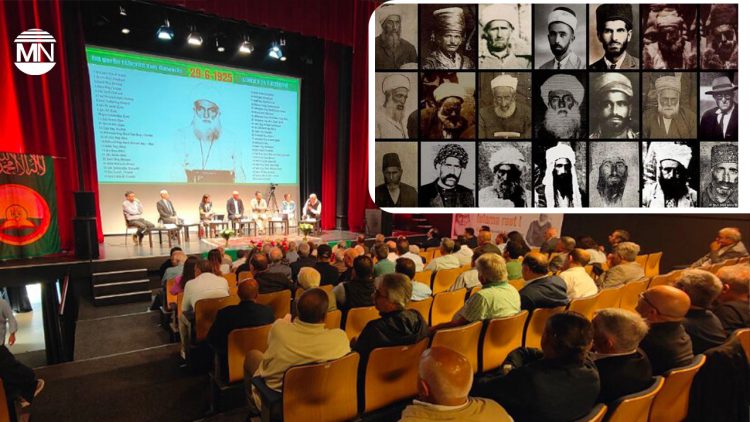
A landmark two-day national conference titled ‘Centenary Conference of the 1925 Rebellion: Azadî Society, Sheikh Said and His Companions, Memory and Collective Objection’ (Konferansa Sedsaliya Serhildana 1925an: Cemîyeta Azadî, Şêx Seîd û Hevalên Wî, Bîr û Îtîraza Hevpar) is taking place in Brussels on 27–28 June to mark the 100th anniversary of the Sheikh Said Rebellion. Coordinated by a Preparatory Committee composed of the Kurdistan National Congress (KNK), the Islamic Community of Kurdistan (CÎK) and the Kurdish Institutes of Germany and Belgium, the programme of events will bring together intellectuals, scholars and representatives of civil society from across the Kurdish diaspora.
The conference, which is currently taking place at the Centre Culturel Espace Magh in Brussels, is addressing the historical, political, social and cultural dimensions of the Sheikh Said Rebellion through a series of discussions. Topics include political conditions in Kurdistan in the early 20th century, the ideological and organisational role of the Azadî Society, the administrative and land policies of the early Turkish Republic, and the broader diplomatic and transborder dimensions of the uprising. Speakers are examining how the rebellion and its aftermath are reflected in Kurdish literature, oral history, collective memory, cultural practices such as dengbêj traditions, and more. The conference also addresses the exile of Kurdish communities and the impact of the uprising on other parts of Kurdistan, namely Rojhilat, Rojava and Başûr. A key focus of the conference lies in exploring the continued relevance of the rebellion for understanding contemporary Kurdish resistance and identity.
“We asked for justice, you gave us the death penalty.”

The rebellion, which began in mid-February 1925 and escalated by late April under the leadership of Sheikh Said, was a pivotal moment in Kurdish–Turkish history. It was a significant uprising against the centralising, nationalist agenda of the newly founded Turkish Republic, which denied and sought to assimilate any identity other than Turkishness. Just two years after the foundation of the Turkish Republic, the rebellion erupted in response to this systematic rejection of Kurdish identity, language, and political rights — rights that had been promised during the early stages of the Turkish national struggle, particularly at the Erzurum and Sivas Congresses which paved the way for the War of Independence. As the largest non-Turkish ethnic group in Anatolia and Mesopotamia, the Kurdish population was disproportionately affected by the imposition of a homogeneous Turkish identity under the new republic. In response to this perceived betrayal, Kurdish leaders established the Azadî (Freedom) movement to advocate for autonomy and recognition. However, the uprising led by Sheikh Said was brutally suppressed by the Turkish state; over 50,000 state troops were deployed to violently suppress the rebellion. On 28 June 1925, Sheikh Said and 47 of his supporters were found guilty by the Independence Tribunal in Diyarbakır (Amed) and executed the following day in Dağkapı Square, Diyarbakır. Thousands more were imprisoned, exiled or killed during the crackdown, with estimates placing the death toll at between 15,000 and 20,000. While the uprising was swiftly criminalised and stigmatised in the official historical narrative, it remains a pivotal chapter in the history of Kurdish resistance.
At the opening ceremony of conference, a message shared from Imralı by Abdullah Öcalan, the imprisoned Kurdish leader, was read out. In his message, Öcalan wrote that the historical reality embodied by Sheikh Said “is more than a rebellion or a local uprising. It is a traditional struggle for survival that has left a deep mark on the collective memory of the Kurdish people.” Describing Sheikh Said as “a pioneer who took on the social responsibility of his time and stood firmly against the policies of denial aimed at the Kurdish people”, Öcalan continued:
“In the early years of the Republic, the implementation of centralist and singular identity policies aimed to erase the existence of the Kurdish people. In response to these policies, Sheikh Said carried the voice of an entire people to the gallows, declaring: “We asked for justice, you gave us the death penalty.” This statement is one of the clearest and most powerful examples of how truth does not retreat in the face of oppression.”
“Sheikh Said’s legacy will be realised in today’s democratic nation.”
In his message, Öcalan cautioned against romanticising the past. He stressed that, like all historical acts of resistance, Sheikh Said’s revolt must be understood in the context of the time in which it occurred. He emphasised the importance of drawing structural lessons from the uprising in order to rebuild historical continuity on a democratic and libertarian foundation. “I have considered this tradition as a basis for the revolutionary transformation of free Kurdishness,” he wrote, explaining that his struggle aims to unite the meaningful legacy of past resistance with a future democratic and pluralistic system founded on societal peace. He concluded: “Sheikh Said’s legacy will be realised in today’s democratic nation.”
Related Article:
Sheikh Said to Abdullah Öcalan: A century of repression and Kurdish resistance
Closing his message, he saluted all participants and reaffirmed his commitment to upholding the values of the resistance: “I respectfully commemorate Sheikh Said and his companions, reaffirming my commitment to carrying forward their legacy and upholding the values of their resistance on the path to freedom and truth.”

As the conference continues, the organisers announce that a mass rally will be held in Cologne, Germany, on 29 June to mark the 100th anniversary of the execution of Sheikh Said and his companions. Speaking on behalf of the Kurdistan Communities Union (KCK), Zübeyir Aydar described the rally as a symbolic response to the gallows that were erected in Diyarbakır a century ago. He called for collective accountability and remembrance, urging all Kurdish parties, institutions and individuals to gather at the rally square in Cologne and take part in this national commemoration.
Speaking to ANF, Aydar emphasised the importance of historical awareness, stating that “it is essential to be able to discuss what happened, when and where”. Aydar also framed the uprising as a reaction to the early republic’s denialist policies: “The Kurds reacted to a republic that was founded on a policy of singularity. The aim of the resistance was to launch a struggle for liberation. In response, the state pursued a policy of repression and destruction.”
Ahmed Karamus, co-chair of the KNK, also spoke to ANF, calling for broad participation in the Cologne rally. He described the rebellion as a just and necessary resistance against forced assimilation and the denial of Kurdish identity. He emphasised that the Sheikh Said uprising was driven by a demand for rights and freedoms, and that it should be recognised as a pivotal moment in Kurdish history. “If true peace is desired, the injustices suffered by the Kurds must be acknowledged,” he said. “Regardless of ideological differences, everyone should join this rally and embrace the Sheikh Said movement. We call on everyone to come to Cologne.”

One hundred years on, the legacy of Sheikh Said’s rebellion continues to resonate. Today, Kurdish movements, particularly the Kurdistan Workers’ Party (PKK) and its imprisoned leader, Abdullah Öcalan, draw connections between the repressed aspirations witnessed in 1925 and the ongoing struggle for recognition and democratic reform. In his commemorative message marking the centenary of the rebellion, Öcalan reiterated his vision for a Democratic Republic — a political framework that would enable Kurds, Turks and all other historically marginalised ethnic and religious groups to live together in equality and justice. For Kurdish political figures, the rebellion is not just a historical event, but a defining moment in the collective memory of Kurdish resistance and a reminder of broken promises regarding a shared future.
The centenary commemoration is taking place during a fragile but ongoing reconciliation process. Over the past nine months, various initiatives have signalled a renewed interest in resolving the Kurdish question within a democratic framework through dialogue. Against this backdrop, the 100th anniversary of the Sheikh Said rebellion is not just seen as historical remembrance, but as a call to finally realise the inclusive, pluralist republic that was never realised. Kurdish political leaders and civil society actors hope that this centenary will be a catalyst for building a democratic future in which Kurdish identity is embraced as a fundamental part of the republic’s re-foundation, rather than being continually denied.
Related Article
Sheikh Said rebellion of 1925 still influential in Turkey: KCK


