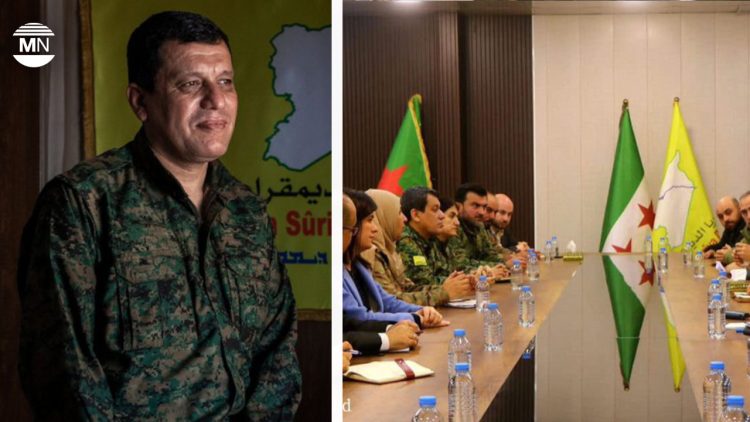
Mazloum Abdi, the General Commander of the Syrian Democratic Forces (SDF), reaffirmed his commitment to the 10 March agreement in a statement posted on his official X account on 5 June. He described the agreement as a vital framework for securing the constitutional rights of the Kurdish people and promoting a pluralistic and democratic Syria.
Highlighting the strategic importance of recent events, Abdi stated: “The establishment of a unified Kurdish delegation is part of the process of implementing the 10 March agreement, which emphasised the constitutional recognition of the rights of the Kurdish people in a united Syria.” He added that implementing the agreement is not only a Kurdish concern, but also lays the groundwork for broader national reconciliation efforts in Syria.
The agreement, which was reached between the SDF and the Syrian Interim Government led by Ahmed al-Sharaa (al-Julani), outlines a political roadmap for the integration of SDF-controlled civil and military institutions into the administrative and defence structures of the Syrian state. This includes constitutional recognition of the Kurdish people as an integral part of Syrian society, the return of key infrastructure, such as border crossings and energy facilities, to the control of the central government, and the establishment of a nationwide ceasefire. The agreement also addresses the protection and return of internally displaced persons (IDPs) and urges the rejection of divisive rhetoric and hate speech. Implementation committees are to be formed to oversee the enactment of these provisions by the end of 2025. The agreement has been widely welcomed as a significant step towards national unity and long-term stability.
Related Article:
Syrian government and Kurdish-led SDF forge historic integration agreement
Abdi also addressed the importance of ongoing political dialogue, drawing attention to the complementary roles of the two delegations, one representing the Autonomous Administration of North and East Syria, and the other being a unified Kurdish delegation comprising representatives from various Kurdish political groups. He stated that these delegations constitute “an integrated path that embodies our commitment to national dialogue as a strategic option towards a future that achieves justice and equality”, reflecting a united vision for Syria’s political transition. Framing his vision for Syria’s future, Abdi stated: “We believe that recognising the rights of all communities is the foundation for building a democratic and just Syria in which everyone participates.”
Related Articles:
Talks begin in Damascus between Syrian government, North and East Syria administration
Damascus, North and East Syria reach four-point agreement in first official talks
The emphasis on the 10 March agreement reflects the SDF leadership’s broader strategy of facilitating a peaceful resolution and democratic transformation in Syria, based on inclusive governance and equal representation for all ethnic and religious communities. By promoting this framework, the SDF is seeking to establish a foundation for a lasting political settlement that addresses long-standing grievances, ensures regional stability and guarantees all communities a meaningful role in shaping Syria’s future through participatory politics.