

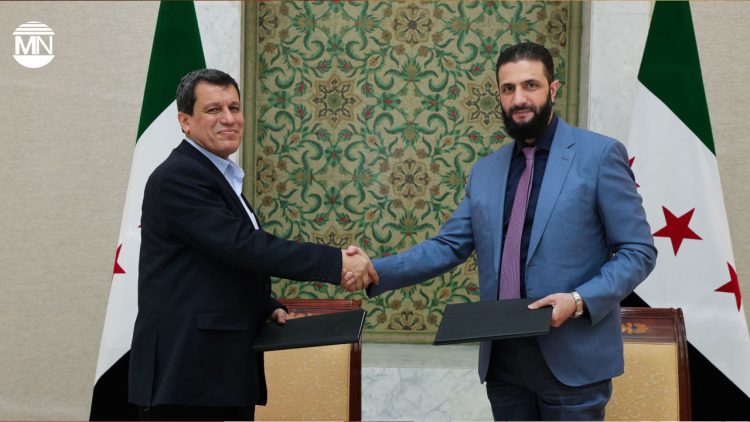
Syria’s state news agency SANA has declared a groundbreaking agreement between the Syrian government and the Kurdish-led Syrian Democratic Forces (SDF). The deal integrates SDF into the state’s institutions, guarantees Kurdish rights, and enforces a ceasefire nationwide. However, SDF and the Autonomous Administration of North and East Syria (AANES) have yet to comment or provide details.
The announcement comes as Ahmed al-Sharaa (al-Julani) faces mounting criticism over the massacres in the Alawite coastal region. This unexpected agreement is the result of months of behind-the-scenes negotiations, initiated in December, between the Kurdish-led authorities in northeastern Syria and the interim government led by al-Sharaa.
In a historic development on 10 March, the Syrian government and SDF have reportedly formalised an agreement to integrate the Kurdish forces into the national framework. The accord was signed by SDF Chief Commander Mazloum Abdi and Syrian President al-Sharaa.
Key provisions of the agreement:
1. Inclusive political representation: Ensuring that all Syrians, irrespective of religious or ethnic backgrounds, have the right to participate in the political process and state institutions based on competence.
2. Recognition of Kurdish rights: Acknowledging the Kurdish community as an indigenous part of Syria, with guaranteed citizenship and constitutional rights.
3. Nationwide ceasefire: Implementing a comprehensive ceasefire across Syrian territories to facilitate peace and stability.
4. Integration of institutions: Merging civil and military institutions in northeastern Syria into the Syrian state’s administration, including control over border crossings, airports, and oil and gas fields.
5. Return and protection of displaced persons: Facilitating the return of displaced Syrians to their hometowns and ensuring their safety under state protection.
6. Unified stance against security threats: Collaborating to combat remnants of the former regime and other threats, while rejecting divisive rhetoric and promoting unity among all components of Syrian society.
7. Implementation timeline: Establishing Executive Committees tasked with executing the agreement’s terms by the end of the year.
This agreement signifies a pivotal shift in Syria’s post-conflict reconstruction, aiming to unify diverse factions under a central governance structure and promote national reconciliation. The international community is closely monitoring these developments, anticipating positive outcomes for regional stability.


