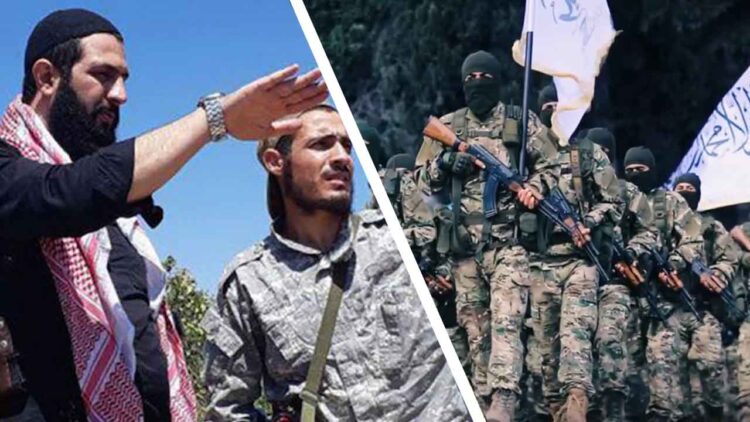
Abu Mohammad al-Jolani, the leader of Hay’at Tahrir al-Sham (HTS), said in an interview with CNN that HTS had left behind its jihadist ideology and violence against minorities and non-Sunni Islamist groups in the areas under its control and was instead focused on building institutions for society. Commentators responded by stressing that HTS’s behaviour was in line with Turkey’s strategy of occupying Syria, and pointed to the Autonomous Administration of North and East Syria (AANES) in Syria as a successful model of democracy and popular governance.
The HTS leader made it clear that the aim of the group is to remove Syria’s Assad government and replace it with an institution and a ‘people’s council’. He specified that he was talking about reconstruction and the future of Syria, where there would be no jihadist rule. However, the group was born as an offshoot of Al-Qaeda and according to a report by the Rojava Information Centre (RIC), has a clear political plan to ‘rebrand’ jihadism by gaining the goodwill of Western public opinion.
Al-Jolani asserted that the HTS had moved on from its jihadist rule after years of war. He also clarified that HTS’s strategy changed when it started to build the ‘salvation government’ in the occupied territory around Idlib. However, as early as 2022, author and jihadism expert Aaron Zelin described HTS’s approach as shifting towards ‘political jihadism’. He argued that HTS was organising itself as a government rather than a non-state actor, without abandoning its jihadist ideology.
According to al-Jolani, HTS is seeking to institutionalise itself on the basis of tolerance towards religious and ethnic communities. Political commentators have made it clear that since its establishment in Idlib and the surrounding area, HTS has used violence against the Druze, Armenian, Christian and Shia Islamist communities in the area. Displacement, violence and theft of property have been frequent, and the demography of the communities has changed drastically.
Political commentator Ehmed Mihemed noted that HTS operates with the support of Turkey. Although al-Jolani does not mention it in the interview, Mihemed argued that HTS is part of the plan of Turkey’s multilateral strategy to invade and occupy Syria militarily, politically and economically.
Al-Jolani, meanwhile, has praised the changed nature of HTS, based on a commitment to an inclusive government in the hands of society. A Kurdish journalist noted that in Syria, the AANES government has been developing social councils and representative structures for society for more than 12 years, and has been able to guarantee stability and political representation for all communities. Despite this, the AANES is under embargo and its status is not recognised internationally.
The Western media took different attitudes towards HTS, as reported in a comparison of different media channels. The jihadist nature of HTS, which the US and EU have designated as terrorist, is often not mentioned, preferring to use the terms “rebels” or “Islamist factions”. The recent CNN interview also failed to explore HTS’s relationship with Turkey or its stance against the AANES government.
Aleppo war and Syria’s future: A battle of geopolitical realignments and a hope for democratic confederalism