

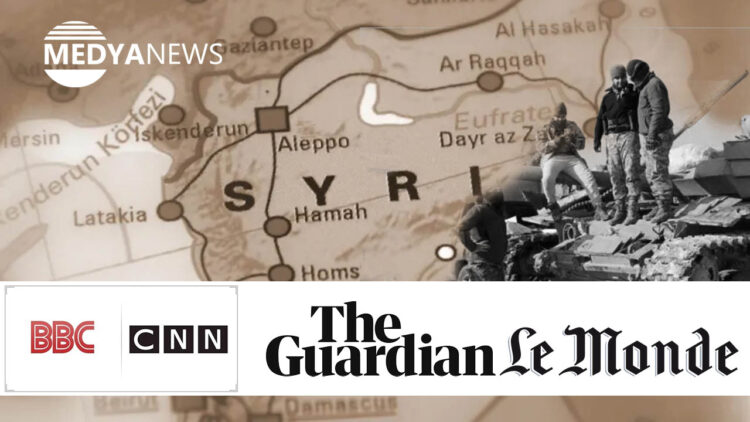
The recent offensive by Hayat Tahrir al-Sham (HTS) and allied factions in Aleppo (Haleb) has reignited debates over how Western media portrays armed groups in Syria. Outlets such as the BBC, CNN, and the New York Times framed HTS as “rebels” or “Islamist factions”, while others like The Guardian and Le Monde described them as “jihadists”. These differences reflect a larger challenge in balancing geopolitical analysis with the complexities of Syria’s conflict.
HTS, a rebranded offshoot of Al-Qaeda, has sought to distance itself from its extremist origins, emphasising governance in Idlib, where it maintains de facto control. While the BBC highlighted HTS’ recent efforts to reposition itself, The Guardian pointed to ongoing accusations of human rights violations under its rule, including arbitrary detentions and suppression of dissent. Meanwhile, CNN underscored the tactical sophistication of HTS, which has capitalised on weakened Assad-aligned forces.
The Syrian National Army (SNA), a Islamist rebel coalition backed by Turkey, has been portrayed variably in Western media. Mainstream outlets, including the New York Times, often refer to it as a “moderate opposition”, while independent platforms like Democracy Now and Ronahî stress its role as a Turkish proxy accused of war crimes, including the displacement of Kurdish populations. This divergence in framing obscures the underlying dynamics, where Turkey leverages the SNA for geopolitical gains, particularly to counter Kurdish autonomy.
Turkey’s role in shaping these groups’ actions remains a critical yet underexplored dimension in much of the mainstream reporting. While Le Monde noted Turkey’s logistical and military support for both HTS and the SNA, BBC stopped short of explicitly critiquing Ankara’s broader objectives. Analysts suggest that Turkey’s alliances with these groups serve both to expand its influence in northern Syria and to maintain pressure on Kurdish self-administration.
The reluctance of outlets like CNN and the BBC to label the SNA as anything beyond a rebel coalition contrasts starkly with accounts from human rights organisations, which document abuses such as forced displacements, looting, and violence against minority groups. Guardian recently reported on these allegations but framed them as secondary to broader geopolitical manoeuvring. This hesitancy raises concerns about how narratives are shaped by Turkey’s position within NATO and its strategic importance to the West.
Mischaracterising armed groups risks downplaying the human cost of Syria’s conflict, particularly for marginalised communities like the Kurds. As Ronahî has reported, the Kurdish population in Afrin (Efrîn) has been severely impacted by SNA-led operations, with allegations of systematic displacement and exploitation. Such realities are often sidelined in mainstream narratives, leaving critical questions on accountability unanswered.
The timing of the HTS offensive, with Assad’s key allies such as Russia and Iran distracted by conflicts elsewhere, has also drawn scrutiny. The New York Times observed that HTS’s capture of Aleppo marks a pivotal moment in the Syrian civil war, while Democracy Now linked the offensive to broader regional instability, including strained Turkish-Syrian relations. As HTS consolidates control, the challenge of governing a diverse and ideologically varied population may test its capacity for pragmatic adaptation.
As the conflict evolves, the role of media in shaping international perceptions is critical. Consistent and accurate reporting is essential not only for understanding Syria’s war but also for holding powerful actors accountable. By failing to critically examine Turkey’s influence and the broader implications of supporting groups like HTS and SNA, Western outlets risk perpetuating narratives that obscure the lived realities of those most affected by the conflict.


