

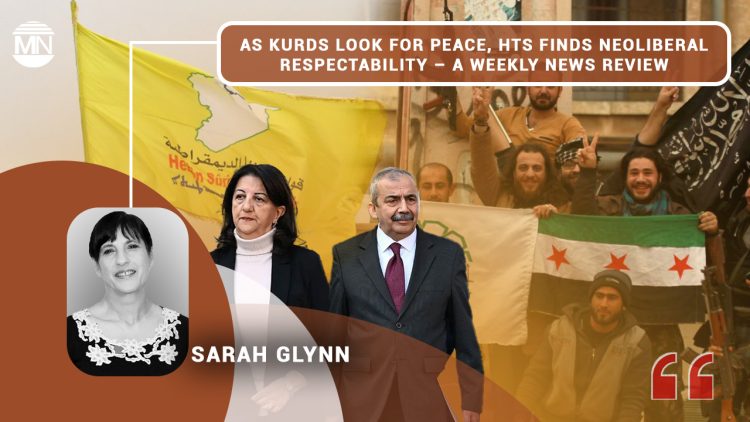
Sarah Glynn
This week, a delegation from the pro-Kurdish DEM Party visited İmralı Prison a second time, and spent four hours in discussion with Abdullah Öcalan. The internet is full of talk about possible deals, and predictions that the Kurdistan Workers’ Party (PKK) will be dissolved. At the same time, Turkey continues to detain activists and imprison journalists, Turkish planes continue to target North and East Syria’s Tishreen (Tişrîn) Dam, and Turkish media has proudly published video of a drone hitting dancing civilians.
We have only been given snippets of information about these long meetings with Öcalan, but a DEM Party official has made clear that Öcalan is taking a holistic approach that includes all four parts of Kurdistan; that he stresses the importance of democracy in Turkey and of changing the denialist constitution and the underlying issues that caused the conflict; and that he wants to ensure the solution process involves all of society, not just himself and the Government. Öcalan also reiterated the importance of establishing proper working conditions: negotiations are not possible while he is denied his visiting rights. He has been able to discuss ideas with the other three prisoners in İmralı, and both Öcalan and the DEM Party delegation claim to feel hopeful that, this time, they will achieve success.
Most of us can’t know what is discussed behind closed doors and have no contacts in high places. The only thing we can say with certainty is that Turkey is at a crossroads. What way it will turn is impossible to know, so I will move my focus onto the wider context in which all these events are taking place. I will look at the aims of the Kurdish Freedom Movement – meaning all those organisations that follow Öcalan’s ideas – and also look at the wider geopolitical context in which these are playing out.
Davos
For an understanding of that context, I will begin in Davos, where the Foreign Minister of Syria’s interim government, Asaad Hassan al-Shiabani, has been one of the guests at the World Economic Forum, the gathering for liberal capitalist elites.
On Wednesday, al-Shiabani spoke with former British Prime Minister, Tony Blair, in an interview so ingratiating it was embarrassing to watch. The unrepentant cheerleader for the destruction of Iraq, invited correct liberal answers from the smiling representative of the world’s favourite Islamist “terrorists”, and made no attempt to follow up al-Shiabani’s failure to answer any mildly challenging question.
Al-Shiabani was a founder member of Hayat Tahrir al-Sham (HTS), as of its predecessor Jabhat an-Nusra, and effectively foreign minister for their Salvation Government in Idlib This government was intolerant of opposition and applied strong restrictions on women. Cédric Labrousse writes that al-Shiabani was “Intermediary between Julani [Ahmed al-Sharaa] and [Abu Bakr al-Baghdadi, leader of the Islamic State] between 2011 and 2013.” And also “Responsible for contacts with western secret services.”
In Davos, al-Shiabani was recognised not only as the representative of a group that has taken power in a strategically important country, but also because, in the words of the Financial Times, “Syria’s new rulers plan to privatise state owned ports and factories, invite foreign investment and boost international trade”. Before the HTS take-over, Syria’s economy was increasingly being run for the benefit of corporations in Russia and Iran. Now, it will be up for grabs by Western corporations. As DD Geopolitics observe, this is another example of disaster capitalism. HTS, which was able to take control thanks to active support by Turkey and more passive support from the United States and its allies, have shown their allegiance to the neoliberal club.
Syria’s current economic disaster is not just due to the war but also to the West’s crippling sanctions, which al-Shiabani is demanding be lifted. His acceptance of the Western line is demonstrated even in the way he makes that demand. Rather than acknowledge that the sanctions have always made life hard for everyone, he told Blair, the sanctions were put in place for the Syrian people but are now against the Syrian people.
Blair himself is at least consistent. When Bashar al-Assad came to power in 2000, he was courted by Blair’s New Labour Government, which had already strengthened relations with Bashar’s father and which believed that Bashar was the harbinger of “modernisation”, including economic “reform” and “liberalisation” – code for privatisation and deregulation. When Bashar al-Assad visited the UK, he was given the full red-carpet treatment, and even considered for a knighthood.
Blair is not unique. He is representative of the priorities of our ruling elites, which are the priorities of the corporations. That is how our current world works – the situation in which the Kurdish Freedom Movement must act, and which it is also trying to change.
What Kurds want
The Kurdish struggle takes place on two levels. It is a struggle for basic cultural rights, equality and dignity, and it is also a struggle for a different type of world based on a different philosophy – for the realisation of Öcalan’s ideas on women’s rights, peaceful multi-ethnic coexistence, ecology, and grassroots democracy.
Kurdish rights could be conceded with little impact on others – though, so far, these rights have been firmly denied – but philosophical change can’t be won by negotiation. The very most the Kurdish movement can hope for is space in which to develop and spread their ideas, and a functioning democracy, aided, if possible, by sufficient local autonomy to allow the creation of new social organisations and structures. Kurdish rights are a prerequisite for Turkish democracy, and democracy is vital for both Kurdish and Turkish rights and for the possibility of peaceful social change.
It will not be easy to achieve even a basic level of liberal democracy in Turkey which has become increasingly authoritarian under Recep Tayyip Erdoğan. Erdoğan will only be ready to relinquish his authoritarian control if he believes he will win at the ballot box. The loss of his overall majority to the HDP – the DEM Party’s predecessor – in June 2015 triggered his full rejection of the peace process which began in late 2012, and his repudiation of the recently signed Dolmabahçe Agreement that set priorities for resolving the Kurdish Question.
In Syria, a peaceful, dignified, and democratic future for the Kurds and their neighbours in the Autonomous Administration of North and East Syria depends both on reaching peace with Turkey, and on coming to an accommodation with the de facto interim government in Damascus, which, as al-Shiabani told the Financial times, has a “special relationship” with Turkey, though he claimed that this does not amount to subjugation. In the Administration’s relations with both Turkey and Damascus, America retains a dominating role, and America’s actions are dictated by the financial elites. At stake, are lives and livelihoods, cultural traditions, and the fabric of social structures and civic institutions that have been patiently built up over twelve years of autonomous control.
Turkey’s attacks
For the present, the United States and their allies have convinced Turkey to hold off from invading Kobanê, as they would like to do. But Turkey has suffered no political comeback from the operations carried out by their mercenary militias – the so-called Syrian National Army (SNA) – that, backed by Turkish airpower, have occupied al-Shahba and Manbij, and that continue to attack the Tishreen Dam over the Euphrates. As I described last week, the electricity that used to be generated by the now damaged dam supplied power and pumped water to some million homes, in addition to which the constant bombardments have put the whole structure in danger of catastrophic collapse. Groups of civilians have been holding a vigil to protect the dam, but Turkey’s reaction has been to target the civilians. There have now been at least twenty civilian deaths, with people hit both at the dam and on their way there, and ambulances also becoming targets. Médecins sans Frontières has called “on all warring parties”, though without naming names, “to take all necessary measures to protect civilians, health workers and medical facilities in accordance with International Humanitarian Law.” The dead have included the much loved actor, “Bavê Teyar”, and two German activists are among the wounded. Turkey is not only unembarrassed by what they are doing. They filmed and publicised a drone hitting a group of people as they danced. Another video, recovered from a Turkish drone shot down near the dam, shows a Turkish military base and confirms Turkish direct involvement in these attacks.
Relations with HTS
HTS remains silent with respect to this Turkish aggression. At the same time, they are themselves in talks with the Autonomous Administration’s Syrian Democratic Forces (SDF). The SDF warn us not to believe Turkish propaganda that claims there have been tensions between the SDF and HTS, but, even so, coming to an agreement will not be easy. The Administration wants to keep its autonomy and argues that decentralisation could respond to the needs of all Syrians. HTS leader, Ahmed Al-Sharaa, has made it clear that his Syria is a centralised state, where power is not divided or shared and where the primary force in state building is constituted by the mujahedin, the Islamist fighters. This vision has no room for local autonomy, let alone any sort of independent defence. Al-Shiabani, the “Foreign Minister”, tweeted a message in Kurdish about equality and justice and Kurds adding “beauty and light to the diversity of the Syrian people”; but he told the Financial Times that “the existence of the SDF no longer has justification.” He claimed that his government, which includes former ISIS members and sympathisers, was ready to take over control of the prisons full of ISIS fighters, and that, in contrast to the oppression under Assad, Kurdish rights would be recognised in the future constitution.
Turkey, of course, supports HTS centralism and pushes them to demand total dismembering of the SDF. The SDF is a much bigger armed force than HTS, but ultimately HTS has the backing of the second biggest army in NATO, plus increasing recognition as the de facto Syrian Government. The Syrian “Defence Minister”, Marahf Abu Qasra, was reported on Wednesday as ready to use military force against the SDF if necessary, though HTS later denied this. Meanwhile Turkey’s attacks provide constant arguments against the dismantling of the Autonomous Administration’s vital self-defence force.
Davos versus Öcalan
HTS developed from al-Qaeda, and has given plenty of reasons for secular democrats to be concerned – such as Islamic training for new police recruits, which was described by Reuters on Thursday. They may talk about equalities and inclusivity, but their self-appointed interim government includes no women and no members of other political groups, and there is no guarantee that the promised elections will ever materialise. By contrast, the Autonomous Administration is guided by values that Western politicians like to consider as of the West, with a central emphasis on ethnic inclusion and women’s rights; and the Administration still controls a quarter of Syria. Yet, Western politicians have been lining up to engage with the HTS takeover as they would with a legitimate government, while some regard the Autonomous Administration more as a problem to be negotiated away. Part of the reason for this is reluctance to upset Turkey, but another part is HTS’s readiness to offer Syria up to Western capital.
The model of society being developed by the Autonomous Administration is avowedly anti-capitalist, if relatively mixed in practice. Their philosophical approach – Öcalan’s approach – would not be welcome at Davos.
The Barzanis
This ideological gap has been exploited by Masoud Barzani and politicians linked to his Kurdistan Democratic Party (KDP) and to the related Kurdish National Council (ENKS) in Syria. Barzani’s crony capitalism is at home in Washington, and his closeness to Erdoğan’s Turkey allows him to assume the role of intermediary. Masrour Barzani, acting Prime Minister of the Kurdistan Region of Iraq and Masoud’s son, had a meeting with al-Shiabani in Davos on Thursday.
The Kurdish Freedom Movement has welcomed the agreement by the Barzanis to be part of a united Kurdish approach to negotiations on Syria’s future. This makes a stronger Kurdish voice for Kurdish rights and removes a possible source of external opposition; but Barzani’s involvement will also put pressure on the Autonomous Administration to compromise on their unique political approach – an approach that has provided inspiration across the world. Notably, too, the Administration is not simply a Kurdish project, and includes many Arab majority areas liberated from ISIS.
Iran
Syria has dominated recent headlines, but Israel and America’s remaking of the Middle East has also, of course, had major impacts for Iran. Sadly, this has not stopped the Iranian Republic’s brutal crackdown on dissent.
On 14 January, United Nations Human Rights experts issued a statement criticising Iran’s extensive use of the death penalty and violation of fundamental rights. They criticised in particular “the targeted persecution of Kurdish women activists on politically motivated charges,” and they called for the death sentence for Kurdish activist Pakhshan Azizi to be revoked.
Last Saturday, at the instigation of the Brussels-based Kurdistan National Congress, six Kurdish parties from Iran made a joint call for a general strike on Wednesday to protest the death penalty for Azizi and also for Warisheh Moradi. Despite text warnings from the government that participation would be considered a crime, the strike was widely observed across the Kurdish region in Iran, and videos show streets of shuttered shops. At the same time, women in Tehran’s Evin Prison went on a day’s solidarity hunger strike.
On the day of the strike, Azizi’s sentence was postponed, but a postponement is only temporary. The struggle goes on.
European institutions
The next day, Thursday, a call to release both women was passed by a nearly unanimous vote in the European Parliament. Introducing the resolution, MEP Hannah Neuman said, “Pakhshan Azizi cared for the wounded and displaced in Rojava, helping those fleeing from the brutality of ISIS. Warisheh Moradi fought against ISIS herself on the front lines in Kobanê, defending not only lives but also human dignity. In a normal country these two would be heroes. In Iran they face death row… Yes, the henchmen of this regime can imprison people, but this will only amplify the unstoppable call for freedom. Pakhshan and Warisheh embody everything this regime fears: zan, zendegi, azadi [Persian for women, life, freedom].”
Earlier in the week, four MEPs visited the vigil for Öcalan outside the Council of Europe in order to give statements in support of peace talks and of ending Öcalan’s isolation so that he can play his vital role.
But while the elected politicians were demonstrating their human side, the European Union’s Commissioner for Equality, Preparedness and Crisis Management, Hadja Lahbib, was visiting Syria and Turkey and underlining the interests of the EU establishment. Alongside a picture of a smiling handshake with Turkish Foreign Minister and former intelligence chief, Hakan Fidan, she tweeted, “I reaffirmed Türkiye remains a key EU partner, including to address the evolving situation in Syria & Gaza. In today’s geopolitical turmoil, EU-Türkiye cooperation — with our international partners — is critical to stability in Syria, Gaza & region.” The people of North and East Syria might want to disagree.
Sarah Glynn is a writer and activist – check her website and follow her on X or bluesky


