Sarah Glynn
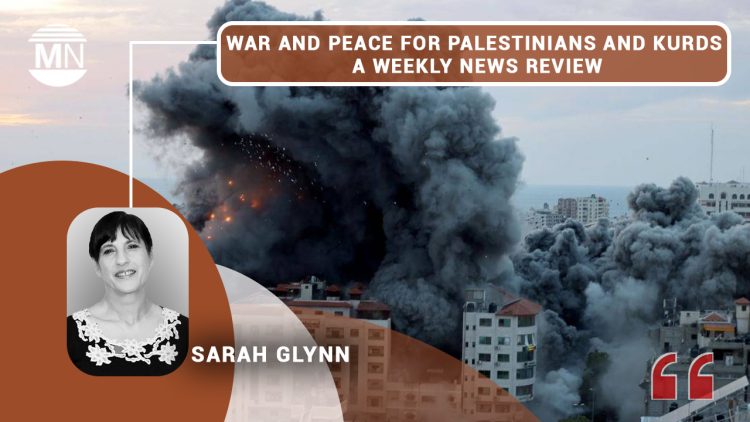
This is the week that a ceasefire was agreed between Israel and Hamas. Until the last minute, Israel’s signing was uncertain, and it may be that Israel’s agreement was made in the full knowledge that – as with every other agreement they have made – they will not allow this to proceed beyond the first stage. I’m not going to join the very many people attempting a detailed analysis of this ceasefire, but, before looking at the week’s Kurdish news, I do want to look at how the nature of Israel’s war and their approach to negotiations can impact the approach taken by other countries – specifically Turkey. This is over and above the more obvious impacts from the changing balance of power in the region following Israel’s attacks, which facilitated the collapse of Bashir al-Assad’s government in Syria. Israel’s genocide in Gaza provides vital background to understanding the practice of international politics more generally.
This week’s review will go on to look at Turkey’s continued war on the Autonomous Administration of North and East Syria and their attacks on the Tishreen Dam and on the civilians protesting to protect it. It will discuss the meeting between Mazloum Abdi, Commander in Chief of the Administration’s Syrian Democratic Forces (SDF) and Masoud Barzani, head of the Kurdistan Democratic Party (KDP), still the dominant party in the Kurdistan Region of Iraq. And it will examine the latest uncompromising messages and actions from President Erdoğan and his government and their implications for those pursuing peace and dignity for Kurds in Turkey. But first, the broader world picture – the political context in which these events are taking place.
Lessons from Gaza
The example set by Israel, with the full backing of the United States and the support of most Western governments, has made the whole world a more brutal place. Horrific as this genocide has been, it is not unique in its levels of sadistic violence, but never before has a genocide been intimately recorded and livestreamed into people’s homes in this way. The lack of action by other governments in response to such a widely known abuse of rights and blatant Israeli lies has been exposed for all to see. This can act as a wake-up call to their disillusioned citizens, but it also sends out a message to oppressive leaders everywhere that they are free to act as they will with impunity. Talk of human rights is just talk, and no-one will challenge states that work on the premise that might is right.
With respect to the ceasefire agreement itself, and also to government statements and press briefings, the example from Israel is very clear. There is no penalty for lying or for reneging on a deal.
Turkey has already found this to be true, but the Israeli example reinforces the message that states that are powerful enough can act with impunity. And it demonstrates the near impossibility of negotiating a peace deal with a strong and genocidal state.
The destruction of Gaza has blown apart the illusion of an international moral order and exposed how states will always act in the presumed interests of their own ruling elites. For how American interests will be interpreted by the incoming Trump administration, we can find clues in his appointees, notably Marco Rubio, who Trump has nominated as his Secretary of State, the US equivalent of foreign minister.
The message from Marco Rubio
Rubio is the son of Cuban immigrants and completely opposed to anything that can be in any way connected to communism. He openly and unequivocally prioritises US ‘national interest’, which for him means engaging in the world with the aim of making a safer, stronger, more prosperous America. He takes a frighteningly hawkish position with respect to China, and also Iran, and is fully supportive of Israel. In the Senate Confirmation hearing on his appointment, which took place on Wednesday, Rubio responded to a question from Democratic Senator Chris Van Hollen on whether the US should continue to support their Syrian Kurdish partners. (Van Hollen described the Syrian Kurds and the SDF as “the tip of the spear in our fight against ISIS” – which is not a position that anyone would want to be in.) Rubio’s answer to the question of US support was a clear yes, and he explained how this served US national interests. Besides highlighting the SDF’s role in restricting the regrowth of ISIS, he talked about wanting a stable Syria that would help the situation in Israel and Lebanon, and about preventing Russia and Iran from regaining influence. (Israel has been vocal in pushing the Kurds as a counter to Turkey and the Islamists of Hay’at Tahrir al-Sham (HTS).) Rubio also warned Erdoğan not to try and take advantage of the transition of power in America to violate existing agreements.
Turkey’s attacks on North and East Syria
In his question to Rubio, Van Hollen observed that, thanks to the United States, Turkey had paused their attacks against the Kurds, and Rubio also referred to Turkey’s ‘ceasefire’. So, what does this Turkish ceasefire entail, and what does it leave out?
Turkey’s promised invasion into Kobanê is indeed on hold. There have clearly been talks behind the scenes, and the presence of US troops, like that of the Russian troops they replaced, makes such an invasion politically sensitive. The commander of the Women’s Protection Forces (YPJ), Rohilat Afrin, told Rojava Information Centre, “If Turkey attacks Kobane, do we expect that the US will help? Materially, no. But in general, with the support they exhibit and through them meeting with Turkey, they have shown that their position is that the issue must be peacefully resolved. Even if they are purely following their own interests, it has prevented the doors to a Turkish invasion into Kobane from being opened. It is evident from certain things within their diplomatic efforts that they have attempted to help us. However, we see that the [International Coalition against ISIS] has a responsibility to put a halt to the current fighting and aerial attacks. So in general, we do not expect that there will be any type of concrete blocking of a ground invasion, but in the diplomatic context there are efforts to prevent this, even if they are not enough.”
At the same time, Rohilat Afrin described the ongoing war against North and East Syria that is being waged by Turkey’s mercenaries – the so-called Syrian National Army (SNA) – supported by Turkish air power. The offensive that began in parallel with the collapse of the Assad government, has already seen the SNA take control of the isolated region of al-Shahba and the multi-ethnic city of Manbij. It is now focussed on the Tishreen Dam and Qereqozak Bridge over the Euphrates, where there has been intense fighting. What seems to be easily disregarded by the politicians in Washington, is described by the YPJ commander as a major confrontation in which Turkey and their mercenaries are pursuing policies of destruction and subjugation: policies aimed at dismantling the achievements of the Autonomous Administration and destroying the “collective mentality” the Administration has built up between the different peoples that make up the region.
America’s apparent blindness is consistent with their earlier failure to respond to Turkey’s breaches of the 2019 ceasefire, of which they were a guarantor, including the aerial bombardment of much of the region’s vital civilian infrastructure.
Bizarrely, one of Joe Biden’s last acts as president has been to amend Donald Trump’s 2019 executive order so as to remove the clause allowing the freezing of US assets held by the Turkish government and its officials. That order was made in response to the major Turkish invasion that Trump himself had facilitated and which was then seen to be undermining the campaign against ISIS and threatening regional security. Biden’s amendment claims that it is a response to “changing circumstances on the ground in Syria”. But there is nothing in the public domain that can explain the adoption of such an amendment at this time of intense Turkish aggression.
The attacks on the Tishreen dam have already affected the supply of electricity and of pumped water over a huge area, and warnings of possible collapse have become more urgent with every Turkish bombardment. If the dam collapses, the rush of water could be enough to breach the Tabqa dam downstream, too, and carry a wave of devastation all the way into Iraq. Ecologists claim that the destruction would turn hundreds of thousands of people into refugees and make the region uninhabitable for generations, while the chaos would immediately endanger the security of the ISIS prisons.
There are international laws against targeting essential civilian infrastructure, and you can’t get much more essential than water and power. There are also explicit rules against targeting dams because of the potential for such massive destruction. But who needs to observe international law? One could also mention that Turkey’s attacks on the dam are taking place within the context of an unprovoked war, which is itself a war crime.
The Autonomous Administration has been trying to draw world attention to the current crisis and the potential for major catastrophe, but no one is listening. For ten days now, in an attempt to highlight the dam’s importance and discourage the attacks, convoys of civilians from different cities have been taking part in turn in a protest vigil at the dam. But these civilians have come under Turkish attack – twice at the protest site itself and twice enroute – leaving eight dead and 55 injured. Casualties among the people protecting the dam are not collateral damage from Turkish attacks targeting the dam, but are the result of attacks directed at those civilians themselves.
These vigils are a testament to people’s bravery and determination in the long struggle to protect their land and freedom. They feed into the spirit of popular resistance, but such demonstrations in a war zone are a dangerous form of action. We know from experience (from the time of the invasion of Afrîn as well as now) that Turkey will not hold back from attacking civilian protestors, and that, crucially, the so-called ‘international community’ will largely remain silent. We live in a world in which serious breaches of humanitarian and international law have become increasingly commonplace, and states are left free to breach established norms and laws with impunity – especially if, as in Turkey’s case, there are political reasons for other states not wanting to antagonise them. Attempts to appeal to morality and human rights through actions such as the Tishreen vigil (or also hunger strikes) come up against an uncaring world and are increasingly dangerous.
Mazloum Abdi in Erbil
The most significant event for North and East Syria this week didn’t take place on the battlefield, or even within Syria. On Thursday, the SDF’s Commander, Mazloum Abdi, came to Erbil and met with Masoud Barzani, the leader of the Kurdistan Democratic Party (KDP) and still the most powerful figure in the Kurdistan Region of Iraq. In Abdi’s words, they “deliberated on the ongoing developments in Syria and found common ground on the necessity of fostering Kurdish unity in Syria and maintaining peaceful dialogue with Damascus to secure the rights of the Kurdish people.”
The prospect of Kurdish unity at this crucial juncture and after years of destructive enmity brought people onto North and East Syria’s streets in celebration.
The Barzani family and their feudal KDP have long been resentful that their sister political group in Syria, the Kurdish National Council (ENKS) was eclipsed by the Democratic Union Party (PYD), which follows the ideas of Abdullah Öcalan. The KDP has become increasingly close to Turkey and the ENKS has been accused of acting as a fifth column and trying to destabilise the Autonomous Administration. The Americans have long been trying to bring the PYD and the KDP/ENKS together, without success, but changing circumstances produce changed political calculations, and both parties now appear to believe that they will benefit from a united front. This should give the Kurds a stronger hand in their negotiations with HTS in Damascus and, from Barzani’s perspective, could strengthen the role of the KDP and ENKS in any future arrangements. Kurds in Iraq will be able to feel safer if the Autonomous Administration is able to maintain some sort of control over their region, rather than finding themselves neighbours to a centralised Syria controlled by HTS.
Turkey maintains a strong influence over the Barzanis, and the Prime Minister of the Federal Kurdish Region of Iraq, Masoud Barzani’s son Masrour, was in Ankara just a week and a half ago. While Turkey is attempting to force the collapse of the Autonomous Administration altogether, they might, as a back-up, tolerate a North and East Syria that was closer to the conservative KDP. Turkey is a skilled political operator and always ready to change plans in response to changing circumstances.
While Kurdish unity brings hope of Kurdish strength and survival, it also brings fears that the democratic, feminist, and multicultural ideas and aims of the Autonomous Administration will be diluted and weakened.
Proto peace talks in Turkey?
Abdi’s meeting needs to be understood in conjunction with the meetings that have been taking place in Turkey with the pro-Kurdish leftist DEM Party in what is still hoped could evolve into a peace process.
Recent speeches by Erdoğan and by his ally, the Nationalist Movement Party (MHP) leader, Devlet Bahçeli, do not give much hope of real movement from their side. Erdoğan in Diyarbakir last Saturday told his party’s provincial congress that the “single purpose” of recent work was the “self-dissolution” and “liquidation” of the Kurdistan Workers’ Party (PKK), “the unconditional surrender of weapons, the complete removal of the organisation’s tutelage over politics”.
Bahçeli told his party group meeting, “The destiny of the Kurd and the Turk has been written together. We are all Turkish people… The contacts and visits made by the DEM delegation have been realised positively in our eyes. After the second meeting to be held between the DEM delegation and İmralı [i.e. Öcalan in prison], it should be declared without any conditions that the organisational existence of the PKK has ended… We are what we have said for 56 years. Our line has never changed. Turkishness is the badge of honour of our existence. Terrorism cannot be negotiated, it can only be fought…”
Since their initial meeting with Abdullah Öcalan on 28 December, leading members of the DEM Party have been having talks with Turkey’s other political parties. Despite the unpropitious comments just quoted, and the lack of any concrete steps that would indicate a change in official attitudes towards the Kurds, they announced, in a statement issued yesterday.
“Our overall impression is that there is a common desire and will among all political parties to move beyond the conflict-ridden and tense phase of the Kurdish issue. There is a common understanding that it is in everyone’s interest to promote unity and brotherhood among all ethnic, religious and sectarian groups in our country. In addition, there is widespread agreement that the peace process should also contribute to wider democratisation and the expansion of the democratic political sphere.”
The DEM Party have no option but to take this process seriously. They cannot be seen to be putting anything in the way of a peace settlement, and their involvement and bringing in of other parties can itself help change the political dynamic. This is a time of political upheaval and fluidity and even the Turkish government may come to realise that Turkey could be more secure and more prosperous if it were not at war with one fifth of its population.
On behalf of the PKK, Helin Ümit from the Central Committee told Medya Haber:
"We, too, want a terror-free Turkey; state terror must end… The Turkish state has escalated the conflict to its highest point, but the developments in the region are now forcing Turkey toward change."
That change, she argued, has to include an end to the discrimination and oppression that drove the PKK to take up the armed struggle four decades ago, and recognition of Öcalan’s key role in negotiations.
As we saw in the collapse of the 2013-15 talks, as well as in the Israeli example with which I began, peace will not come to fruition without sincerity. However, for now, the distorted presentation of news published by Turkey’s state-aligned media often gives such an inversion of the truth that it is hard to read. This week they were pulled up for claiming that the SDF had bought their drones from Iran, when they had actually manufactured them themselves.
But the rapid evolution of events is driving further change, and even in this time of genocide, key actors may come to believe that peace is in their best interests.
Sarah Glynn is a writer and activist – check her website and follow her on Twitter or bluesky