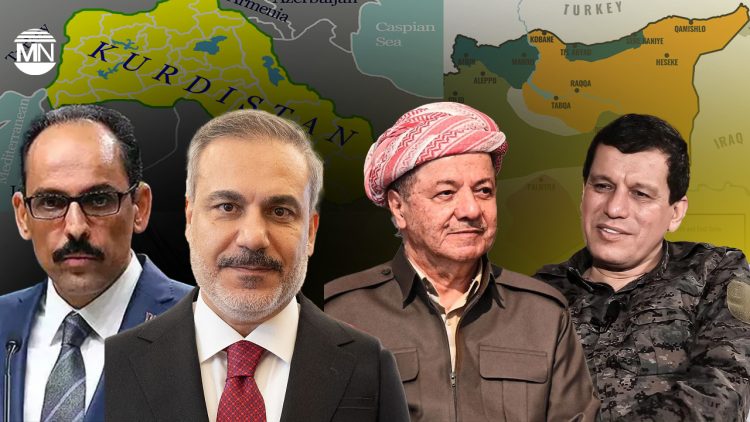
Turkey’s Foreign Minister Hakan Fidan and National Intelligence Agency (MİT) Chief İbrahim Kalın held key meetings in Damascus and Baghdad this week, as Turkish diplomatic efforts intensify, with particular focus on the future of Syria. With regional power dynamics shifting, Ankara appears focused on preventing Kurdish political gains, targeting the Kurdish-led Autonomous Administration of North and East Syria (AANES), its military backbone, the Syrian Democratic Forces (SDF).
Foreign Minister Hakan Fidan met with his Iraqi counterpart Fuad Hussein in Baghdad on Saturday, to discuss regional security, border coordination and energy projects. However, the meeting occurred amid heightened tensions: just two days earlier, Iraqi Foreign Minister Fuad Hussein warned that any Turkish attack on Kurdish forces in northern Syria would be dangerous and deepen the region’s refugee crisis.
Fidan reiterated Ankara’s stance during the meeting, describing the SDF as an “artificially created terrorist organisation” and calling for its disbandment. He also stressed the importance of the Development Road Project, a network of transport routes aiming to link Iraq to Europe through Turkey, as a regional initiative for economic cooperation, framing Turkey as a key regional partner.
While the two leaders discussed cooperation, Hussein notably avoided labelling the Kurdistan Workers’ Party (PKK) as a terrorist organisation during their joint press conference, despite Iraq having officially banned the group. This omission highlighted Baghdad’s cautious approach to balancing its relations with Turkey and Kurdish political entities.
A day later, 26 January, MİT Chief Kalın travelled to Damascus for discussions with Ahmad al-Shara’a (nom-de-guerre Abu Mohammed al-Jolani), leader of Hay’at Tahrir al-Sham (HTS), and senior Syrian officials. Central to Turkey’s agenda was to pressure HTS to curb Kurdish influence in northern Syria, sources indicate.
The AANES has advocated for a political settlement to bring stability to Syria, including the incorporation of the SDF into a unified national military structure. Ankara is opposed, and reportedly requested HTS block such integration, which it views as a step towards Kurdish autonomy and a weakening of Syria’s territorial integrity.
Despite Turkey’s diplomatic efforts to influence al-Shara’a and his team, negotiations between the AANES and Syria’s transitional government are progressing, with talks centred on developing an integrated military.
SDF Commander Mazloum Abdi, has expressed openness to joining the Defence Ministry as an independent military bloc, while Defence Minister Murhaf Abu Qasra is advocating for a unified military under a central command. Nevertheless, both sides have signalled cooperation on key issues, such as resource-sharing and decentralisation. Notably, Abdi clarified decentralisation is “geographical, not ethnic”, aiming for an inclusive and unified Syria.
These negotiations, critical to shaping Syria’s future, continue against a backdrop of international appeals for diplomacy. UN Special Envoy Geir Pedersen recently called for restraint and stressed the importance of resolving tensions peacefully to prevent further destabilisation.
Ilham Ahmed, co-chair of AANES’s Foreign Relations Committee, while discussing Turkey’s involvement in Syria’s transition, recently asserted Turkey has expanded its control by appointing advisors to the interim Damascus government.
Turkey seeks to expand its influence across Syria, Ahmed warned, by embedding key personnel in central administration and maintaining military deployments. She emphasised that these actions jeopardise Syria’s territorial integrity and urged for decentralised governance to prevent further conflict and the oppression of ethnic groups, including Kurds. Ahmed also called for international and regional unity to counter Turkey’s ambitions and promote a pluralistic, democratic future for Syria.
Ankara’s intensified diplomacy comes as Kurdish groups across the region work toward reconciliation. A recent meeting between SDF Commander Abdi and Kurdistan Democratic Party (KDP) leader Masoud Barzani, from the Kurdistan Region of Iraq (KRI), highlighted efforts to strengthen ties between the AANES and the KRI.
Adding to the complex dynamics, Barzani made a significant statement on Iraq’s Shems TV on Sunday, warning Syria’s transitional government that excluding the AANES or adopting an aggressive stance towards the Kurdish autonomy in northern Syria would lead to strong repercussions. “If the transitional government does not include my sisters and brothers of Rojava’s Kurds [AANES] and instead becomes aggressive against them, we are ready to support them militarily and in any way they may need,” Barzani declared, signalling potential military backing for the SDF.
Turkey remains deeply opposed to the existence of the AANES, and its military arm the SDF, citing links to the PKK, which is deems a terrorist organisation. Fidan and Kalın’s visits to Turkey’s southern neighbours reinforce Ankara’s strategy to prevent any political or military consolidation of Kurdish-led entities in Syria, fearing that such moves could inspire similar aspirations among Kurds in Turkey.
As regional alliances shift and the new Syrian leadership engages diplomatically, Turkey is jostling to position itself as a central player in shaping Syria’s future. However, its aggressive push to block Kurdish political aspirations has drawn criticism from both Kurdish leaders and international observers, who argue that Ankara’s policies undermine stability and democratic progress in the region.