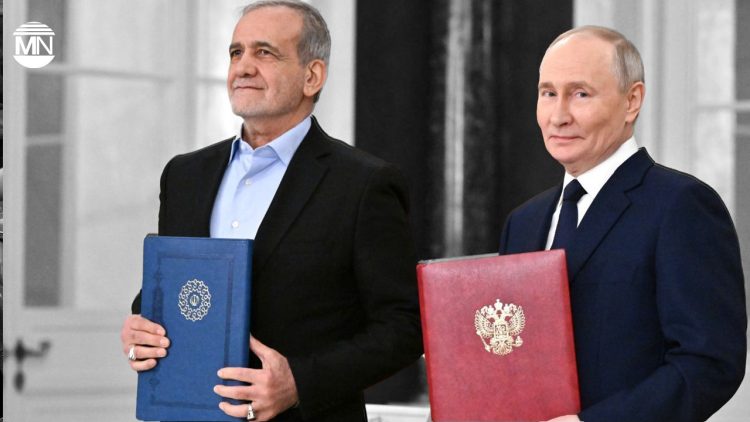
On 17 January, Iranian President Masoud Pezeshkian and Russian President Vladimir Putin signed a landmark 20-year strategic agreement, encompassing 47 articles on military, nuclear energy, advanced technology, and financial cooperation, aimed at countering US and European sanctions.
At a ceremony held at the Kremlin, Putin and Pezeshkian formalised a comprehensive agreement, which, according to TASS, spans a wide array of sectors, including defense, counter-terrorism, energy, finance, transport, industry, agriculture, culture, science, and engineering.
Putin expressed his satisfaction with the completion of the agreement, highlighting its significance as a catalyst for advancing cooperation across nearly all areas. “This is a crucial step, as it will provide the momentum to invigorate almost every facet of our collaboration,” he remarked during the meeting with Pezeshkian.
He further elaborated on ongoing and future initiatives, noting, “We continue with major projects, including those in nuclear energy. There are also emerging ventures in the energy sector, alongside promising prospects in logistics.”
Pezeshkian reaffirmed the importance of the bilateral relationship, stating, “We view our relations with the Russian Federation as both strategically vital and multifaceted. Our dialogue and collaboration will continue to strengthen and expand.”
Abbas Araghchi, Iran’s Foreign Minister, emphasised ahead of the Iranian delegation’s visit to Moscow that the “Joint Comprehensive Strategic Agreement” was a key objective, focusing on deepening long-term relations.
Russian Foreign Minister Sergei Lavrov underscored the extensive scope of the agreement, highlighting its commitment to enhancing regional and global peace and security through strengthened cooperation.
In this context, Esmail Baqaei, the spokesperson for the Ministry of Foreign Affairs, stated that the comprehensive joint cooperation agreement between Iran and Russia is essentially a refined iteration of the pact initially forged between Tehran and Moscow in the late 1990s. This agreement, which underpins the mutual relations and cooperative framework between the Islamic Republic of Iran and the Russian Federation, has been in force since 2001 and remains legally binding. In light of evolving circumstances and the deepening of bilateral relations, a more detailed and nuanced agreement was drafted to better encapsulate the expanding scope of collaboration between the two nations.
Kazem Jalali, Iran’s ambassador to Russia, in an interview with IRNA, stated that the agreement covers all aspects of bilateral relations. He highlighted its inclusion of areas such as “new technologies and cyber security”, “nuclear energy”, “defense and military cooperation”, “counter-terrorism”, and “combating money laundering and organised crime”.
Under President Pezeshkian, Iran’s foreign policy closely mirrors Ali Khamenei’s vision of prioritising ties with Eastern nations over Western alliances. Khamenei has consistently emphasised the need for Iran to strengthen relations with its neighbours, particularly Russia and China, while reducing dependency on the West. Pezeshkian’s visit to Moscow marks a significant step in Iran’s strategic pivot East, underscoring its increasing reliance on Russia. However, despite efforts to cement this partnership, it remains fraught with complexities, disparities, and contradictions.
While Tehran considers its alliance with Russia a strategic advantage amid growing international isolation, analysts argue that Russia views Iran as a secondary player within its broader geopolitical strategy. Iran’s role must therefore be understood within the larger context of Moscow’s relations with Washington, especially following Trump’s return to power.