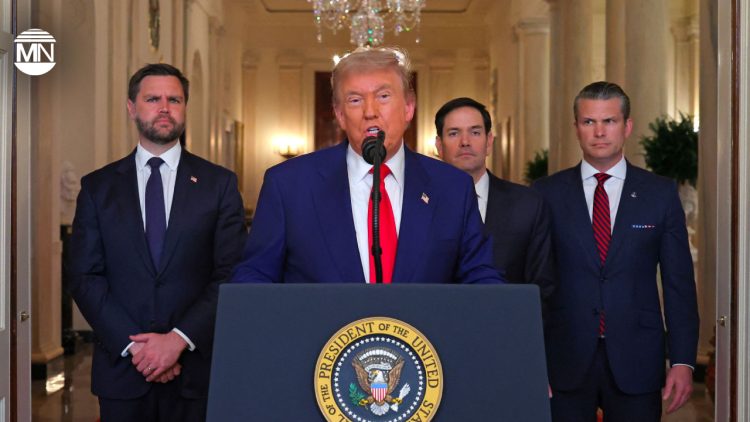
In a constitutionally contested escalation of the ongoing Israel-Iran conflict, the United States on Saturday conducted airstrikes on three Iranian nuclear facilities – Fordow, Natanz and Isfahan. US President Donald Trump hailed the operation as a “spectacular military success” but faced sharp criticism for bypassing Congressional approval, raising serious legal and ethical questions under both US and international law.
The strikes, which involved US B-2 stealth bombers deploying at least six GBU-57 “bunker buster” munitions and submarines launching approximately 30 Tomahawk missiles, targeted Iran’s key nuclear enrichment sites. Speaking from the White House Situation Room, Trump claimed the facilities were “completely and totally obliterated”, asserting that the aim of the operation was to eliminate Iran’s nuclear threat and force Tehran to “make peace”. He warned that any Iranian retaliation would be met with “force far greater than what was witnessed tonight”. Iranian officials, however, dismissed Trump’s claims as exaggerated. A spokesperson for Iran’s Atomic Energy Organisation (AEOI) said that the sites had been evacuated prior to the attack, and that they had sustained minimal damage with no radiological contamination. An official of Qom told Anadolu Agency that Fordow Fuel Enrichment Plant in the the province had been targeted but that the damage was limited, implying that Trump’s rhetoric was overstating the impact of the operation. Iranian state media went further, alleging that Trump’s claims are being overstated in order to project power, all of which casts doubt on the extent of the destruction.
The operation was conducted in close coordination with Israel and marked a significant escalation in the 10-day conflict sparked by Israeli strikes on Iranian targets that began on 13 June. Israeli Prime Minister Benjamin Netanyahu praised Trump’s “bold decision”, describing it as a “historic” step toward crippling Iran’s nuclear programme. “President Trump and I often say peace through strength. Strength comes first, then peace,” Netanyahu said in a video message, calling the US action a “unique achievement”.
The unilateral strikes drew immediate condemnation from Democratic Party lawmakers, who argued that Trump had violated the US Constitution and the War Powers Act of 1973, which requires Congressional approval for sustained military engagements. Congresswoman Alexandria Ocasio-Cortez labelled the action “grounds for impeachment”, stating, “The president has no right to drag the United States into a war without Congressional consent”. Senate Democratic Leader Chuck Schumer called for immediate enforcement of the War Powers Act, while Senator Bernie Sanders described the attack as “grossly unconstitutional”. The White House did not notify the “Gang of Eight”—the bipartisan group of senior Congressional leaders typically briefed on sensitive operations—prior to the strikes, further fuelling accusations of executive overreach.
Under international law, the strikes have been widely criticised as a potential violation of the United Nations Charter, which prohibits the use of force except in self-defence or with Security Council authorisation. UN Secretary-General António Guterres expressed “deep concern”, warning that the attack represents a “dangerous escalation” with “catastrophic consequences” for regional stability. He urged all parties to exercise restraint and pursue diplomacy, stating that military options are not the solution and the only hope is peace.
Iran’s Foreign Minister Abbas Araghchi condemned the strikes as a “grave violation” of international law, asserting Iran’s right to self-defence under Article 51 of the UN Charter. The AEOI charged the International Atomic Energy Agency (IAEA) with enabling the attacks, claiming the agency neglected to denounce earlier Israeli strikes and failed to ensure the protection of Iran’s nuclear sites.
Iranian officials rejected Trump’s portrayal of the strikes as a decisive blow, emphasising that their nuclear programme remains operational. Iran confirmed the attacks on Fordow, Natanz and Isfahan but maintained that damage was minimal. On Sunday morning, Iran retaliated with missile and drone attacks on Israeli territory, triggering air raid sirens in Jerusalem and other cities. Iranian officials described the targets as “strategic sites”, though specific details remain unconfirmed.
The US communicated to Tehran via diplomatic channels that the strikes were not intended to pursue regime change, according to CBS News, which cited US sources. This message followed reports that Trump had rejected plans to target Iran’s Supreme Leader Ayatollah Ali Khamenei, indicating a desire to limit the scope of the conflict.