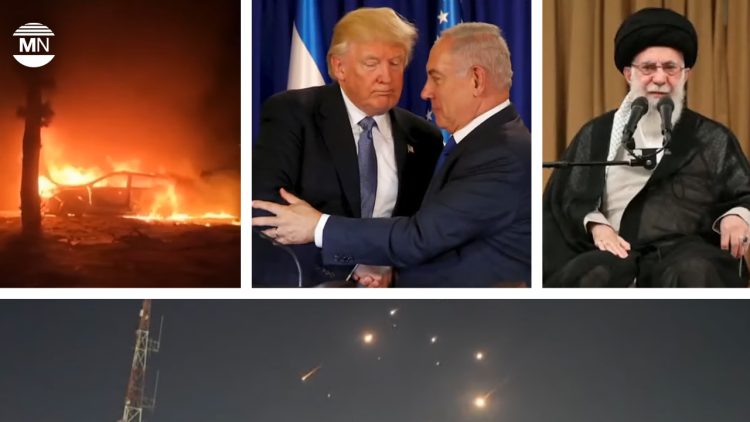
Israel’s ambassador to the United States, Yechiel Leiter, stated on Tuesday that the Israeli government is preparing further covert operations targeting Iran’s nuclear and missile infrastructure. “We have some surprises up our sleeves,” he said, referring to operations expected to unfold on Thursday and Friday.
In an interview with Merit TV, Leiter defended Israel’s strikes, arguing that they are crucial in preventing Iran from acquiring nuclear weapons and expanding its ballistic missile arsenal. He claimed that Iran intends to produce 10,000 ballistic missiles in the coming years and is capable of doing so.
Leiter also emphasised President Donald Trump’s support for Israeli policy, pointing out that Trump has publicly declared that Iran “will not have a nuclear bomb” on at least 15 occasions since returning to office. He praised the US administration’s support, particularly the provision of THAAD and Aegis missile defence systems, which he said had intercepted the majority of Iranian projectiles.
Amid speculation over direct US military involvement in Israel’s attacks on Iran, Leiter clarified that Israel’s request to Washington is “clearly defensive”. He added, “Allies, the United States will make a decision as to whether or not they’re coming in and joining us. That’s an American decision.”
Leiter also addressed recent reports that President Trump had vetoed a plan to assassinate Iran’s Supreme Leader, Ayatollah Ali Khamenei. While he did not confirm the existence of such a plan, he did assert that Israel’s targeted operations had significantly weakened Iran’s leadership structure. “The Supreme Leader looks to his right and he has no IRGC leadership; he looks to his left and all of his nuclear scientists are gone,” Leiter said.
Asked about the possibility of negotiations, the ambassador stated that Israel have always been ready, but insisted that any deal must include the full dismantlement of Iran’s nuclear and ballistic missile programmes. He suggested that Iran’s recent willingness to negotiate might be due to the cumulative damage caused by Israel’s operations against senior officials and strategic infrastructure.
These remarks followed President Trump’s comments at the G7 summit, where he expressed optimism that a deal could be reached between Iran and Israel while urging civilians in Tehran to evacuate areas near suspected nuclear sites.
However, Israel’s continued military operations and increasingly assertive rhetoric have raised concerns among European leaders and international observers, as diplomatic efforts face growing strain. According to the Iranian Health Ministry, at least 224 civilians have been killed and hundreds more injured in Israeli airstrikes on strategic locations across Iran. One such strike hit the headquarters of the Islamic Republic of Iran Broadcasting (IRIB) in Tehran during a live broadcast, killing at least two media workers. Further strikes and cyberattacks on Iran’s telecommunications infrastructure have caused significant internet disruption in parts of the capital, fuelling public alarm and interrupting emergency services.
Meanwhile, Israel’s genocidal campaign in Gaza has intensified since the outbreak of attacks on Iran. On 17 June, Israeli tanks shelled crowds waiting for food aid in Khan Younis, killing at least 59 Palestinians and wounding 221 others, according to medics. This was the highest death toll in a single day since aid deliveries resumed in May via the Gaza Humanitarian Foundation (GHF) — a US- and Israeli-backed initiative which has been criticised for bypassing established humanitarian frameworks and operating under Israeli military oversight. According to the Gaza Health Ministry, 397 Palestinians have been killed and over 3,000 injured while attempting to access aid since late May.
In his interview on Merit TV, the ambassador described the conflict as existential, declaring: “This is a war to end all wars.” The phrase echoes the infamous slogan of the First World War, later viewed with bitter irony as that conflict became prolonged and catastrophic. World War I claimed around 10 million soldiers and at least 6 million civilian lives, leaving a traumatised generation and deeply scarred societies. It was also during this time that the Armenian Genocide occurred, with starvation systematically used as a method of extermination. Today, as Palestinians in Gaza endure mass displacement, bombardment, and deliberate starvation under siege, the parallels with past atrocities are stark. By invoking this historical phrase, Leiter underscores the magnitude of earlier catastrophes, prompting questions about whether such language serves to justify the current scale of violence or to obscure its consequences.