The conflict between Israel and Iran has entered its sixth consecutive day, marked by an intensification of hostilities. Overnight, Israeli fighter jets and missiles targeted nuclear and military facilities in Tehran, Karaj, and Isfahan. In retaliation, Iran launched two waves of missile and drone attacks towards Israel, firing an estimated 400 projectiles in total. Israeli air defences intercepted the majority of incoming threats. According to reports, at least 585 people have been killed in Iran—including 239 civilians and 126 security personnel—and more than 1,300 others have been injured. In Israel, at least 24 people were killed and hundreds wounded.
Israeli strikes have severely damaged Iran’s nuclear infrastructure. The International Atomic Energy Agency (IAEA) confirmed disruptions at the Natanz site, where thousands of centrifuges were destroyed, and damage to surrounding power stations and support buildings. While the Fordow enrichment complex remains largely intact, Israeli strikes have also impaired Iran’s energy and surveillance facilities.
Since 12 June, approximately 200 Israeli airstrikes have prompted nearly 40 retaliatory missile launches from Iran, most of which were intercepted. US President Donald Trump has responded by demanding Iran’s unconditional surrender and stated that American forces now “control Iranian airspace”. He has also ordered the deployment of a carrier strike group, fighter jets, and refuelling tankers to the region.
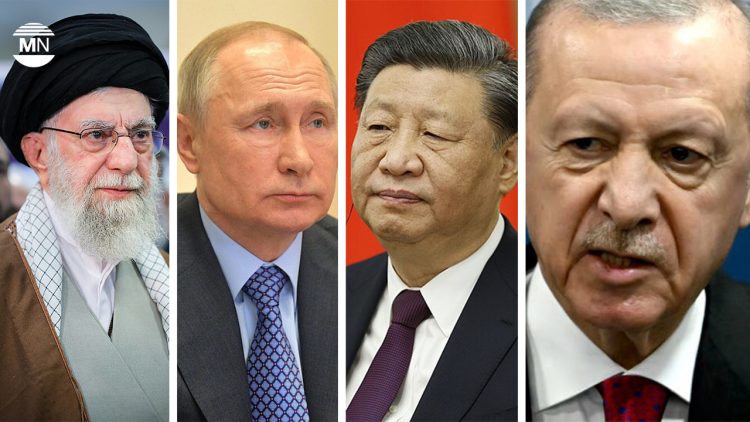
Iran’s Supreme Leader, Ayatollah Ali Khamenei, has rejected Washington’s ultimatum. In his first public statement since the Israeli strikes began, Khamenei said that neither peace nor war could be imposed on the Islamic Republic. “The Iranian nation will not surrender,” he stated, warning that any US military intervention would bring “irreparable damage”.
In an interview with Al Jazeera on Wednesday, Foreign Ministry spokesman Esmaeil Baghaei warned that ‘any American intervention would be a recipe for all-out war in the region’. He said that the conflict between Iran and Israel risked triggering a wider escalation, and stressed that Tehran maintains strong relations with Arab countries. Baghaei accused Israel of trying to draw others into the war, adding: ‘We are sure that the Arab countries hosting US bases would not allow their territory to be used against their Muslim neighbours.’
Russia has also voiced serious concerns. Deputy Foreign Minister Sergei Ryabkov cautioned against US military assistance to Israel, saying it would “radically destabilise” the Middle East. Sergei Naryshkin, head of Russia’s SVR intelligence service, described the situation as “critical”. Russia has labelled Israel’s initial strikes as unprovoked and illegal. President Vladimir Putin has urged an immediate cessation of hostilities.
During a visit to Kazakhstan’s capital Astana, Chinese President Xi Jinping also called for the de-escalation of hostilities. Expressing deep concern over Israel’s military actions, Xi reiterated China’s commitment to sovereignty and territorial integrity, stating that Beijing is willing to play a constructive role in restoring regional peace. China has also advised its citizens to leave Iran.
Turkey has also taken a strong position. Speaking at a parliamentary group meeting on Wednesday, President Recep Tayyip Erdoğan described Israel’s strikes as “state terrorism”, adding that Turkey’s institutions were “on alert against all possibilities”. He called Iran’s right to self-defence “entirely natural, legitimate and legal”, while reaffirming Turkey’s commitment to diplomacy to prevent further escalation.
On 17 June, the Turkish Grand National Assembly unanimously passed a motion condemning Israel’s actions in Gaza as ‘genocide’ and strongly criticising its recent strikes on Iran as ‘provocative and threatening’. The resolution warned that these operations risked dragging the region into a large-scale war, and called on all international institutions to uphold international law and take decisive action.
Despite Ankara’s vocal condemnation of Israel, Turkey continues to host a NATO early-warning radar station in Kürecik that is operated by US personnel. Although Turkish officials claim that no intelligence is shared with Israel, military analysts point out that the radar collects missile trajectory data which enters NATO and US command structures and could therefore indirectly support Israeli operations.
This dual stance highlights Ankara’s strategic ambiguity: publicly opposing Israeli aggression while enabling US military infrastructure that could assist Israel’s defence systems. It raises questions about the extent to which Turkey’s security infrastructure aligns with its diplomatic position and reflects the complex realities of its alliance commitments.
As the death toll rises and nuclear facilities remain under threat, the conflict between Israel and Iran is prompting broader regional and international concerns. Iran continues to reject external pressure, presenting its stance as a defence of national sovereignty. Meanwhile, global and regional powers, including Russia, China and Turkey, have condemned Israel’s actions, urging restraint and warning against the destabilising effects of foreign intervention.
While the international community is increasingly calling for diplomatic solutions to avoid a wider war, the path to de-escalation remains uncertain amid ongoing military operations and hardening rhetoric.