

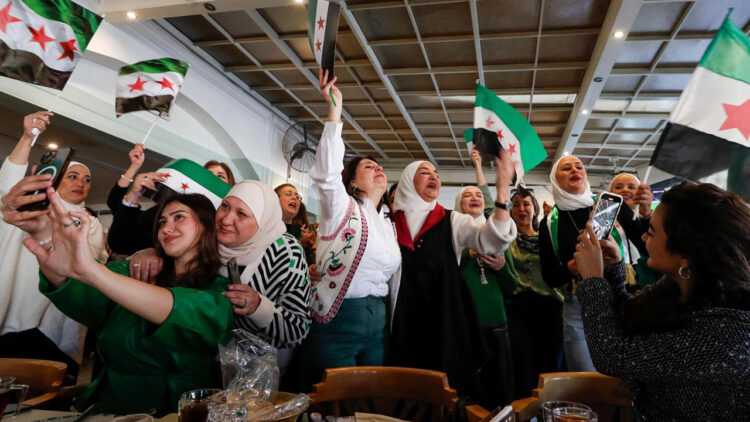
Its 11 days since the fall of Bashar al-Assad’s regime to Hay’at Tahrir al-Sham (HTS) forces. Despite HTS’s reassurances, the group’s attempts to rebrand itself as moderate continues to ignite fear and disbelief among many Syrians, who worry that the new administration will drift toward religious rule, marginalising minority communities and excluding women from public life.
In response to remarks made by Obaida Arnaout, the spokesman of the radical Islamic group HTS, that “female representation in ministries or parliament…is premature” because of “biological” and other considerations, hundreds of women gathered in Umayyad Square on 19 December.
According to published footage and reports, Syrians took to the streets en masse to demand a civic and secular state, directly challenging HTS’s rhetoric on constitutional changes. As reported by Hawar News Agency, demonstrators held placards reading, “Free Civil Syria,” “Towards a State of Law and Citizenship,” and “No Free Homeland without Free Women.” They chanted, “We want democracy, not theocracy.”
Explaining women’s ongoing struggle against the Assad regime, one of the demonstrators stated: “Syrian women have been constant partners on the streets, in protecting protesters, in tending to the wounded, and in prisons and detention centres. The people who took to the streets against the murderous regime are ready to come out again and to rule.”
At the demonstrations, researcher Widad Kreidi added:
“While men were fighting, women were keeping up the economy, feeding their children, and taking care of their families. Nobody has the right to come to Damascus and attack women in any way.”
Rooted in Syria’s branch of Al-Qaeda and proscribed as a ‘terrorist’ organisation by several Western governments, HTS has sought to moderate its rhetoric, promising protection for the country’s many religious and ethnic minorities. However, while HTS attempts to project a public image of inclusivity, there remain no guarantees from its new leadership that women, minority ethnic groups, and minoritised religious communities will enjoy equal participation in Syria’s reconstruction.
Although HTS has made efforts to distance itself from its extremist origins, the true test of its commitment to reform lies in its treatment of women. The group’s draconian policies in Idlib, which include strict restrictions on women’s dress, mobility, and public roles, offer a sobering glimpse into its long-term ambitions for Syria. These measures raise serious concerns about the future of women’s rights in the country.
The 14-year conflict in Syria has inflicted profound and enduring consequences on women, and social activists are voicing growing concerns about their future under the new Islamic group’s leadership. In light of previous experiences with the Islamic Republic of Iran and Turkey under Erdoğan’s rule, the rise of HTS demands a concerted international response. The international community must prioritise support for local civil society and advocate strongly for women’s rights to safeguard Syria’s prospects of developing a truly pluralistic society.


