

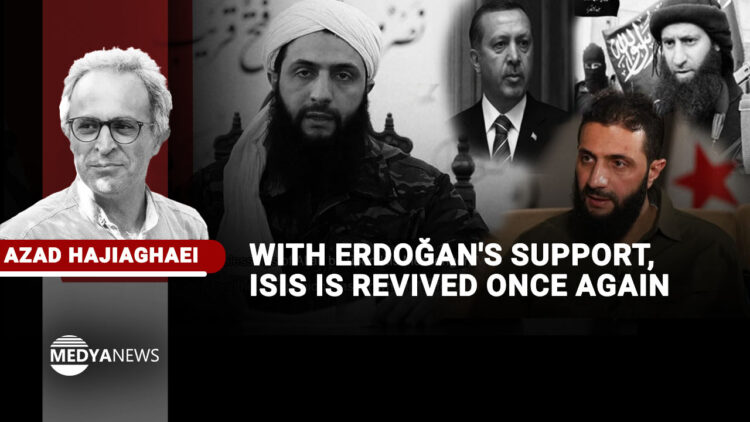
Azad Hajiaghaei
Since 27 November, when Hay’at Tahrir al-Sham (HTS) and the Syrian National Army (SNA) launched their offensive, vast areas across northern and northeastern Syria (Rojava) have come under heavy ground assaults by radical Islamist militants, alongside coordinated air and artillery strikes from the Turkish military. These operations have already claimed 31 civilian lives. Meanwhile, Mohammad al-Julani, the HTS commander, has appointed Mohammad al-Bashir as the transitional prime minister in Damascus. How can one analyse the progression of these events, and Turkey’s role in the potential destabilisation of the region?
To understand recent developments, it is crucial to contextualise the developments within the historical roots of Islamism in Turkey and the US strategic ‘green belt’ policy of the 1960s, aimed at countering leftist and Kurdish movements across the Middle East.
In ‘The Mobilisation of Political Islam in Turkey’, Banu Eligor cites Graham Fuller, who asserts that during the 1960s, the US fostered the rise of a seemingly moderate political Islam to suppress leftist and Kurdish-led movements. M. Hakan Yavuz, in ‘Islamic Political identity in Turkey’, further highlights how this strategy persisted throughout the Cold War, intertwining Turkish nationalism with Islam as a tool for geopolitical leverage.
Today, under Erdoğan’s leadership, the AKP’s Islamist government underscores the enduring relevance of this trajectory. Erdoğan’s policies reflect a renewed focus on empowering Islamist groups, including ISIS in its reconfigured form, which further complicates Turkey’s role in regional de-stability. The continuity between historical strategies and present realities underscores the need for a nuanced analysis of how ideological fusions and past alliances continue to shape political dynamics in Turkey and the broader Middle East. To fully grasp Erdoğan’s policies, it is imperative to consider the ideological underpinnings of Islamic-Turkish nationalism synthesis, a concept shaped in the 1960s by thinkers such as Ibrahim Qafes Oglu and the Turk Ocaglari.
Let me briefly reflect on recent years. Following 9/11, Yasin al-Qadi, designated internationally as a terrorist, faced a global travel ban, including in Turkey. Yet Turkish media exposed al-Qadi’s repeated visits in 2012, facilitated personally by Erdoğan. Cumhuriyet reported that al-Qadi entered Turkey 12 times—seven with Erdoğan’s direct assistance—despite being blacklisted. Notably, his arrival at Istanbul’s airport coincided with the deliberate shutdown of all CCTV cameras. Deflecting concerns, Erdoğan described al-Qadi as a “Saudi investor” and publicly stated: “I trust Mr. al-Qadi as much as I trust myself”.
Further scrutiny revealed meetings between Erdoğan, the MIT chief Hakan Fidan, and Osama Qutb, the son of Mohammed Qutb and nephew of Muslim Brotherhood ideologue Sayyid Qutb. Such incidents underscore the entrenchment of Islamist networks within Erdoğan’s geopolitical vision—a vision that intertwines historical Ottoman revivalism with the strategic empowerment of Islamist figures under the aegis of the AKP.
Building on these connections, Turkey seized the opportunity provided by the ‘Arab Spring’ uprisings to advance its interests, particularly in confronting the Kurds, by leveraging Islamist groups.
Turkey increased support for Islamist groups, after Syrian President Bashar Assad launched a chemical weapons attack on Ghouta, on the outskirts of Damascus, in September 2013. In 2014, ISIS quickly became a destabilising force across the Middle East, seizing vast territories in Iraq and Syria. Its rapid rise as a functioning state can be largely attributed to its relationship with Turkey under President Erdoğan. Despite the group’s brutality, Turkey turned a blind eye to its activities and, in many cases, actively facilitated its growth.
Simultaneously, Russian Foreign Minister Sergei Lavrov, during a joint press conference with his German counterpart, Frank-Walter Steinmeier, revealed that he had observed illicit trafficking across the Turkish-Syrian border from both sides. He also noted that members of the American coalition had expressed concerns regarding this suspicious activity.
Erdoğan’s government allowed ISIS to exploit Turkey’s borders, enabling thousands of foreign fighters to cross into Syria while ignoring recruitment networks operating on Turkish soil. Financially, Turkey became a key hub for ISIS oil sales, with evidence suggesting Turkish tankers smuggled crude oil from ISIS-controlled fields, enriching the terror group. Reports even implicated Erdoğan’s family in these transactions.
Moreover, ISIS fighters launched attacks on opponents from Turkish territory, with Ankara’s implicit consent. This ‘neighbourly’ relationship highlighted Turkey’s reluctance to counter ISIS, reflecting Erdoğan’s ideological alignment with Islamist groups like the Muslim Brotherhood. On the other hand, Turkey’s increasingly anti-Western foreign policy and its eroding reliability as a NATO ally have significant consequences for regional stability, exposing Erdoğan’s ambition to prioritise Islamist networks over global security.
In March 2019, the SDF defeated ISIS in its final stronghold in Baghouz, Syria, and learned from captured fighters that Abu Bakr Al-Baghdadi, the ISIS leader, had moved to Idlib. He was found in Barisha, near the Turkish border, in an area controlled by Turkish-backed forces. Despite Turkey’s military presence in the region, it played no role in the killing of Baghdadi. The SDF, with US forces, was crucial in tracking ISIS leaders, including Baghdadi, in areas under Turkish control. Commander Mazloum Kobani confirmed that Turkish aggression delayed operations. The SDF’s invaluable intelligence contrasted with Turkey’s reluctance, proving that the SDF, not Turkey, was America’s true ally in Syria.
Turkey’s developmental policies in the Middle East, in this regard, have played a pivotal role in the rise of controversial groups like HTS and the Syrian National Army (SNA). Confirmed reports indicate that figures such as al-Baghdadi were instrumental in HTS’s formation. Meanwhile, the SNA, often seen as a proxy force advancing Turkish rather than Syrian interests, has been involved in numerous operations aimed at curbing Kurdish autonomy and furthering Ankara’s regional goals. Their participation in cross-border operations in Azerbaijan and Libya has drawn significant criticism, with many Syrians viewing them as mere instruments of Turkey’s geopolitical agenda, rather than a legitimate opposition force.
Given Turkey’s historical alignment with Islamist groups, Turkish media outlets such as HaberTürk, CNN Türk, and A Haber portray members of the SNA or, in some cases even former ISIS mercenaries, in Manbij (Minbîc) in a favourable light. This portrayal aligns with the appointment of Mohammed al-Bashir as Syria’s transitional prime minister and reflects a broader narrative that underscores Turkey’s strategic interests in bolstering Islamist groups in the region.
These events, when considered through the prism of the intertwining of Islam and nationalism in the Middle East, offers the most accurate reflection of the current political landscape.
Moderate Islam, as personified by the Justice and Development Party (AKP), remains fixated on the ‘National Pact’ (Misaki Milli), or the revival of the Ottoman Caliphate, alongside the authoritarianism inherent in Turkish nationalism. It appears that the Western world persists in turning a blind eye to this approach and engages in negotiations with radical Islamist factions spearheaded by Turkey. The West has either greatly underestimated the Kurdish peoples’ potential in fostering a secular and democratic Middle East, or is, more alarmingly, complicit in perpetuating the vicious cycle of tensions that continue to plague the region.
Azad Hajiaghaei obtained his Ph.D. in Political Philosophy from Tehran University in 2018. Since 2021, he has been a postdoctoral researcher at Jagiellonian University in Kraków, Poland.


