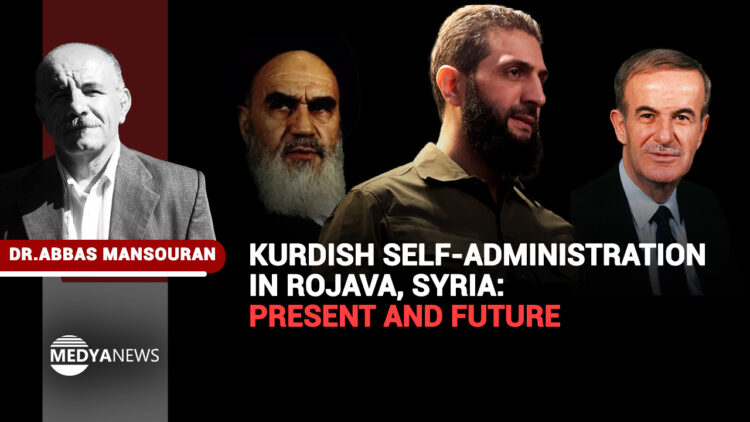
Abbas Mansouran
Today’s Syria marks a continuation of the dark chapter that began with the regime change in Iran in 1979. A new era of oppression has dawned upon Syria.
A dark chapter in Syria’s history continues
With the mobilisation of various extremist groups—including Turkish-backed militias, ISIS, and al-Qaeda—as well as the backing of certain regional powers, Syria has fallen into the hands of yet another tyrannical regime. Here, it is not a regime change but rather an invasion that defines Syria’s plight.
The Assad oligarchy, in collusion with Iran’s Islamic regime and Russia, has imposed a brutal dictatorship on the Syrian people. The regime’s crackdown on dissent, use of chemical weapons, and indiscriminate violence have left the population trapped in an unrelenting cycle of misery.
Dual tyranny and Turkish occupation
Now, with the tyranny of the Assad oligarchs extending into Turkish-backed domination, a new wave of oppression has emerged. Turkish militias, financially and politically supported by Qatar, have pillaged the autonomous regions—stealing livestock, wheat, and bread from already impoverished villages. This occupation creates a fleeting, false hope for those who have forgotten their historical memory, corrupted by decades of tyranny under Hafez and Bashar al-Assad.
In Rojava, however, a model of historical awareness and self-management has emerged, representing resistance against both foreign and domestic oppressors. Yet this resistance remains alienated and invisible amidst Syria’s chaos, war, and relentless propaganda.
Are Syrians, much like Iran in 1978 or Afghanistan, surrendering to compromises dictated by global capitalist forces? This question echoes in the occupied streets of Damascus, where extremist ideology now dominates the pulpits—symbolically taking Syria back to the days of the Umayyad and Abbasid caliphates.
Betrayal of Syria: Astana Process
The current situation in Syria is a direct result of the Astana Process, held in December 2016 between Russia, Turkey, and Iran. This gathering effectively handed Syria over to foreign powers, paving the way for a devastating proxy war.
Under the guise of combating terrorism, Turkey exploited the situation to expand its territorial ambitions, occupying large swathes of northern Syria. This occupation displaced millions of Syrians and deepened sectarian divisions.
Meanwhile, extremist groups like ISIS and al-Qaeda, backed by various foreign actors, committed heinous crimes: mass killings, ethnic cleansing, and the destruction of cultural heritage. Syrians, who once aspired for democracy, now live in a state of shock and occupation.
Historical symbolism of the Umayyad Mosque
The Umayyad Mosque—where Muawiyah, a governor of Syria 1,400 years ago, once competed with Ali, the fourth caliph—has once again become a pulpit of extremist ideology. Turkish-backed forces and al-Qaeda affiliates have re-established dominance in Damascus. In another historical twist, Abu Muhammad al-Julani, a former aide to ISIS leader Abu Bakr al-Baghdadi, now appears as a key actor under Turkish patronage.
Doha Meeting: echoes of Guadeloupe
The Doha meeting of November 2024 echoed the infamous Guadeloupe Conference of 1978, where global powers shaped Iran’s fate. Similarly, the Astana Process and subsequent regional negotiations have reinforced Assad’s rule while enabling Turkey to pursue its neo-Ottoman ambitions in Syria.
The Syrian people now face new monsters—domestic and foreign—brought in by proxy forces. Turkey’s ambitions are further underlined by its resurrection of Ottoman symbolism, such as the reburial of Suleiman Shah’s remains.
Reshaping the Middle East
The Middle East’s geopolitical landscape has been fundamentally altered. The dismantling of Iran’s Shiite Crescent came at a colossal cost: over thirty billion dollars, hundreds of thousands of lives lost, and millions displaced. Chemical weapons, including chlorine and sarin gas, were deployed by Russian and Iranian forces, leaving Syria shattered.
Turkey’s political Islam, backed by Qatari funding, now asserts dominance in northern Syria. Much like Iran’s Khomeinism reshaped the region decades ago, Turkey’s ideological ambitions threaten to impose another violent transformation.
Idlib: a Turkish-backed stronghold
The Turkish-occupied emirate in Idlib, established in 2017, was initially intended as a buffer zone but has since become a hub for jihadist forces. Turkish-backed factions offer higher wages and governance to attract local support, further solidifying their influence.
Abu Muhammad al-Julani’s rise reflects a broader Turkish strategy, consolidating extremist ideologies into organised political entities like the Syrian Liberation Army (Tahrir al-Sham or HTS). This convergence of jihadism and Turkish-backed political Islam underscores Turkey’s neo-Ottoman agenda.
Brutal Turkish expansionist policy
Statements by Turkey’s Foreign Minister, Hakan Fidan, reveal the government’s aggressive policy towards the Kurdish self-administration in Rojava. Turkey’s demands for the disarmament of Kurdish forces and the removal of Syrian Kurdish leaders aim to dismantle Kurdish autonomy—a society defending more than four million people.
This policy echoes a fascist mentality rooted in domination and repression. For Turkey, eradicating Kurdish self-management remains a strategic goal in both Syria and its own border regions.
Revolutionary struggle for Syria’s future
In this climate of foreign occupation, proxy warfare, and extremist resurgence, the fight for Kurdish-led self-management remains critical. The Kurdish people, alongside their internationalist supporters, represent the last hope for a pluralistic, democratic Syria.
While ISIS prioritises the destruction of Kurdish autonomy, millions of Kurds and their global allies remain steadfast in their resistance. This revolutionary struggle for life, freedom, and self-administration stands as the only viable alternative to the violence imposed by extremist and occupying forces.
Dr. Abbas Mansouran is an Iranian-born epidemiologist based in Sweden. He has expertise in burn injuries, having worked extensively in this field during the Iraq War in the 1980s. Mansouran has also conducted independent research in North and East Syria, investigating medical facilities and providing treatment to the wounded, amid allegations of chemical weapons use by Turkey.