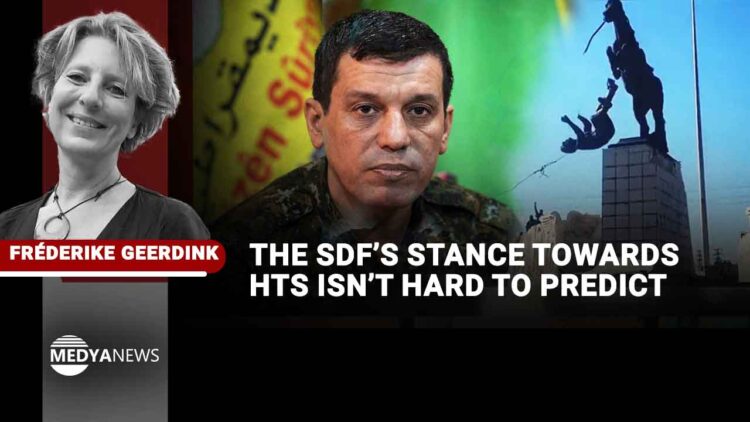
Fréderike Geerdink
The dictator has fallen! Incredible scenes of prisoners being released, statues being toppled, people happy in the streets. In the Autonomous region [of North and East Syria] too, people are happy, though more wary of the future. Parts of their cities, their villages are still under brutal Turkish occupation. But also: What will Hay’at Tahrir al-Sham (HTS) bring? And how will the Syrian Democratic Forces (SDF) navigate the situation?
Much is unclear, but not the principles of the SDF and the Autonomous Administration of North and East Syria (AANES), so that helps us a lot in making an educated guess. They have had very clear goals and core tasks from the very beginning of the Autonomous Administration in 2012, at the time defended by the People’s Protection Units (YPG) and the Women’s Protection Units (YPJ), which now form the backbone of the SDF. In short, they are implementing and defending their project of grassroots democracy.
Everything the YPG and YPJ, and later the SDF has been doing, can be understood through that lens. Everything they will do, will fit those objectives as well. You can clearly see that, when you follow the press statements of the SDF leadership. The reaction of SDF general commander Mazlum Abdi to the fall of the Assad regime, is spot on: “In Syria, we are living through historic moments as we witness the fall of the authoritarian regime in Damascus. This change presents an opportunity to build a new Syria based on democracy and justice, that guarantees the rights of all Syrians.”
They are of course willing to talk to HTS to try to push its leader Jolani to keep his promise of respect for Syria’s ethnic and religious diversity. Kurds are, of course, very cautious, as they have had their share of assorted gangs suppressing them. And don’t forget: The regime areas are Assad-free now, SDF areas have been free for many years, but there are lands under Turkish occupation and the occupation is, like any occupation, brutal. How will HTS deal with the Turkish-backed SNA? How will it deal with the occupation?
Vacuum
The regime still had some presence in SDF areas, more specifically in Deir ez-Zor (Dêrazor), Hasakah (Hesekê) and Qamishli (Qamişlo). They have all surrendered to the SDF. Great scenes in Qamishli, where the important airport is now in SDF hands. In a message on X after capturing Deir ez-Zor, the SDF’s Mazlum Abdi said: “We declare a general amnesty, without exception, in those areas. We count on the role of the people and the tribes to prevent chaos and to protect the region. Our forces are your support.”
Violence has commenced in Manbij, a predominantly Arab region under SDF control since 2016 when they kicked ISIS out. Turkey wants ISIS back in, you could say: The ‘Syrian National Army’ (SNA) may have a different name, but their radicalism and brutality, and being Turkey’s darling, tells you all you need to know. The SNA has launched an offensive against Manbij, and reportedly, the fighting is intensifying.
The SDF was unable to hold on to Shahba (Şehba) in the northwest because the small area was isolated and not directly connected to other SDF territories, and has troops too limited to withstand the SNA. Manbij is another story though: there are plenty of troops, and Manbij is not a pocket but part of the core territory of the SDF. The SDF will do what it can to make sure the SNA doesn’t lay its dirty fingers on the people under their protection.
Aleppo
How different is HTS from the SNA, and why are the SDF and the Autonomous Administration willing to talk to HTS, but not to the SNA? Well, they’d talk to Turkey (read: the SNA) too if Turkey were interested, and Mazlum Abdi has explicitly said he is open to talks, but Turkey never is. Is HTS different? HTS may have distanced itself from jihadists, but actions speak louder than words. In that sense, their willingness to engage with the SDF or not will be telling. That the SDF is still in charge in the Kurdish neighbourhoods of Aleppo could be a good sign, but then again, maybe it isn’t. Maybe HTS was just focusing on Damascus and trying to get goodwill abroad by not instantly getting into fights with others than the regime’s army.
What will possible talks with HTS focus on? On the most fundamental issue of the SDF: democratisation. It was the same with the regime, and it is always the core of any talks the SDF holds. Assad was, surprise, surprise, never interested, so the SDF merely kept the lines of conversation open. Whether they can afford to be as persistent in negotiations with HTS as they were in those with the regime, is uncertain. Assad’s army, as we see clearly now, is weak and fully demoralised, while HTS seems well organised and very dedicated, so the risks are higher.
What is also an unknown, is to what extent Turkey will keep supporting HTS, and how much rivalry there will turn out to be between the SNA and HTS. And will HTS want Turkey to end the occupation of Syrian lands?
The list of questions and unknowns in this chaos may be endless, the SDF is a factor we do know, through both actions and words. May they stand strong.
Fréderike Geerdink is an independent journalist. Follow her on Bluesky (or X) or subscribe to her acclaimed weekly newsletter Expert Kurdistan.