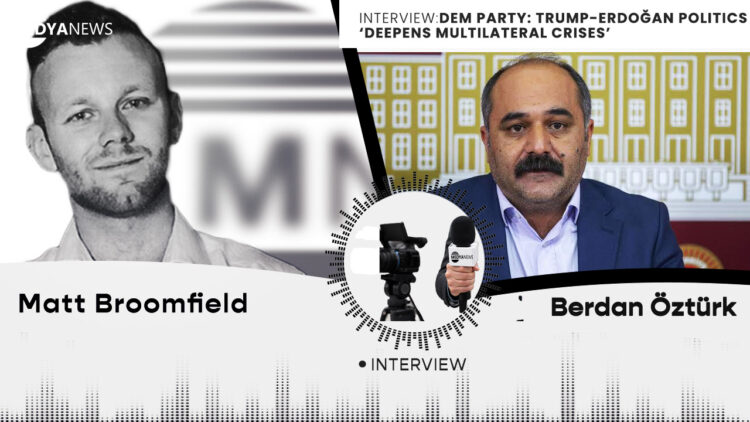
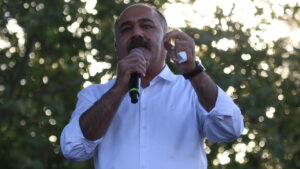
Berdan Öztürk is a foreign affairs spokesperson for Turkey’s pro-Kurdish Peoples’ Equality and Democracy (DEM) Party. Speaking to Medya News, he reflects on the potential political, diplomatic and economic impact on Kurdistan, the Kurdish political movement and the wider region should Donald Trump be re-elected as US President in this November’s crucial elections.
Donald Trump’s presidency would likely result in increased US support for and reliance on Erdoğan’s Turkey. What would be the impact of this?
As we can see from Trump’s prior Presidency then especially in the field of foreign policy, Trump relies on personal rather than institutional diplomacy. This would benefit Erdoğan, because he uses the same methods. For example, the negotiations over [US citizen controversially jailed in Turkey] Pastor Brunson was not between the USA and Turkey, but between Trump and Erdoğan. And one can say the same for Turkey’s military operation against Serê Kaniyê (Ras al-Ayn) and Girê Spî (Tel Abyad) in North and East Syria.
Decisions made by Trump and Erdoğan on the basis of their personal and political interests resulted in broader negative economic, political and cultural impacts, deepening multilateral crises. If proposed support for Erdoğan is implemented, it’s possible that many of Erdoğan’s violations of fundamental human rights will be accepted by the USA.
A pro-Trump electoral manifesto argues for further reliance on Turkey as a NATO partner. What role does Turkey play in NATO?
Albeit there are ongoing conflicts, Turkey remains an important NATO partner. Despite all of Erdoğan’s threats and his close relationships with Russia, Turkey plays an important role as a NATO outpost. This collaboration and role will continue, alongside these conflicts, since the Russia-Ukraine war will also continue. In this conflict, Turkey styles itself as a harbinger of peace; but when we look at Turkey’s policies in Rojava (Syrian Kurdistan), the Kurdistan Region of Iraq and the internal pressure and oppression in Turkey, it’s clear this is far from the truth. Turkey uses ‘peace’ as a tool to achieve its political goals. As a NATO member, it neither supports Russia nor abandons NATO. On the one hand, it buys S-400 missile systems from Russia; on the other, it sells weapons to Ukraine.
Of course, this approach is also evident in the policies of Erdoğan’s AKP [Justice and Development Party] toward the Kurdish people. When they attacked [Syrian Kurdish region] Afrin, this was done with Russia’s permission; in Serê Kaniyê and Girê Spî, this was done with permission from the USA.
What were the experiences of the Kurdish people and political movement during the prior Trump presidency?
In the USA, especially when it comes to foreign policy, the determining factor has never been the President alone. The head of state acts on the advice of the Pentagon and the [State Department]. But at the time you mentioned, of course, Donald Trump sometimes ignored these institutions that which operate in the field and [otherwise] determine foreign policy. The Kurdish people suffered the most from this.
In particular, while the Pentagon stated that the fight against ISIS in Syria alongside the Kurds should continue, Trump withdrew from the region at Erdoğan’s request. Despite the fact that this withdrawal was blocked to some extent by the [aforementioned US] institutions, the AKP took control of Serê Kaniyê and Tel Abyad, and caused the flight of hundreds of thousands of refugees.
Voices around Trump have also called for an end to support for the YPG/YPJ, and a tougher policy against the Kurdish movement as a whole. What would be the consequences of this policy?
In this age when ISIS and similar organisations still continue their existence in Iraq and Syria, it’s not only the people of Iraq and Syria, but the people of the Middle East, even the people of the entire world who are in great danger. European countries have suffered at lot at the hands of ISIS, and similar organisations, who killed hundreds of people in the centre of Europe.
Standing up against this brutality, the Kurdish people in Rojava defended common human values, showing that a free and equal life is possible. Political forces that are afraid of this paradigm, which holds out the hope of a solution, want to determine the future through military means. They are trying to weaken this hope with the help of mercenary forces, corrupt alliances, and continuous attacks.
But until stability is achieved in Syria, the current conflicts and tensions in the region will increase. In particular, the AKP government’s aggressive policy against the Kurds, and their collaboration with mercenary forces documented as having committed crimes against humanity, will worsen the situation in Syria, and open the door to wars which will continue for decades.