

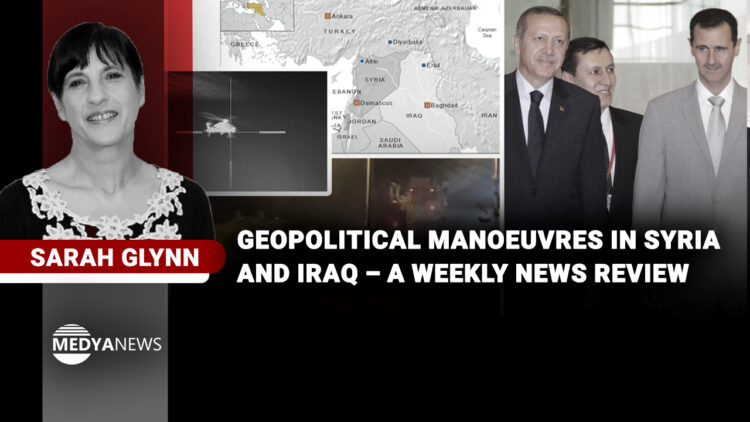
Sarah Glynn
With a Trump Presidency increasingly likely, attention is turning to Project 2025, the 900-page policy document drawn up under the auspices of the Heritage Foundation to guide the next Republican presidency. The Heritage Foundation is a right-wing think tank that claims the credit for Ronald Reagan’s brutal introduction of neoliberalism and for the direction of Trump’s last term. Project 2025 is a manual for taking over America on behalf of white, Christian, misogynist, climate-change denying, market fundamentalists. “Taking over” is very much the appropriate term to use, as the Project envisages revolutionary changes in government departments and the replacement of career civil servants and experts with government appointees from a new database of right-thinking Americans. This is not specifically a Trump project – in fact he claims to have nothing to do with it – but the writers worked for the last Trump administration.
The United States has been interfering aggressively in world politics for eight decades, ensuring that any alternative to capitalism is stifled at birth. But even within this context, Project 2025 is the stuff of nightmares. These nightmares would affect all of us. For the moment, though, I only want to look at what it says about Kurdistan.
There is just one mention, but this is bad news for the Autonomous Administration of North and East Syria, where the United States has worked alongside the Kurds and others in the Syrian Democratic forces (SDF) in the fight against ISIS. Under “Middle East and North Africa” we find these curt and alarming two sentences: “A further key priority is keeping Türkiye in the Western fold and a NATO ally. This includes a vigorous outreach to Türkiye to dissuade it from “hedging” toward Russia or China, which is likely to require a rethinking of U.S. support for YPG/PKK [People’s Protection Units/Kurdistan Workers’ Party] Kurdish forces, which Ankara believes are an existential threat to its security.”
This statement will hardly come as a surprise – to the Kurds or to Turkey. The United States has stood by while Turkey has destroyed North and East Syria’s infrastructure and picked off leading figures in the administration, and Trump infamously asked his advisors why he would “give a fuck” about the Kurds. However, it is still unsettling to see this approach set out in black and white. It ignores the distinction that the United States has so far been careful to make between the Syrian-based YPG (now part of the SDF) and the PKK, copying Turkey’s equating of the two organisations; and it seems unconcerned whether or not they are in fact an existential threat to Turkey. In making American readiness to abandon the Kurds so clear, the Project’s writers weaken the hand of the Autonomous Administration in any negotiations with President Assad over the region’s future.
In practice the American calculation may not be so simple. Trump himself said that he was keeping some troops in Syria because of the oil, but, for the United States, what is even more important than the oil is the foothold that Syria gives them in any future contest with Iran (a contest that would only be more bad news for the people of Syria).
Will Erdoğan meet Assad?
The future of North and East Syria continues to be the subject of much speculation as President Erdoğan pushes for a meeting with President Assad. Turkey’s first intervention in Syria’s civil war was in support of Islamist opposition groups, but when America stopped supporting these groups, and Russian troops came to defend Assad and allow him to regain control of much of the country, Turkey found a new strategy. Erdoğan’s main concerns have been to increase Turkish control over northern Syria and to end any flicker of Kurdish autonomy. He talks of a controlled band of territory (euphemistically called a “safe zone”) across the north of both Syria and Iraq.
Erdoğan stopped calling for Assad’s downfall and instead demanded a role for the Islamist groups in the construction of a new Syrian constitution. And he turned the groups’ militias – now effectively Turkish mercenaries – against the Kurdish-founded Autonomous Administration.
With the aid of these mercenaries, Turkey invaded and occupied Afrîn in the west and the central part of the proposed band of control, from Serêkaniyê to Girê Spî. They brought the occupied areas under the overall control of the Turkish state, with Turkish currency and Turkish education; and they handed over the areas’ day to day running to the brutal warlords who ran their mercenary militias. When America and Russia, who both have troops on the ground, refused to greenlight a further invasion, Turkey began a war of attrition against the Autonomous Administration, with constant low-level attacks, targeted killings, and destruction of vital infrastructure.
But the war is taking a toll on Turkey’s troubled economy, and the political exploitation of anti-refugee sentiment is putting pressure on Erdoğan to send the over three million Syrians who have taken refuge in the country back to Syria. He is now seeking a route to achieve his aims through an agreement with Assad, in which he hopes to persuade the Syrian president to combine forces with Turkey against the Autonomous Administration. Russia has long been trying to bring about a reconciliation between the two countries, but the statements put out after the various meetings between ministers from Syria, Turkey, Iran and Russia have always fudged over vital disagreements, with unspecified references to “terrorists” and empty calls for sovereignty.
Although Erdoğan is approaching reconciliation with Syria with a new urgency, and his statements have kept the issue at the top of the news agenda, he has shown no indication of conceding to Assad’s precondition of a firm written commitment to end the Turkish occupation, and Assad has shown no indication of conceding any power to those who have fought against him. The Syrian government remains firm that any normal relations must involve a return to the situation that existed before 2011. Assad reiterated on Monday that “The problem is not the meeting, but its content”, and that the basis of any meeting with Erdoğan must be ending Turkey’s support for terrorism – meaning the Islamist opposition militias – and the withdrawal of Turkish forces from Syrian territory.
Assads determination to maintain and strengthen his centralised control was clear in the parliamentary elections this week, in which all the candidates are said to have been pre-vetted, and all Assad’s Baath Party candidates won their seats.
Meanwhile, the opposition militias and the millions of people who have supported them do not want to see the return of control by Assad, and no one asks the Autonomous Administration for their views. The Administration has been clear that any plans for the future of Syria must be made by the people and peoples of Syria. Saleh Muslim, co-chair of the dominant Democratic Union Party (PYD), told journalist Amed Dicle, “Any move by Damascus in alliance with Turkey against us would harm Syria. But if such a situation occurs, we would naturally defend ourselves with our self-defence forces.” However, there is little to suggest that Assad would want a military conflict with the Kurds.
Erdoğan stated last Saturday that Turkey’s military operation in Iraq and Syria would soon be at an end, claiming, “We will complete the missing points of the security belt along our southern border with Syria,” and “We will very soon complete the lockdown of the area of operation in northern Iraq.” It is difficult to envisage an imminent conclusion to their aggressive claims over Syria. And in Iraq, although Turkey is expanding military control, the PKK resistance remains strong. On Tuesday the PKK reported that they had brought down another Turkish helicopter. Turkish military convoys are continuing to arrive.
Invading Iraq
On Monday, the Community Peacemaker Teams NGO (CPT) published their estimate of the civilian impacts after one month of Turkey’s current intensified military operation in the Kurdistan Region of Iraq. Turkey is carrying out an invasion and occupation on the pretext of attacking the PKK. The CPT explain that “The military operations have been conducted by both ground and aerial forces with the deployment of an estimated 1,250 Turkish soldiers, 300 tanks, and intensifying aerial bombardments.” And they report that “9 villages have been completely displaced. At least 184 families have been displaced. Approximately 68,000 dunams [68 sq km] of land have been burned. 1 church, 1 tahini factory, 1 car, 2 water projects, and 19 civilian houses have been damaged or destroyed… The electricity grids and towers of Bari Gare villages and Miska village have been targeted. [And] Turkish telecommunication equipment and towers have interrupted the networks in the areas of over 110 villages.” At that time, just one person had been injured, but on Thursday, Turkish bombs killed an off duty peşmerga while he was tending his bees, and left another person critically hurt.
Turkey has been able to take over so much land and build so many bases thanks to the active support of the Kurdistan Democratic Party (KDP), controlled by the Barzani family. The Barzanis treat the region as their fiefdom and believe that their personal fortunes will increase through becoming vassals of Turkey. The KDP has been losing support but has held onto power by delaying the long overdue regional elections. Together with their rivals in the Patriotic Union of Kurdistan (PUK), the KDP has been growing rich from oil smuggling that is estimated to bring in hundreds of millions of dollars a month. The region’s roads are solid with lines of tankers, but no income from this trade appears in public records.
The Brussels-based Kurdistan National Congress (KNK) has been visiting Erbil to try and bring together parties that oppose Turkey’s invasion. There has been public support from the wife of Iraq’s Prime Minister, who is PUK royalty, and from a group of Arab sheikhs, but the response from Iraq’s federal government has been fairly equivocal. Winthrop Rodgers observes that “Baghdad appears to be showing a new level of tolerance” to Turkish aggression. Iraq’s foreign minister, who is from the KDP, tried to downplay Turkey’s operation as “minor troop movements”. The KNK points out that the invasion has been ignored internationally and also hardly mentioned in the Turkish media. This allows Turkey to manage expectations, though it makes the operation less useful as a nationalist rallying point.
In both Syria and Iraq, there are well-justified fears that Turkey will not give up the land they have occupied. These fears are reinforced by the experience of Cyprus, where Turkey is celebrating the fiftieth anniversary of their invasion today.
Bartering human rights
Erdoğan’s turns over Syria’s Assad exemplify his transactional approach to politics. Of course he is far from alone in this, but in Erdoğan’s case the transactional approach is unashamedly blatant.
For Turkey, it seems that everything is regarded as negotiable, even human rights. Besê Hozat, co-chair of the Executive Council of the Kurdistan Communities Union (KCK), the umbrella organisation that includes the PKK, revealed on Medya Haber that “A reliable source close to Turkish President Tayyip Erdoğan has promised contact with [Abdullah] Öcalan if the Kurdish movement makes certain concessions in return. First, a conversation with Öcalan’s brother could be arranged, and later with his legal team.”
Throughout Öcalan’s 25-year imprisonment, visits from his family and lawyers have been difficult and restricted; and he has now been allowed no communication at all with the outside world for nearly 40 months. Kurds are massively concerned about the situation of the man who millions look up to as their leader, but Hozat and the Kurdish Movement have made very clear that they will not succumb to this bullying, and they reject outright this dirty deal.
Turkey’s human rights violations have been under scrutiny this week in Geneva at the current session of the United Nations Committee against Torture (UNCAT). Nearly 30 NGOs have submitted reports, and UN experts have been questioning Turkish officials based on their own reports and the reports by the NGOs. Critical questions have been asked about conditions in Turkish prisons and in the regions under Turkish occupation and also about Öcalan’s isolation. The Turkish delegation tried to present Öcalan’s situation as in line with the rules and nothing out of the ordinary. İbrahim Bilmez, one of Öcalan’s lawyers, noted that their every appeal against baseless disciplinary sanctions has been turned down, and observed, “As lawyers, we have not received a positive result from the Turkish judiciary in 25 years of our applications.”
The extent to which denial of human rights has become normalised in Turkey became clear when the head of the Turkish delegation and their chief legal advisor were both themselves accused of torture. The former was involved in kidnapping schoolteachers accused of membership of the Gülen Movement when she was ambassador to Kosovo. The latter is accused of torture operations against civilians in Urfa in 2015-21, enabling ISIS attacks, and war crimes in Syria.
This week we also heard worrying news of about a prisoner who has moved many hearts, including those of world-famous musicians. Nudem Durak, the young Kurdish singer who was punished for her music with a 19-year prison sentence in 2015 is suffering from Graves disease and osteoporosis. In normal conditions, Graves disease is usually relatively easy to control, but Turkish prisons are far from normal conditions. Durak’s mother has been appealing for more support for her daughter. “If it wasn’t for her illness, we would have been able to endure it,” she explains, “but with her severe illness, she cannot stay in prison for so many years.” As is Turkey’s practice, and despite international rules, Durak is imprisoned a long way away from her mother, who can thus only visit her once a year.
Iran’s prisons
From Iran, news of arrests and executions never stops – though the great majority of executions are not officially announced in the state media. Hengaw Organisation for Human Rights has recorded that at least 266 prisoners were executed in the first half of this year, with only 21 of these officially announced. 72 of those executed were recorded as Kurds and only 44 were recorded as Persian.
Conditions in Iran’s prisons are appalling – as exemplified by the case of Zeynab Jalalian, who is serving a life sentence. She has multiple severe health problems after 17 years behind bars, but has been denied medical treatment because she refuses to make a televised “confession”.
Iran has demanded the extradition of nearly 120 Kurds from Iraq under a security agreement that was signed in March 2023. It is not yet clear how Iraq will respond.
Also in Europe
For some, even Europe is not safe. Germany has taken it upon themselves to act as Turkey’s policeman. Kenan Ayaz, who was extradited to Germany from Cyprus, was in court this week. His closing statement began with the history of the Kurds and Kurdish oppression.
Next week, an Amsterdam court will decide on Germany’s request for the extradition of journalist Serdar Karakoç, who lives as a refugee in the Netherlands.
A Syrian amnesty
Meanwhile, back in Syria, the Autonomous Administration has agreed an amnesty law in response to the forum of Syrian Clans. For Syrians who have committed crimes under anti-terrorism legislation, sentences will be reduced, and the old and ill will be released. This excludes emirs, terrorist leaders, participants in bombings and hostilities against the SDF, and people whose crimes led to deaths. It is intended to encourage reintegration and coexistence – central ideas of the Rojava Revolution, which was twelve years old yesterday.
Sarah Glynn is a writer and activist – check her website and follow her on Twitter


