The United States on Saturday urged de-escalation in Syria, responding to the latest offensive of the jihadist group Hay’at Tahrir al-Sham (HTS) on Assad-held territories in the northwest of the country. The attacks, which have led to the collapse of some of the regime’s defensive lines, have raised concerns about humanitarian and regional security implications.
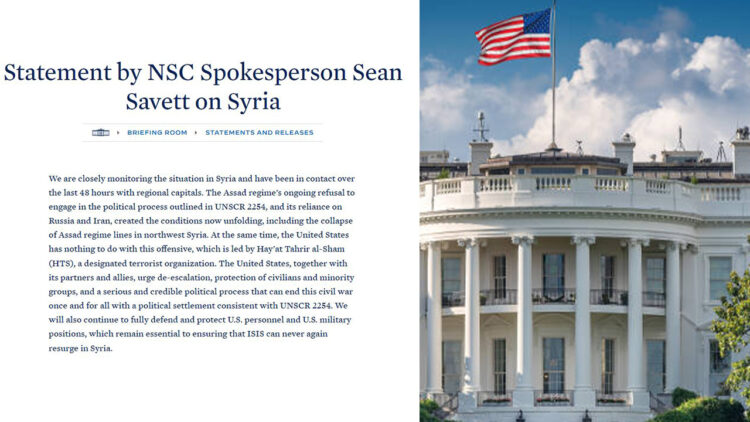
US National Security Council Spokesperson Sean Savett said, “The Assad regime’s ongoing refusal to engage in the political process outlined in UNSCR [UN Security Council Resolution] 2254, and its reliance on Russia and Iran, created the conditions now unfolding.” He added, “The United States has nothing to do with this offensive, which is led by Hay’at Tahrir al-Sham, a designated terrorist organisation.”
The HTS advances have further destabilised a region already mired in conflict, with fears of civilian casualties and displacement mounting. The US reiterated its commitment to safeguarding civilian populations and minority groups while calling for “a serious and credible political process that can end this civil war once and for all with a political settlement consistent with UNSCR 2254.”
Savett also affirmed the US’s ongoing military presence in Syria, stressing its importance in preventing an ISIS resurgence. “We will also continue to fully defend and protect US personnel and US military positions,” he said, reinforcing Washington’s priorities in the region.
Regional capitals are reportedly in close contact with US officials, with Washington stressing the need for calm and renewed focus on a UN-backed resolution to Syria’s decade-long war.
UNSCR 2254 was adopted unanimously on 18 December 2015 as a framework to resolve Syria’s protracted civil war through peaceful means. The resolution stresses the immediate need for a ceasefire and unrestricted humanitarian access to alleviate the suffering of civilians in conflict zones. It outlines a Syrian-led and Syrian-owned political process, facilitated by the United Nations, to establish a credible, inclusive and non-sectarian governance structure that represents all factions.