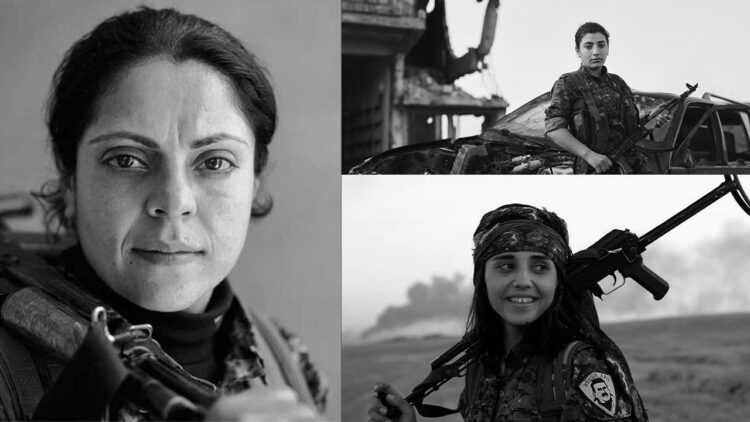
The Rojava revolution emerged in Kobani (Kobanê), Rojava (Kurdish northern Syria), on 19 July 2012, driven by an unwavering commitment to women’s liberation. The movement swiftly garnered global attention, particularly after its decisive victory against the Islamic State (ISIS) in 2014, said journalist Nûjiyan Adar, in the first part of her report to celebrate the revolution’s 12th anniversary, adding that its unique blend of democratic, environmental and feminist ideals has set a precedent for societal transformation, with women taking the lead in every sphere.
The revolution symbolises a broader struggle for freedom, justice and equality. Women were not just participants but architects of change, influencing areas ranging from economy and culture to self-defence and diplomacy, Adar said. “Their leadership and resilience has inspired communities worldwide, proving that the fight for women’s rights is intrinsically linked to the fight for a just society.”
She highlighted the revolution’s commitment to women’s freedom and noted that the organisation has drawn women globally into the movement, solidifying a network of solidarity and support.
In this first part of her report, Adar explains the various women’s institutions founded within the scope of the revolution.
Organisational milestones: from Yekîtiya Star to Kongra Star
“Abdullah Öcalan’s influence in Rojava sowed the seeds for women’s organisations, leading to the establishment of Yekîtiya Star (Star Union of Women) in 2005. This organisation evolved into Kongra Star (Star Congress) in 2016, extending its reach beyond Rojava to Lebanon, South [Iraqi] Kurdistan and Europe,” she noted.
Women’s Houses: centres for community solutions
Women’s Houses were established in every city and town in the region. These centres became critical hubs for addressing community issues throughout liberated North and East Syria. Initiated in Qamişlo (Qamishli) in 2011, the centres spread swiftly, fostering women’s participation in societal rebuilding efforts.
By 2012, 53 such centres had been established, providing a structured approach to tackling local problems and empowering women, she added.
Women’s military formation: YPJ
Women also played a pivotal role in military self-defence. Initially, women in defence in the region were part of the People’s Protection Units (YPG), but they later formed their own unique battalions, leading to the creation of the Women’s Protection Units (YPJ) in 2013. “The YPJ’s efforts were instrumental in combatting ISIS, rescuing Yazidi women, and promoting a women’s liberationist, democratic and environmental paradigm,” said Adar.
Syrian Women’s Council: advocates for peace and democracy
Founded in 2017, the Syrian Women’s Council works towards building a democratic and ecological society based on women’s freedom. With representatives from across Syria, the council strives for justice, equality and democratic conversation, aiming to include women in all peace negotiations and in constitutional dialogue.
North and East Syria Women’s Council: a diverse coalition
The North and East Syria Women’s Council was established in 2019 and unites 52 women’s movements from diverse ethnic backgrounds, playing a crucial role in political, military and cultural liberation and fostering a cohesive approach to women’s rights and societal transformation.
Zenobia Women’s Community: rebuilding in liberated areas
In 2021, the Zenobia Women’s Community was founded to support women in liberated areas like Manbij (Minbic), Raqqa (Reqa) and al-Tabqa (Tabqa), “Organising into committees, the community focuses on education, justice and cultural initiatives, aiming to integrate women’s perspectives into rebuilding efforts.”
Women’s Internal Security Forces: guardians of peace
Formed in 2013, the Women’s Internal Security Forces have been essential in maintaining peace and order in North and East Syria. Their work includes addressing violence against women and children, and raising awareness about these critical issues, ensuring a safer, more just society, Adar concluded.