

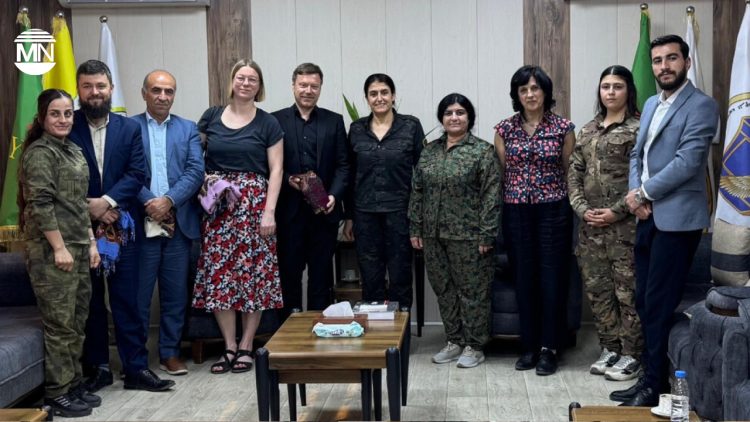
On the sixth day of their Kurdistan visit – the second in North and East Syria – Martin Schirdewan MEP and his delegation discussed a broad range of issues, from local services to geopolitics. In the morning, they met with representatives from the Organisation for North and East Syria Municipalities; in the afternoon, with Rohilat, leader of the Women’s Defence Forces (YPJ) and Mazloum Abdi, Commander-in-Chief of the Syrian Democratic Forces (SDF).
Schirdewan is co-chair of the Left Group in the European Parliament. He is accompanied by Rosa Luxemburg Centre Deputy Executive Director Philip Degenhardt; Equality and Democracy (DEM) Party representative to the European institutions in Strasbourg Fayik Yağızay; Schirdewan’s assistant Nora Friese-Wendenburg and Yağızay’s assistant Sarah Glynn.
Municipal officials gave an overview of the work carried out by local authorities and some of the challenges they face. They explained the enormous problems in meeting basic needs such as water and electricity as a result of Turkey’s restriction of river flows, its seizure and shutdown of the Alouk Pumping Station, a critical source of water in the region, its bombing of infrastructure, and its blocking of a UNICEF agreement to bring water from the Tigris. They also highlighted the growing threat of desertification.
The same overstretched municipalities also provide support for internally displaced people – recently from Shahba (Şehba) and Manbij (Minbîc), and earlier from Ras al-Ayn (Serêkaniyê) and Tell Abyad (Girê Spî), both occupied by Turkey in 2019. Most of the 2019 arrivals to Hasakah (Hesekê) are now in refugee camps, though five and a half years on, some are still living in the schools, rendering childrren’s education impossible. The municipal representatives noted that while there had been some international support for internally displaced persons (IDPs), this has significantly declined due to other global crises – in Gaza and Ukraine – and President Donald Trump’s closure of the US Agency for International Development (USAID).
The delegation sought to understand the YPJ’s perspective in this time of change and negotiation. YPJ leader Rohilat described the situation as “not bad, not good”, and that things could go either way. She explained that Damascus was procrastinating on reaching an agreement with the Autonomous Administration of North and East Syria (AANES), and excluding YPJ prisoners from the agreed prisoner exchange. However, she also emphasised the strength and determination of the YPJ and SDF, saying they were “well-prepared”, would defend their gains and change the nature of the Syrian army.
At their meeting with SDF Commander Mazloum Abdi, the delegation was told that while the new Syrian government wants the Autonomous Administration to be integrated, the AANES wants to work in partnership with Damascus. Abdi spoke of the need for Western countries to encourage the new government to honour the agreement, and for pressure to be brought to bear on Turkey to cooperate with the ceasefire. He also stressed the importance of foreign investment programmes including North and East Syria unlike the recent deal focused solely on investment in power stations, referring to the $7 billion memorandum of understanding signed in May 2025 between Syria and a consortium led by Qatar’s UCC Holding. This deal focuses on constructing four combined-cycle gas turbine power plants with a total capacity of 4,000 megawatts and a 1,000-megawatt solar power plant in southern Syria, aimed at addressing the country’s severe electricity shortages.
Abdi outlined his vision of an arrangement similar to that of the Kurdistan Region of Iraq, but including all the peoples of the North and East region, not just the Kurds. Though he has discussed this at length with Syria’s interim president Ahmed al-Sharaa, he acknowledged that reaching such an agreement will be difficult.


