

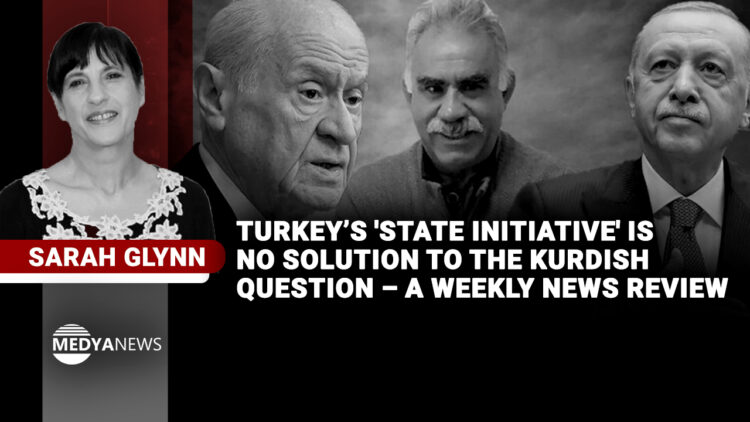
Sarah Glynn
Today, tens of thousands of Kurds are again gathering from all over Europe to march through Cologne. They aim to draw attention to the continued isolation of Abdullah Öcalan, and to demand his release and a political solution to the Kurdish Question. The march is taking place at a time when the Turkish Government has simultaneously raised hopes of new peace negotiations, and demonstrated their determination to extinguish hopes through continued attacks on Kurdish politicians and on the Autonomous Administration of North and East Syria.
Kurdish leaders have made it clear that while they welcome any genuine moves for peace, words need to be accompanied by actions that prove sincerity. Meanwhile, Mehmet Uçum, President Erdoğan’s Chief Advisor, has declared that what is happening is not a “solution process”, as in 2013-15, but a “state initiative towards a terror-free Turkey”. Öcalan has made very clear that, given the right conditions, he is ready to exchange armed struggle for diplomacy, but so far this “state initiative” doesn’t look very different from the previous approach of elimination of the PKK through state violence. There is no evidence so far that the government has made any serious offer that could convince the PKK to lay down their arms; but there is plenty of evidence of state terror.
In October, Turkey bombed North and East Syria, and removed and imprisoned the elected Republican People’s Party (CHP) mayor of Esenyurt. Two weeks ago, when I was taking a week’s break from writing this news review, they removed three elected mayors from the pro-Kurdish DEM Party; and this last week, Erdoğan has reiterated his plans to occupy more of North and East Syria.
Attacking local democracy
The attack on the mayors continues, and normalises, Erdoğan’s earlier attacks on Kurdish local democracy. The current turn against Kurdish politics began in 2015, when the pro-Kurdish Peoples’ Democratic Party (HDP – predecessor of the DEM Party) won eighty seats in the June election, depriving Erdoğan of an overall majority, and Erdoğan turned his back on the initial agreement that had been reached in peace talks between the Turkish Government and Abdullah Öcalan. The aborted coup of July 2016 provided Erdoğan with the excuse for an authoritarian clamp down, and although no one associated Kurds with the coup, Kurdish politicians and organisations were targeted in the government response. Kurdish politicians are accused of being terrorists acting for the PKK, with “evidence” consisting of their legal political activities or the word of “secret witnesses”.
Of the 102 mayors elected from the HDP’s sister Democratic Regions Party (DBP) in 2014, 96 were removed and replaced with a government-appointed Trustee. Fifty-seven of these deposed mayors faced arrest.
After the 2019 local elections, pro-Kurdish mayors were hit again. Six HDP mayors were denied certification, and 48 out of 65 were replaced by trustees. In the most recent local elections, the DEM Party won 78 municipalities. State authorities attempted to deny certification to the elected mayor of Van, but backed down in the face of mass protest and international condemnation. However, the elected mayor of Hakkâri was removed and imprisoned in June.
On 30 October, state authorities removed and arrested the mayor of Esenyurt, who is from the main opposition Republican People’s Party and had been elected with the help of Kurdish votes; and on 4 November, the authorities removed and replaced the elected mayors of Mardin, Batman, and Halfeti. This latest attack coincided with the anniversary of the mass arrest of Kurdish MPs in 2016, and was also quickly lost behind the election news from America.
When Turkey removes a mayor in this way, the whole elected council is shut down and the municipality put into the sole charge of a government trustee. Not only is the removal of the mayors blatantly political, but the mechanism used for their replacement is unconstitutional. In the case of a legal challenge to an elected mayor, the constitution (and international law) requires that a replacement be chosen from council members of the same party. The pro-Kurdish parties operate a co-mayor system where duties are shared between a man and a woman, but this is not officially accepted and acknowledged, so the state simply removes the person officially recognised as mayor, and their co-mayor and councillors are then excluded from the municipal offices. When the previous trustees were replaced by newly elected DEM Party mayors last spring, the large-scale corruption of the trustee regimes was exposed.
The mayor of Mardin, the veteran politician, Ahmet Türk, had been similarly dismissed from the mayorship in 2016 and 2019. The mayor of Batman (Êlih), Gülistan Sönük, won her position with a massive 64.5% of the vote, destroying claims that this conservative city would not elect a woman. When she was about to take office, three military jets flew menacingly overhead. In Halfeti, Erdoğan’s Justice and Development Party (AKP) had attempted to cheat the election with mass voting and had made an unsuccessful challenge to the results.
Protest and oppression
As was to be expected, the expulsion of the mayors was met with widespread protest, and as equally expected, those protests were met with oppression and police brutality. The Kurdish protestors link their struggle for these basic democratic rights with the struggle for Öcalan’s freedom and for a peaceful resolution to the Kurdish Question.
Last weekend, the Ministry of the Interior announced that there had been protests in 47 provinces, with 253 people detained, and 33 of these arrested. Photographs of badly injured Batman protestors have been shared on social media, and DEM Party MPs have accused the police of torture. Protestors have also faced unidentified armed masked men claiming to be police. In Mardin, protests have been officially banned until 24 November, but this hasn’t stopped people protesting. The DEM Party is also challenging the decisions in the courts, and a major demonstration is planned to take place in Batman tomorrow.
The CHP has been protesting in Esenyurt, and they have spoken up against all the mayoral usurpations. Their party leader, Özgür Özel, went to Mardin the day Ahmet Türk was removed, where he described Türk as “a dove of peace who advocated peace instead of conflict and led us all in this regard”. The Turkish Government is now putting pressure on the CHP-run metropolitan municipalities of Istanbul and Ankara through financial investigations; and also on the municipality of Beykoz. The mayor of Istanbul, Ekrem İmamoğlu, had already been found guilty of “insulting electoral officials” and has a potential political ban hanging over him, and now these two most important municipalities are being impeded in their work. The CHP have no choice but to contest this, but their overall integrity has been somewhat damaged by several examples of CHP municipalities capitulating to government pressure and cancelling concerts by prominent Kurdish singers
It has been reported that the government plans to “investigate” 37 more DEM Party municipalities.
Human Rights Watch has stated that the removal of mayors and dissolution of councils is a “significant blow to Türkiye’s democratic credentials and violates the rights of over half a million voters.” Marc Cools, President of the Council of Europe’s Congress of Local and Regional Authorities, has observed, through a public statement, that the use of appointed trustees is “undermining the very nature of local democracy”, and this has been similarly condemned by the European Union’s Turkey Rapporteur, Nacho Sanchez. It will provide another reason for refusing Turkey’s request to restart the frozen EU accession process, but won’t stop favourable trade agreements. The dismissals have also been condemned by the European Greens and by the Socialist Group in the Council of Europe, and have been discussed in the Norwegian parliament, but they deserve to be much better known and more widely condemned.
Occupation by ‘safe zone’
Beyond Turkey’s borders, Erdoğan has not given up on his plan to control a 30-40km strip across the northern parts of Syria and Iraq – which he euphemistically calls a “security corridor” or “safe zone”, and he reaffirmed this again to journalists on Friday 8 November. Last Sunday, he used a commemoration of Atatürk to stress the continuation of cross border operations, stating, “we will complete the missing links of the safe zone we have established along our borders.”
In Syria, Turkey currently controls the west of this strip and a section in the middle, but not the part around Kobanê, nor the eastern section. The northern strip is where most Syrian Kurds live and is also important agriculturally. It should be noted that the Kurds in Syria have no intention of crossing the border and attacking Turkey. Turkish “security” is not an issue.
Erdoğan repeated his intention to journalists on Wednesday, claiming that they would “drain the swamp of terror”, and, on Thursday, the Ministry of Defence underlined Turkish impunity, stating, “We have done whatever is necessary on this issue until now, and we will do so in the future as well,” and claiming that it was Turkey’s “natural right”.
The latest meeting between Syria, Iran, Russia, and Turkey in Astana was held on Monday and Tuesday, and Turkey’s later comments can be understood as a rebuff to Russia, who underlined their disapproval of such operations and, in the words of their Ambassador to Syria “still hope that the Turkish side will refrain from these steps that could have negative consequences for Syria.”
Trump’s America
All the leaders at Astana want to see the withdrawal of the 900 troops the United States maintains in North and East Syria. Their ostensible purpose is only helping the Autonomous Administration’s Syrian Democratic Forces (SDF) in the fight against ISIS, which no longer controls territory but is far from eliminated. In the long run, a US departure would only be to the benefit of local people, but for now their presence stands in the way of a further invasion by Turkey.
The re-election of Donald Trump, and his selection of a witches brew of department heads, has led to much debate about what this may mean for the Kurds – among all the other implications. Past speeches and even actions, can only give an indication of what to expect as politicians’ approaches change according to their own interests, though we can note that there are several appointments that have not pleased pro-government Turkish media.
For Kurds, there are fears that Trump will choose to withdraw those American troops. No-one can forget the last Trump presidency when, in 2019, after a phone call from Erdoğan, Trump pulled out US soldiers and allowed the Turkish invasion and occupation of Serêkaniyê and Girê Spî. Erdoğan raised US troop removal in his congratulatory phone call to Trump, and Robert Kennedy has reported that Trump has already talked about it. However, predictions are never easy – especially not when considering a person ready to act on a whim, such as Trump. He has appointed several anti-Iran hawks, and could, instead, be persuaded that retaining US forces in Syria is important for US opposition to Iran, which has always been a reason for their presence there.
In a different scenario, if the United States and Israel were to extend their war further against Iran, this could open a Pandora’s box of violent political upheavals, as well as immediate death and destruction. While optimists might see possible openings for Kurdish groups to take advantage of power vacuums, as they did in Syria, this could also allow space for the resurgence of ISIS.
Israel has been cynically intensifying their pro-Kurdish rhetoric in an attempt to win friends in the region, and even without Kurdish forces reciprocating these advances, this could make Arab groups suspicious of the Kurds, who have found themselves allied with Israel’s US sponsors in the fight against ISIS.
So far, regional powers have been very wary of precipitating further Israeli attacks. Iranian responses have been deliberately measured, and Syria has chosen not to defend their Hezbollah allies and risk becoming a target themselves. Russian troops have been reported restricting the entry of Iranian-backed militias to parts of Deir ez-Zor to prevent their provocative attacks on the nearby US base in North and East Syria.
The Trump presidency could also impact regional dynamics through changing relations with Russia and altering the course of the war in Ukraine, though how much the American approach will indeed change is unclear.
ISIS
ISIS is still a major concern for North and East Syria – both attacks from sleeper cells, and what is commonly referred to as the ticking time bomb of ISIS prisoners and ISIS families, whom the Autonomous Administration have been left to look after and secure. These include many foreign nationals whose countries have abdicated responsibility, and a generation of children being brought up by ISIS mothers.
The SDF, the Women’s Protection Units (YPJ), the Internal Security Forces, and the US-led International Coalition have completed another sweep of the sprawling Al Hol camp, which houses ISIS families. They particularly focused on the foreigners’ section and the section for children – the “cubs of the caliphate”. Over a week they detained 79 people suspected of active involvement with ISIS, and found weapons – including weapons for training the “cubs”, communication devices, and a dead body. But the camp is porous, and they know that ISIS will continue to infiltrate and to establish their cells there. Two of the captured men have talked about the help they received from Turkey, including the supply of equipment and treatment of ISIS wounded.
In the Kurdistan Region of Iraq
In the Kurdistan Region of Iraq, Turkey is carving out their “security corridor” while ostensibly targeting the PKK – and the Barzani family’s Kurdistan Democratic Party (KDP) is helping Turkey to do it. The Barzanis have chosen to throw in their lot with Turkey, making the KDP, effectively, vassals of the Turkish state, and making themselves extremely wealthy in the process. In a demonstration of their loyalty, they have expelled the HDP office from Erbil, even while the party is still legal in Turkey itself, and forcibly transported its members to the part of the region dominated by the Patriotic Union of Kurdistan.
More Turkish authoritarianism
Returning to Turkey, this week the government’s growing authoritarianism was also demonstrated by the “agents of influence” bill, and by government-backed environmental destruction in Şırnak’s Mount Cudi, where extensive deforestation has been followed by mining, and the dynamiting of the rock itself.
The proposed new law on “agents of influence” threatens to be even more draconian than previous laws, and is so vaguely written that almost any journalistic report could be targeted as contrary to political interests. It was temporarily withdrawn on Wednesday, but is expected to appear again.
Turkey’s rights violations have been discussed and condemned by the United Nations Human Rights Committee. They focussed especially on the need for judicial independence, on clarifying and rationalising the legal definition of terrorism, and on the lack of freedom of association.
Iran’s regime of death
I will end not in Turkey, but in Iran, which may be showing a degree of tactical restraint in its foreign policy, but which feels no need to hold back when it comes to inflicting violence – including lethal violence – on its citizens. October saw at least 161 executions – the highest monthly total this year.
I have previously quoted from the brave and inspiring letters written by the political prisoner, Warisheh Moradi, who is a member of the Free Women’s Organisation of East Kurdistan (KJAR), and has dedicated her life to women’s solidarity and resistance. Following solitary confinement, torture, and a travesty of a trial, Moradi has been condemned to death. A few weeks back, she went on hunger strike to draw attention to the cruelty of death sentences. After twenty days gaining publicity for the cause and becoming dangerously ill, she was persuaded by comrades to eat and preserve her own life. Now she has been given a death sentence herself, and people around the world have been protesting for her. In a public letter written during her hunger strike, Moradi reminded us, “Do not allow cross-border wars to obscure the issue of internal repression.”
Sarah Glynn is a writer and activist – check her website and follow her on Twitter


