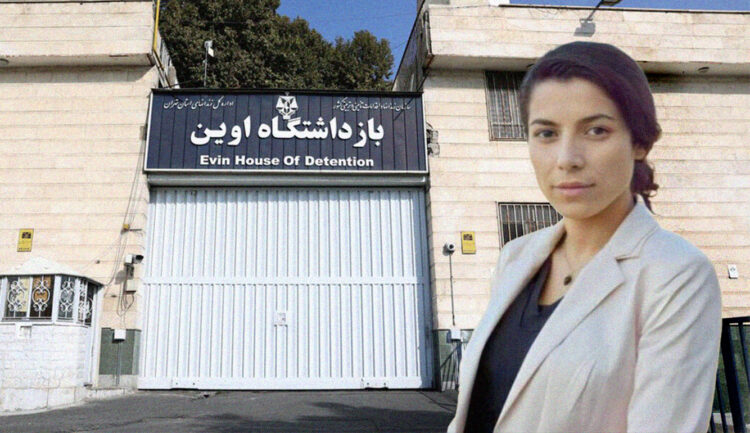
Imprisoned Kurdish activist Warisheh Moradi has launched an indefinite hunger strike from Tehran’s notorious Evin Prison, protesting Iran’s escalating human rights abuses, particularly the alarming rise in executions. In a defiant second letter from behind bars, Moradi appeals to international organisations, highlighting the ongoing suffering of women and freedom-seekers under the oppressive Iranian regime.
Moradi’s letter addresses the broader Middle Eastern conflict, describing how authoritarian regimes and global capitalist powers have turned the region into a battleground, with women and marginalised groups bearing the brunt of the violence. She draws parallels between Iran’s domestic repression and cross-border wars, condemning the regime’s mass executions as part of a strategy to silence dissent.
Moradi’s hunger strike coincides with the European and World Day against the Death Penalty and is part of her call for global solidarity, urging the international community to oppose both Iran’s internal human rights violations and its role in regional conflicts.
Read our translation of Moradi’s letter below:
To the Free Society and International Organisations
The fires of war have engulfed the entire Middle East—a conflict that has raged for decades across this ancient land under the guise of a so-called new order. These flames suffocate society, consuming ever more of this beautiful human existence with each wave of violence. The neoliberal policies of the global capitalist system, aimed at consolidating its dominance in the Middle East, combined with the ambitions of traditional regional powers, have exposed this war like never before. On one side, the West seeks to reshape the Middle East, not through peace, but through war. Despite its failed attempts to homogenise the region and erase its rich history and culture, the West persists. Meanwhile, conservative states in the region, stoking nationalism and religious fervour, continue to fan the flames. The various repercussions of these conflicts, coupled with the escalating violence, risk ushering in a dangerous rise of fascism across the region.
It is evident that this war will continue, likely drawing in vast areas of the region. Amid these ongoing challenges, the Islamic Republic of Iran—after years of attempting to create a “Shia Crescent”—now speaks of an Arab NATO and the unity of the Muslim Ummah. The recently diplomatic traffic [of iranian officials] to Arab countries underscore this plan. Yet, these contradictions, challenges, and rivalries can only lead to further devastation in the Middle East. The people—particularly women—who have already suffered under authoritarian regimes now face additional threats from the havoc wrought by this war.
In short, while global capitalism seeks to weaken and control the nation-states of the region, this is far from a support for the people, especially women. In the power struggles among rival forces, society—particularly women and children—are the true victims. They are violated, forced to flee their homelands, or conscripted into the service of warlords. A critical issue that must be addressed is that the rise in domestic repression is intrinsically linked to these cross-border wars. In other words, both are inextricably connected. This creates a grim equation in the region, and Iran is no exception. On the contrary, it follows the same path it did in the 1980s, when mass executions of prisoners and freedom-seekers took place alongside conflicts outside its borders. The crucial issue now, as history recalls the events of the 1980s, is to ensure that history does not repeat itself.
In recent years, the Islamic Republic has attempted to portray itself as an island of peace amidst the turmoil in the Middle East. Yet its domestic and foreign policies have proven unsuccessful. Internally, the totalitarian regime faces mounting pressure, and should it fail to seize its last opportunities to retreat from tyranny, it will inevitably face the consequences. At the same time, conditions continue to deteriorate—economically, politically, socially, and psychologically. Human rights violations are on the rise, with 531 executions carried out since the start of this year. Last year, 811 individuals were executed, marking a 35% increase in the execution of women compared to the previous year. These figures illustrate the regime’s utter disregard for improvement. Instead, through its policies of denial and elimination of those it considers “other”, it is driving society toward ruin. Despite this painfully obvious reality, it remains essential to communicate these bitter truths to the world. The struggle against this situation and opposition to this tyrannical regime fall upon us, the prisoners, just as it falls upon others.
As someone who has worked to transform society and impart meaning to life, and who stands in solidarity with women and all oppressed peoples, my decisions and actions are intended to bring attention to the current situation. My stand against the oppression of freedom-seekers is not for personal gain. I am undertaking an indefinite hunger strike on the International Day Against the Death Penalty with this very purpose. If you see the toll of war and cry “No to War,” you must also recognize the domestic killings and daily executions carried out under the guise of political Islam. Do not allow cross-border wars to obscure the issue of internal repression. Through this hunger strike, I aim to ensure that the voices of domestic fighters who have bravely stood up are not lost amidst the clamour of war and futile ventures. To this end, I announce my indefinite hunger strike in solidarity with the global campaigns of #No_to_Executions, spearheaded by groups, institutions, and international organisations dedicated to abolishing the death penalty.
Werisheh Moradi
Prison of Evin-Tehran-Iran, Women’s Ward
October 2024