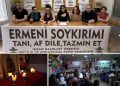
“What was his crime? It was crystal clear: his love for humanity, his passion for democracy and human rights, his unwavering belief in freedom of expression, and his advocacy for peace between two peoples,” declared Takuhi Tovmasyan, an Armenian cultural writer, addressing the crowd that filled the street in front of Sebat Apartment, İstanbul. It was here, on 19 January 2007, that Armenian journalist Hrant Dink was shot dead in broad daylight, his murder becoming a turning point in Turkey’s struggle with its past and its treatment of minorities.
The commemoration, held 18 years to the day after Dink’s assassination, brought together thousands of supporters to honour his memory and continue his struggle for peace and accountability. Dink, the founder of Agos newspaper, was a tireless advocate for Armenian-Turkish reconciliation and a critic of the divisive policies that suppressed dialogue and justice. His assassination shocked the nation and remains a potent symbol of the challenges minorities face in Turkey.
Tovmasyan’s speech was a deeply personal reflection, interweaving Dink’s life with her family’s history of loss during the Armenian genocide. “I still cannot believe, cannot accept, that you are gone,” she said, addressing Dink directly. “Like my grandmother who searched for her lost child, I hold onto the hope that your dreams will live on. If one day the border opens, I promise to make halva [a sweet delicacy] at the gate, just as you imagined.”
Her address also laid bare the profound injustice of Dink’s killing. “They silenced him because he loved humanity, because he believed in peace, and because he had the God-given gift to persuade others. That terrified them,” she said, her voice trembling with emotion. “Eighteen years later, we are still here, together, refusing to forget.”
The ceremony included messages from imprisoned political figures who, like Dink, embody the struggle for justice in Turkey. Filmmaker Çiğdem Mater, imprisoned in Bakırköy since 2022, shared a poignant message that resonated deeply with the attendees. Read aloud by actress Tülin Özen, her letter reflected on the passage of time and the persistence of memory. “It has been 18 years since Hrant Dink was taken from us, and this is the third time I am commemorating him from afar, like so many others in Turkey’s prisons,” she wrote.
Mater’s words captured the profound injustice of Dink’s murder and the unexpected solidarity it inspired. “Hrant Dink was killed in the heart of Istanbul in what was a ‘National Consensus murder’ that openly declared itself,” she wrote, referring to the ultranationalist climate that fostered his assassination. “But he was farewelled in a way that this ‘Consensus’ likely never imagined. Tens of thousands poured into Istanbul’s streets, each for different reasons, and most of them didn’t even know Hrant Dink personally.”
Mater described the varied motivations of those who joined the historic funeral march. “Some came to bid farewell to a compatriot, others were reminded of the events of a century ago, and still others thought of their own families and stories,” she said. “In the end, those tens of thousands broke an unspoken agreement. For the first time, such a large crowd recognised and accepted an Armenian identity.”
The commemoration also included an artistic tribute on the facade of Sebat Apartment, where a video projection titled “Liberating Promise” by Memed Erdener lit up the night. The installation, a tradition since 2019, symbolised the enduring fight for justice and reconciliation, themes that defined Dink’s work.