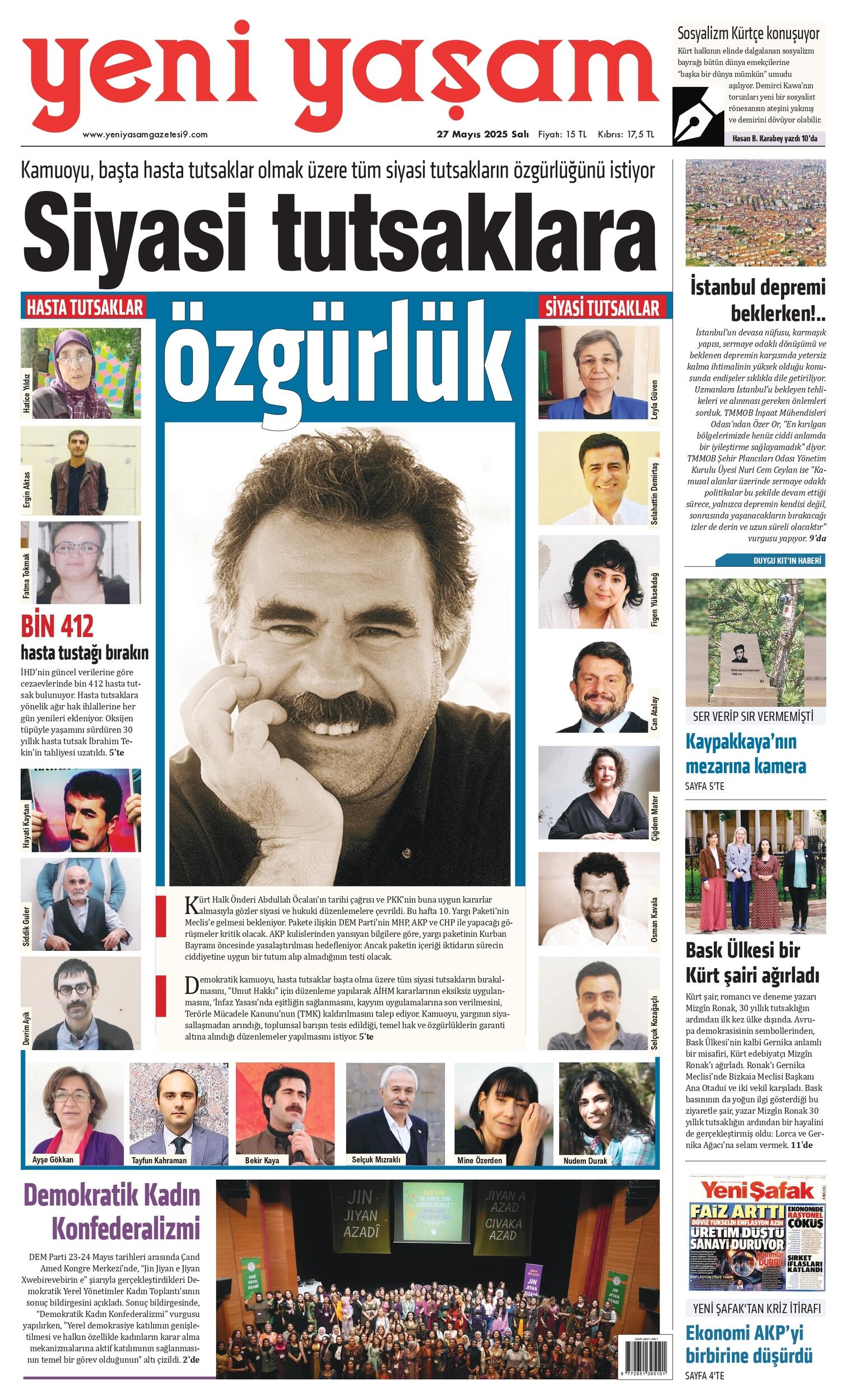
A Tuesday headline in pro-Kurdish newspaper Yeni Yaşam has reignited scrutiny over the fate of political prisoners in Turkey, spotlighting the continued solitary confinement of Abdullah Öcalan, the jailed Kurdish leader detained for over 26 years, amid a broader crisis in the country’s prison system.
The coverage coincides with alarming new figures disclosed by the Ministry of Justice: 1,026 people have died in Turkish prisons between 24 July 2023 and December 2024. The figures were revealed in response to a parliamentary question submitted by pro-Kurdish Peoples’ Equality and Democracy (DEM) Party MP Newroz Uysal Aslan.
The Ministry did not disclose how many of the deceased were ill or political prisoners. However, the Human Rights Association (İHD) stated on 28 April that 1,412 prisoners are currently ill, including 335 classified as gravely sick.
Those named in the Yeni Yaşam headline include prominent pro-Kurdish politicians Selahattin Demirtaş, Figen Yüksekdağ, Leyla Güven, Ayşe Gökkan, and Selçuk Mızraklı; civil society figures Osman Kavala, Çiğdem Mater, Tayfun Kahraman, and Can Atalay; and artists and activists such as Nudem Durak and Mine Özerden. Other political or ill prisoners featured were Bekir Kaya, Devrim Ayik, Siddik Guler, Hayati Kaytan, Fatma Tokmak, Ergin Aktaş, and Hatice Yıldız.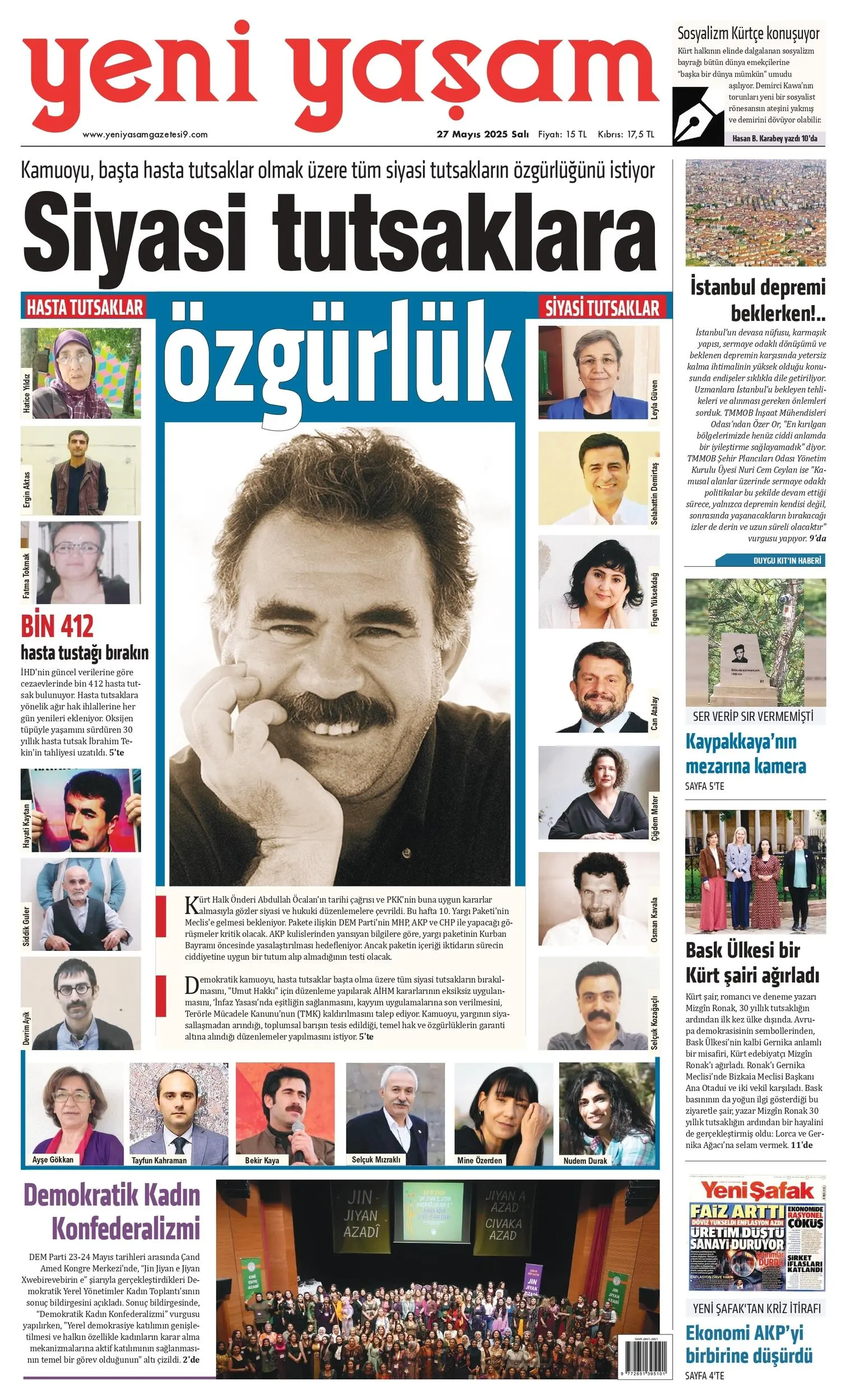 At the centre of the article was Abdullah Öcalan, the imprisoned Kurdish leader held in total isolation on İmralı Island since 1999. DEM Party officials argue that Öcalan’s voice must be heard in Parliament for any credible path to peace.
Beyond high-profile names, Yeni Yaşam detailed the case of İbrahim Tekin, a 67-year-old prisoner who completed a 30-year sentence on 11 May 2025 but was denied release on grounds of “bad behaviour”. Tekin, tortured during his 1995 arrest, now requires oxygen support due to a chronic illness. His lawyer, Özcan Sarıoğlu, condemned the parole board’s decision as “an unofficial retrial driven by ideology”.
Similarly, Fırat Nebioğlu, a 92% disabled prisoner in Diyarbakır (Amed), is in critical condition from kidney failure. Despite a medical report recommending release, he remains in custody—underscoring concerns that medical parole decisions are politically influenced.
“This is no longer about crime and punishment,” said Sarıoğlu. “It’s about maintaining power through institutional cruelty.”
The revelations come just as Turkey’s 10th Judicial Reform Package is expected to be introduced in Parliament. DEM Party lawmakers are urging that the bill include the equal application of parole laws, an end to political filtering by prison boards, and compliance with European Court of Human Rights (ECtHR) rulings.
Rights groups warn that the growing number of political detainees—many of them elderly, ill, or imprisoned for peaceful dissent—exemplify how Turkish prisons have become sites of prolonged punishment and political suppression.
As names like Kavala, Yüksekdağ, Demirtaş, and Güven return to national debate, the demand for structural reform and an end to politically motivated detention grows louder.