

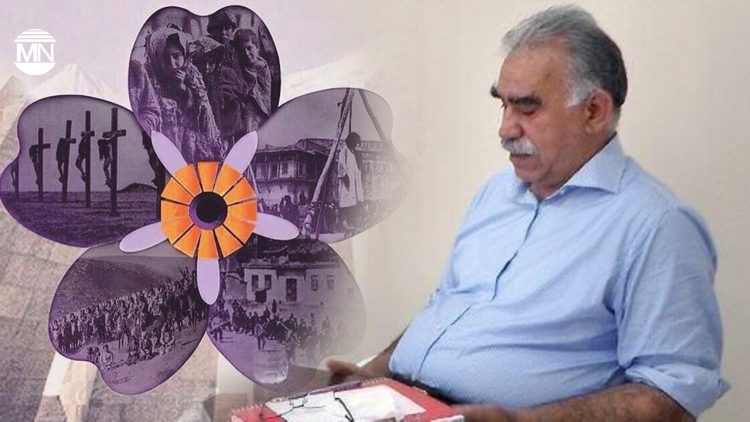
Jailed Kurdish leader Abdullah Öcalan’s views on the Armenian cause were the theme of a panel held in Cairo on Saturday marking the 110th anniversary of the Armenian Genocide.
The event, organised by the Armenian National Committee of Egypt and titled “Öcalan’s Thoughts on the Armenian Cause”, featured prominent intellectuals, authors and politicians, including Egyptian historian, Armenologist and genocide expert Dr Mohammad Rifaat al-Imam of Alexandria University and researcher at the al-Ahram Centre for Political and Strategic Studies Karam Saeed, who led the discussions. The panel explored Öcalan’s advocacy for a shared future and democratic coexistence, with speakers stressing his role as a proponent of mutual culture and democracy.
In his 2014 letter to the Turkish-Armenian weekly Agos, Öcalan wrote, “The Kurdish people’s fight for freedom and the cure for the Armenian people’s sorrows have overlapped in the fight to [be able to] live in this land as citizens who share the same rights.” He also stressed the importance of global recognition of the genocide, stating, “In our time, it is necessary that the whole world recognises the Armenian people’s tragedy, paving the way for the mourning of their sorrows. The Turkish Republic too will eventually approach the matter with similar maturity and reckon with this bitter history.”
Armen Mazlumian, Chair of the Armenian National Committee of Egypt, highlighted the significance of holding the panel at this time, reflecting on regional developments. He stressed the importance of recognising historical struggles for justice and peace.
Karam Saeed noted the sensitivity of the timing, coinciding with the anniversary of the Armenian genocide, committed by the Ottoman Empire. He drew parallels between Armenian and Kurdish suffering, arguing that Öcalan’s calls for peace and reconciliation offer a pathway forward. Saeed stressed that factors uniting Armenians and Kurds far outweigh those dividing them, reinforcing Öcalan’s consistent advocacy for peace in the Middle East.
Dr Rifaat al-Imam analysed the causes of the Armenian genocide from a cultural and historical perspective. Building on Öcalan’s reflections, al-Imam highlighted how religious conflicts and Ottoman “divide and rule” tactics exacerbated ethnic tensions, contributing to the roots of the genocide.
The panel sparked deep reflections on the shared historical trauma of Armenians and Kurds, stressing the need for joint efforts in the fight for peace and recognition. As the region grapples with its past, the discussions in Cairo highlighted the importance of dialogue and mutual understanding between communities with a shared history of suffering.


