


On 18 June, George Aslan, a member of the Peoples’ Equality and Democracy (DEM) Party, delivered a speech to Turkey’s Grand National Assembly in which he sharply criticised the recent inauguration of a monument honouring Talat Pasha. He described the move as an act of historical denial, saying that it was an affront to the memory of Armenians and other Christian communities who suffered mass atrocities under Ottoman rule.
The monument was unveiled in Ankara’s Altındağ district by Mayor Mansur Yavaş and installed on Talat Paşa Boulevard, which was already named after him. The monument honours the former Ottoman official who served as Interior Minister during World War I and as Grand Vizier in 1917. He is widely considered to be one of the chief architects of the Armenian Genocide. As the leading civilian figure in the Committee of Union and Progress (CUP), Talat exercised significant control over government policy and the Special Organisation (Teşkilat-ı Mahsusa), run by the CUP inner circle, which played a central role in implementing the genocide. From the capital, he oversaw the mass deportations and massacres of Armenians, resulting in the deaths of more than one million people. Other Christian minorities, including Assyrians and Greeks, were also subjected to massacres and forced displacement during this period.
“As we continue to wait for a sincere reckoning with the genocide committed against Christian peoples in 1915, instead we see the perpetrators being honoured with street names, parks and schools — and now monuments,” said Aslan. Referring specifically to the monument on Talat Paşa Boulevard, he added, “While tens of thousands of Armenians were killed, exiled, and had their property confiscated in the Ankara province alone, a monument should have been erected in honour of the victims, not the man who signed their death warrants.”
“Some individuals may be regarded as heroes by one people,” he continued, “but for others, they are not heroes — they are murderers. Talat Pasha is such a figure for us because he is responsible for the deaths of hundreds of thousands.” Aslan recalled Talat’s notorious 1912 remark to the Danish orientalist Johannes Østrup, during which he vowed to destroy the Armenians once he was in power — “and he did just that”. Aslan also mentioned that Talat was responsible for the massacre of Syriacs in Diyarbakır (Amed), where Governor Reşit, who had been appointed by Talat, had overseen the mass execution of Syriacs in the courtyard of the Meryem Ana Church.
Following Aslan’s remarks, Şenol Sunat, a Good Party (İYİ Party) MP, responded angrily, calling Aslan’s speech “slanderous to the Turkish nation and a glorification of traitors”. Her intervention prompted immediate objections from MPs of the DEM Party.
Deputy Speaker Tekin Bingöl, from the Republican People’s Party (CHP), cautioned Sunat about her use of language, stating that her choice of words was inappropriate for the General Assembly. This led to a heated exchange, during which another İYİ Party MP, Yasin Öztürk, who is also a clerk of the Assembly, struck the table and accused Bingöl of silencing Sunat. Öztürk shouted “Be impartial!” as he advanced towards the rostrum. The session was suspended for ten minutes amid heightened tensions. MPs from the Nationalist Movement Party (MHP), a coalition ally of the ruling bloc, remained silent.
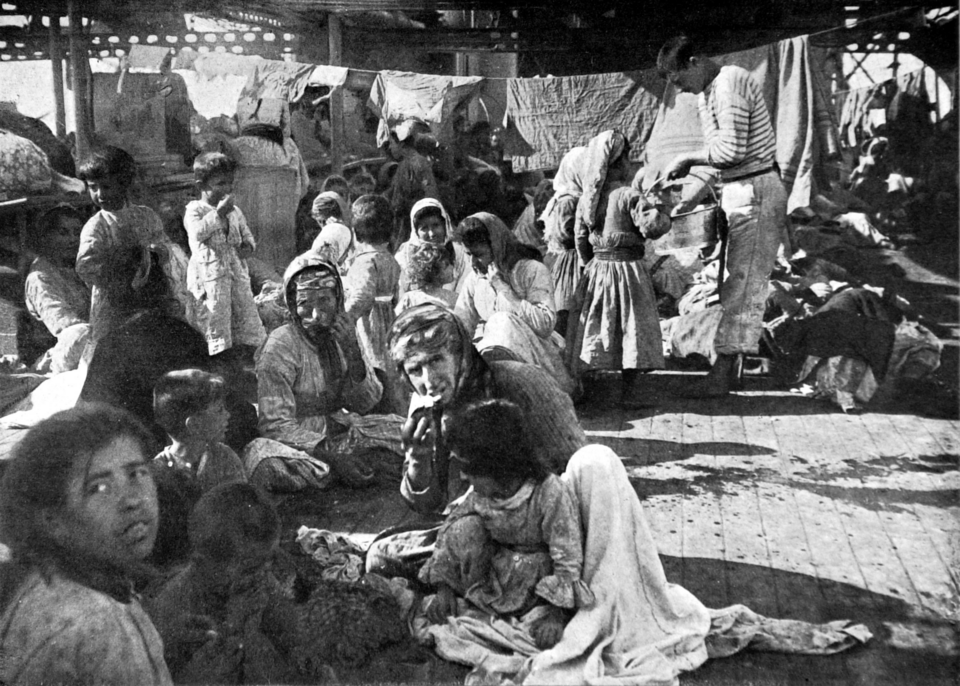
Talat Pasha, among other CUP leaders including Enver and Cemal pashas, was sentenced to death in absentia by the Istanbul courts-martial on 5 July 1919 for his role in the deportation and mass killing of Armenians during the First World War. Although the verdicts were severe, many of those convicted had already fled the country. Talat escaped to Germany, where he was assassinated in 1921 by Soghomon Tehlirian, a genocide survivor and member of the Armenian Revolutionary Federation’s Operation Nemesis.
The trials, which were conducted under Ottoman law, came to a halt with the rise of the Turkish nationalist movement under Mustafa Kemal Atatürk. In 1923, all remaining sentences were annulled. Even though they ended abruptly, these trials are still considered the first state-led effort to recognise the Armenian Genocide and pursue legal accountability for crimes against humanity.
Despite this historical judgement, Talat continues to be commemorated across Turkey. “It is now 2025,” Aslan concluded in his speech, “yet we still witness the persistence of the same mentality. If there had been a sincere reckoning, such monuments would not be possible.” He continued: “Confronting the past means remembering its pain and preventing its repetition. Monuments must be built for the victims of the 1915 genocide, not for those who carried it out. Perpetrators must be exposed and condemned. That is essential for social peace.”
*Fatma Müge Göçek, Denial of Violence: Ottoman Past, Turkish Present, and Collective Violence against the Armenians, 1789-2009, Oxford University Press, 2015.
**Hans-Lukas Kieser, Talaat Pasha: Father of Modern Turkey, Architect of Genocide, Princeton University Press, 2018.
***Vahakn N. Dadrian and Taner Akçam, Judgment at Istnabul: The Armenian Genocide Trials, Berghahn Books, 2011.


