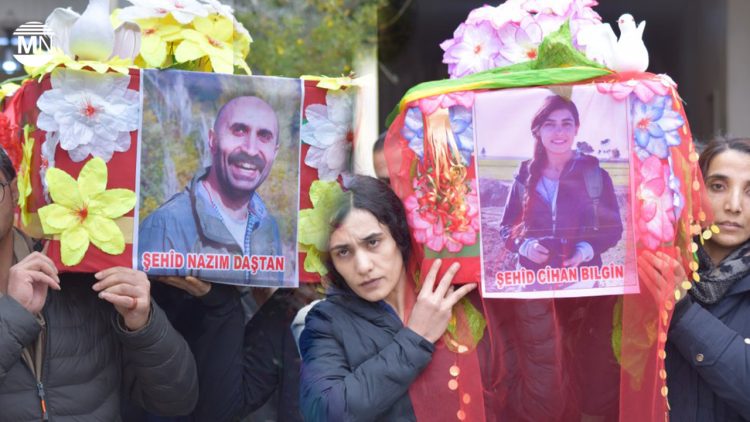
Slain Kurdish journalists Nazim Daştan and Cîhan Bilgîn were buried in Qamishli (Qamişlo), northern Syria, yesterday, after a delegation including members of their families was prevented from crossing the Turkish border to take the bodies home for burial. Hundreds of people, including former colleagues of the journalists, joined the ceremony.
On 6 January, thousands of people bade farewell to Daştan and Bilgîn and sent them off to the Semalka Border crossing, where they were supposed to be received by a delegation and taken to be buried in their homes at the request of their families. The bodies were to be brought from Qamishli to the Nusaybin (Nisêbîn) district of Mardin (Mêrdîn) and from their to their homes. However, when the families went to Nusaybin they did not receive the bodies.
Later they were told the bodies would be taken from the Semalka Border Gate between the Kurdistan Region of Iraq (KRI) and North and East Syria for collection in the KRI, and that they could be brought to Turkey through the Habur Border Gate in the Silopi, Şirnak (Şirnex).
Accordingly a delegation including members of the families of Daştan and Bilgîn went to the Habur Border Gate to cross over to KRI, but was refused passage by the Turkish authorities. A vigil was organised, which went on for three days accompanied by protests from journalists and human rights organisations demanding the delegation be allowed through the border gate.
However, the delegation was not allowed to cross, and finally the decision was made to return the bodies to Qamishli and bury them there, denying their families’ the right to bury and bid farewell to their murdered children.
Turkey’s Human Rights Association (IHD) co-chair Hüseyin Küçükbalaban, called the killing of Nazim Daştan and Cîhan Bilgîn a “war crime” and said that the deadly attack was a “continuation of the [recent] attacks against the websites of the free press and the detentions and arrests of journalists”.
Daştan and Bilgîn were covering clashes between the Syrian Democratic Forces (SDF)and the Turkish-backed Syrian National Army (SNA) close to the Tishreen Dam in northern Syria, when they were targeted and killed in a Turkish drone strike on 19 December. The deaths of Bilgîn and Daştan once again highlight the risks faced by journalists operating in conflict zones.