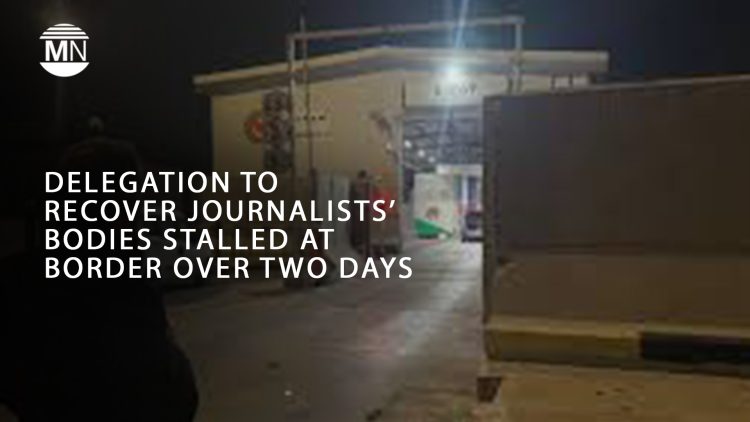
“The right to be buried is being taken away,” said Kamuran Tarhan, a Peoples’ Equality and Democracy (DEM) Party MP, on Wednesday, as a delegation attempting to recover the bodies of Kurdish journalists Cîhan Bilgin and Nazim Daştan remained blocked at Turkey’s Habur border crossing for over two days. The journalists, killed in a Turkish drone strike on 19 December while reporting on clashes in northeast Syria, have yet to be returned to their families.
The delegation, including the journalists’ families, DEM Party MP Tarhan, members of the Dicle Fırat Journalists Association (DFG), the Association of Lawyers for Freedom (ÖHD), and civil society representatives, has been awaiting clearance to cross into the Kurdistan Region of Iraq (KRI) since Monday. Turkish authorities have cited a “technical failure” as the reason for the delay, but many, including those stranded at the border, have dismissed this explanation as implausible.
Civilians attempting to cross the border have also been caught in the disruption. A two-kilometre queue of vehicles has formed, with Turkish police and soldiers maintaining a heavy presence at entry and exit points. Some civilians suspect political motives behind the delay.
Speaking to reporters at the scene, Tarhan described the delay as a moral and humanitarian crisis. “There is no problem in the passage to our right and left,” he said, accusing authorities of deliberately targeting their group. The MP emphasised the delegation’s primary goal: retrieving the journalists’ bodies for burial.
Among the civilians impacted is Şivan Silo, a traveller from the KRI, who has been waiting for three days. “They say it’s a systemic problem, but I don’t believe them. This is the first time we’ve faced such a situation. We are miserable,” he said, expressing doubts about the official explanation.
Others shared similar frustrations. Abdulbaki Çelebi, stranded at the border for over two days, expressed concern over the lack of basic provisions for those waiting. “I cannot even meet my personal needs because I have to wait at the border,” he said. “People are being victimised here.”
Another civilian, Agit Yılmaz, voiced his suspicions about the nature of the delay. “They told us that there was a systemic problem. Then we learned that it was because of the bodies of the journalists who were slaughtered in Syria,” he said, highlighting the connection between the journalists’ deaths and the border standstill.
The deaths of Bilgin and Daştan have drawn attention to the risks faced by journalists operating in conflict zones. Advocacy groups have criticised their killings in the drone strike as a violation of international norms, while the delay in retrieving their bodies has raised questions about press freedom and humanitarian principles in the region.