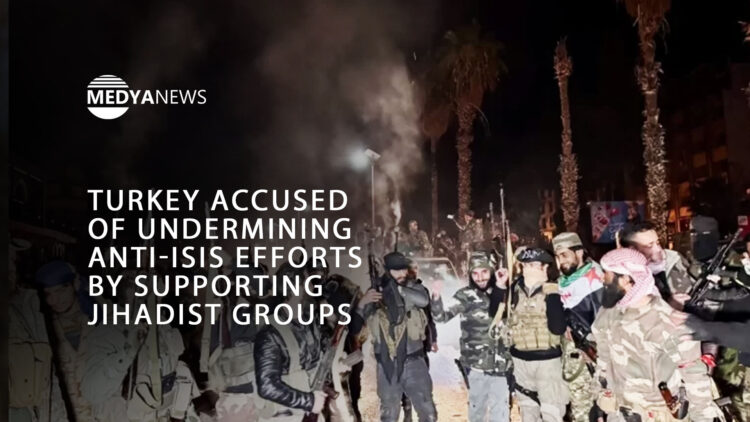
The United States faces growing challenges in Syria, as Turkey’s reliance on jihadist groups to consolidate territorial gains threatens the US-led fight against ISIS. As the fall of Bashar al-Assad’s regime creates a power vacuum, Washington’s partnership with the Kurdish-led Syrian Democratic Forces (SDF) is coming under increasing strain from Ankara’s military ambitions and alliances.
Turkey has intensified its military operations in northern Syria, targeting SDF positions and seizing key areas such as Manbij (Minbîc) and Tal Rifaat. Ankara’s coalition includes the Syrian National Army (SNA), a group with links to jihadist groups. The SNA has clashed with the SDF, which has been instrumental in the US-led campaign against ISIS. Despite repeated warnings from Washington, Turkey’s actions risk undermining stability in the region.
“The US cannot allow actions that compromise our partners in the fight against ISIS,” said John Kirby, White House national security communications adviser. He reiterated that the SDF remains a critical ally in ensuring the defeat of ISIS.
Ankara’s military campaign appears aimed at establishing a buffer zone along its border and curbing the SDF’s influence. Turkey regards the SDF as an offshoot of the Kurdistan Workers’ Party (PKK). This stance has put Turkey at odds with its NATO allies, particularly the US, which supports the SDF.
Turkey’s alignment with groups such as Hay’at Tahrir al-Sham (HTS) has drawn criticism. Once designated as a jihadist organisation, HTS has been involved in operations that analysts say could further destabilise Syria.
On the other hand, HRW has reported that tens of thousands of civilians seeking safety in Kurdish-controlled northeast Syria are enduring dire conditions due to inadequate shelter, water, food, and healthcare. The influx of displaced individuals has overwhelmed reception centres in areas like Tabqa and Raqqa, prompting the establishment of additional centres in Kobani, al-Hasakah, and Qamishli. Displaced persons have recounted harrowing experiences, including children suffering from hunger and cold, and pregnant women giving birth without medical care.
In response to Turkey’s actions, US Secretary of State Antony Blinken visited Ankara for high-level talks. According to a State Department statement, Blinken is urging Turkey to respect minority rights and to ensure that its military operations do not endanger US forces or their mission.
The Pentagon has also been engaged in diplomatic efforts, with Defence Secretary Lloyd Austin stressing the importance of coordination to prevent incidents such as the recent friendly fire downing of a US MQ-9 Reaper drone by SDF forces.
Meanwhile, the US continues its military operations to prevent an ISIS resurgence. Recent air strikes on ISIS strongholds underscore the importance of the US-SDF partnership. General Erik Kurilla, commander of US Central Command, reaffirmed this commitment during a visit to Syria, stating: “There should be no doubt that we will hold any organisation accountable for supporting ISIS.”
Turkey’s actions have also come under international scrutiny. Israel, which has been carrying out airstrikes in Syria to neutralise weapons stockpiles, has reportedly been in talks with the SDF. This development has raised concerns in Ankara, with Turkish officials accusing Washington of facilitating such talks to bolster the SDF’s position.
The relationship between the US, Turkey and the SDF highlights the complexities of post-Assad Syria. As Turkey continues to use jihadist-linked groups to achieve its strategic objectives, Washington faces the dual challenge of maintaining its alliance with Ankara while safeguarding its partnership with the SDF. The outcome of this dynamic will significantly shape Syria’s future stability and the broader fight against ISIS.