

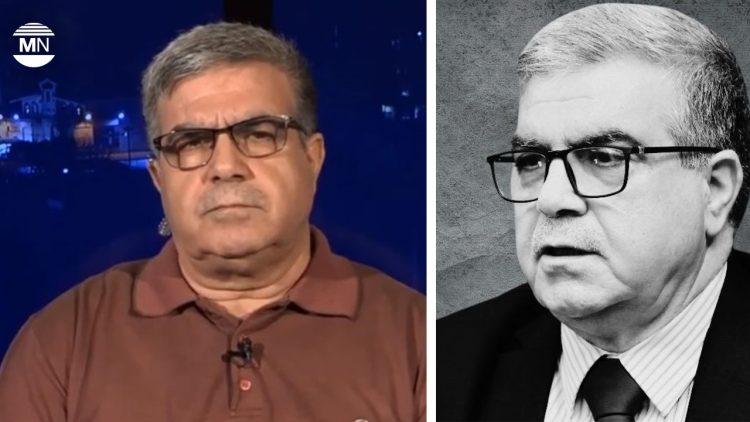
Ehmed Silêman, deputy secretary general of the Syrian Kurdish Progressive Democratic Party and a member of the Rojava Kurdish Negotiation Committee, spoke about recent efforts to unify Kurdish political positions in Syria. His comments followed the Kurdish Unity Conference held on 26 April 2025.
Silêman explained that the Democratic Union Party (PYD) and his own Progressive Party initiated meetings aimed at bringing Kurdish political parties together. Initially, broader unity talks were delayed due to the complex situation on the ground, including clashes between the primarily Kurdish and Arab factions which compose the Syrian Democratic Forces (SDF) and the Turkish-backed Syrian National Army (SNA).
Instead, the parties began with seminars on the Kurdish issue in Syria. Conditions for wider political dialogue improved when SDF Commander Mazloum Abdi met with Kurdish representatives in Iraq, including the KDP and PUK, with backing from the United States and France.
Silêman distinguished this latest initiative from earlier attempts, recalling the formation of the Kurdish National Council (ENKS) and the Rojava People’s Assembly in 2011. Since then, several attempts to unite Kurdish political institutions have been made, but significant progress did not occur until 2019.
He stated that peace in Syria will remain elusive until Kurds are granted their “legitimate national rights”, describing this as a necessary precondition for any meaningful peace initiative.
Silêman said that a joint political framework document has been drafted to guide talks with the new Syrian government and international stakeholders. He stressed that the negotiations aim to build a democratic Syria that respects all ethnic and religious groups, adding that it is not about confrontation, but about finding a solution.
Addressing concerns over internal divisions within the Kurdish community, Silêman said the committee would act responsibly to maintain unity. “Kurdish political parties in Syria must overcome narrow party interests, set aside secondary issues, and move forward with a broader understanding,” he said.
He also acknowledged the role of Kurdish political groups outside Syria—such as the Kurdistan Democratic Party (KDP), the Kurdistan Workers’ Party (PKK), and the Patriotic Union of Kurdistan (YNK)—and Kurdish diaspora organisations in supporting the dialogue process.
Silêman concluded by emphasising that the goal of the negotiations is a united and peaceful Syria, based on dialogue and mutual compromise—not confrontation.


