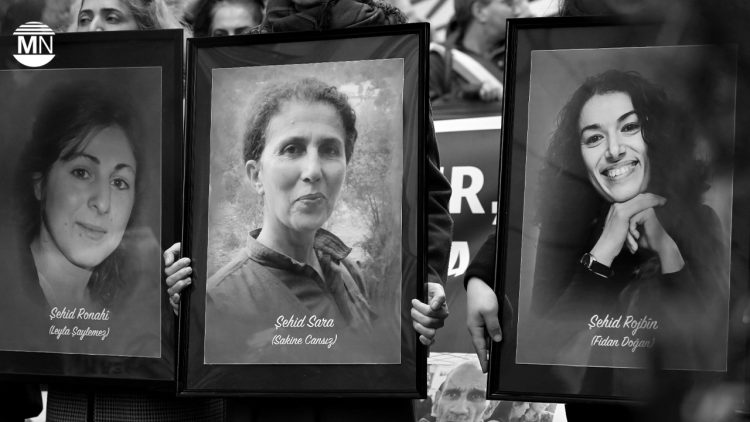
On 9 January 2013, three prominent Kurdish activists – Sakine Cansız, Fidan Doğan and Leyla Şaylemez – were murdered execution-style in the heart of Paris. The murders, widely attributed to Turkey’s National Intelligence Organisation (MIT), remain unsolved, prompting annual commemorations and renewed calls for justice.
Sakine Cansız, a co-founder of the Kurdistan Workers’ Party (PKK), Fidan Doğan, a representative of the Kurdish National Congress, and Leyla Şaylemez, a Kurdish youth activist, were shot dead at the Kurdish Information Centre in Paris. Investigators linked the main suspect, Ömer Gülney, to the MIT, but his death in custody in 2016 left critical questions unanswered.
Protesters demand clarity on 12th anniversary of Paris massacre
On the 12th anniversary, Kurdish organisations held events across France and Europe, including marches, memorials and letter campaigns to the French Ministry of Justice. Activists from the Kurdish Women’s Movement (TJK-F) delivered over 1,000 letters demanding transparency and the lifting of the secrecy order surrounding the case.
In the Paris suburbs of Evry and Drancy, women’s groups highlighted the pattern of targeted killings of Kurdish women activists. Meanwhile, commemorations in Turkey, including in Sakine Cansız’s hometown of Dersim and Fidan Doğan’s grave in Elbistan, were attended by political figures and women’s organisations.
Speakers at these events emphasised the wider implications of the murders, describing them as attacks on the Kurdish women’s movement and gender equality. Sakine Cansız, remembered as a pioneer for Kurdish women, has become a symbol of resistance. Fidan Doğan and Leyla Şaylemez were also celebrated for their contributions to Kurdish political advocacy and youth mobilisation.
Human rights groups and Kurdish organisations accuse France of negligence and complicity in failing to hold the perpetrators to account. The unsolved case has strained relations between France and its Kurdish community. Activists argue that transparency is essential to prevent future attacks, citing the December 2022 shooting at the Ahmet Kaya Kurdish Cultural Centre in Paris as evidence of ongoing threats.
As Kurdish communities commemorate the lives of Sakine Cansız, Fidan Doğan and Leyla Şaylemez, their calls for justice resonate louder than ever. As pressure mounts on the French authorities to act, the struggle to uncover the truth behind the 2013 murders remains a testament to the resilience of the Kurdish women’s movement.