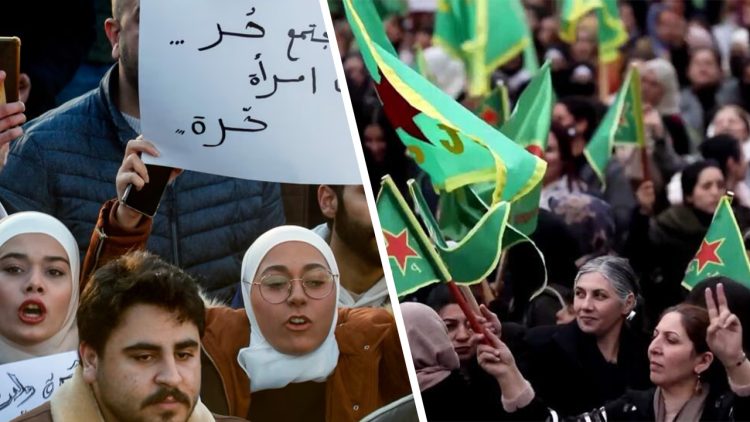
With the rise of Islamist forces backed by Turkey after Bashar al-Assad’s retreat to Russia, the rhetoric and actions of Syria’s new rulers have intensified concerns among women. Obaida Arnaout, spokesperson for Hay’at Tahrir al-Sham (HTS), recently claimed that women, due to their biological nature, are unfit to participate fully in societal and political matters. In response, Syrian women took to the streets in protest. However, reports from Aleppo and beyond reveal that many women have faced threats, sexual assault, and torture at the hands of HTS. Despite this, they remain unwavering in their struggle for their rights, standing firm against the Islamist regime’s oppression.
The Syrian women between pragmatism and policy gaps
In an interview with NuJINHA, Zeynep Ali, a resident of Aleppo (Heleb) and a Syrian women activist, discussed the severe restrictions placed on women by armed groups in the city. Ali explained that HTS use religion to justify the silencing of women who defend their rights, excluding them from the public sphere and treating them as criminals. She emphasised the ongoing violence women face, including arrest and torture. Ali called for urgent action from national and international organisations to protect women’s rights and stressed the pivotal role women and young people play in shaping the future of the country.
She shared the story of a friend, a university student, who was arrested and subjected to psychological abuse for sitting in a park with a male classmate, an event that caused her family to face societal exclusion. Ali also highlighted the plight of a woman who was injured during a protest demanding the release of her family members. Despite the violence and uncertainty, the woman remains committed to the struggle.
Moreover, Syrian women are fearful that the country may follow the path of the Islamic Republic of Iran, where women’s rights were initially promised but later repressed. Susan Zakzak, a member of the Syrian Women’s Association, voiced her deep concern about the uncertainty surrounding women’s futures under this new rule. In an interview, she stressed that, after the fall of the Assad regime, Syrian women will no longer accept being relegated to their “traditional place”. After Iran’s revolution in 1979, Ayatollah Khomeini’s regime swiftly abandoned its promises of freedom and equality, silencing opposition, journalists, and activists. In Syria, HTS’s repression of women activists, journalists, and humanitarian workers suggests a similar prioritisation of control over meaningful reform.
In parallel, Mona Al-Tahawi, a Syrian feminist and author, highlighted the complexity of the situation, questioning whether the fall of Assad alone can liberate Syrian women. She stressed that women’s struggle extends beyond opposing repressive regimes to battling daily oppression embedded in societal norms.
According to her, women are engaged in two parallel revolutions: the first, fighting alongside men against repressive regimes, and the second, resisting the tyranny that extends from the streets to the most intimate spaces, where oppression is imposed on anyone who does not conform to societal standards, regardless of their sexual orientation. “The reckoning with our culture and religion, confronting both despots and Islamists—two sides of the same coin—is rooted in feminism, and it is this foundation that will ultimately lead us to freedom,” she asserted.
The author argued that the revolutionary ideals which falter behind closed doors should ignite a response that transcends mere anger, urging a deeper and more sustained reaction.
Najla Temo, a Syrian civil activist, highlighted the varied experiences of women across the country, shaped by Syria’s political, economic, and cultural diversity. While HTS claims to offer educational opportunities and female participation in governance, Temo remains deeply sceptical about meaningful progress for women’s rights under its rule. She notes that HTS’s ideological roots fuel fears of ongoing repression, leaving the future of women’s rights in Syria fraught with uncertainty.
Kurdish women promise a better future
Kurds advocating socialism and feminism in northeastern Syria stand in solidarity with Syrian women against the looming threat of a quasi-Islamic government poised to dominate the country’s future. They champion women’s freedom and secular governance, organising rallies across cities to counter regressive ideologies.
On 25 December, representatives from political parties, civil institutions, and women’s movements convened at Al-Jabanat Square in Aleppo’s Sheikh Maqsoud neighbourhood to support a statement issued by the Syrian Women’s Council. Rawa Bakir, Administrative Officer of the Council’s Relations Committee, highlighted the decade-long Syrian crisis, defined by economic collapse, widespread chaos, and systematic violations under the criminal Ba’ath regime. She reflected on the disillusionment that followed the regime’s fall, as initial celebrations of newfound hope were soon eclipsed by renewed turmoil, sectarian conflict, and destabilising acts.
Arefe Bakr, a member of the Syrian Women’s Council, in this regard, addressed the future of women in Syria, particularly in the North and East, stating: “Our ultimate goal is to secure women’s rights and liberate women from all forms of subjugation. This is why the vision for a new Syria holds such profound significance for women. We advocate for the establishment of a democratic, egalitarian, just, peaceful, and decentralized Syria that guarantees the protection of women’s rights.”
Although Mohammed Al-Khalid, a member of the political affairs department in Syria’s transitional government supported by Turkey, sought to downplay the HTS spokesperson’s remarks in a conversation with Al-Arabi Al-Jadeed, framing them as a misunderstanding, fears of continued repression against women persist. Whether Syria’s next phase will deliver on promises of gender equality or revert to entrenched patterns of exclusion remains uncertain.
Nevertheless, it appears that the social contract model, established and enforced in northeastern Syria, may be the sole guarantee for securing the rights of a secular, feminist, and diverse society in Syria’s future.